
Jefferson County and the broader Greater Birmingham region are in the midst of an employment and investment cycle that is reshaping how and where people work across central Alabama. Newly confirmed federal awards, major private industrial projects, and long-run shifts in the county employment base all point to a metropolitan economy that is both expanding and trying to become more inclusive.

Jefferson County’s expanding employment and wage base
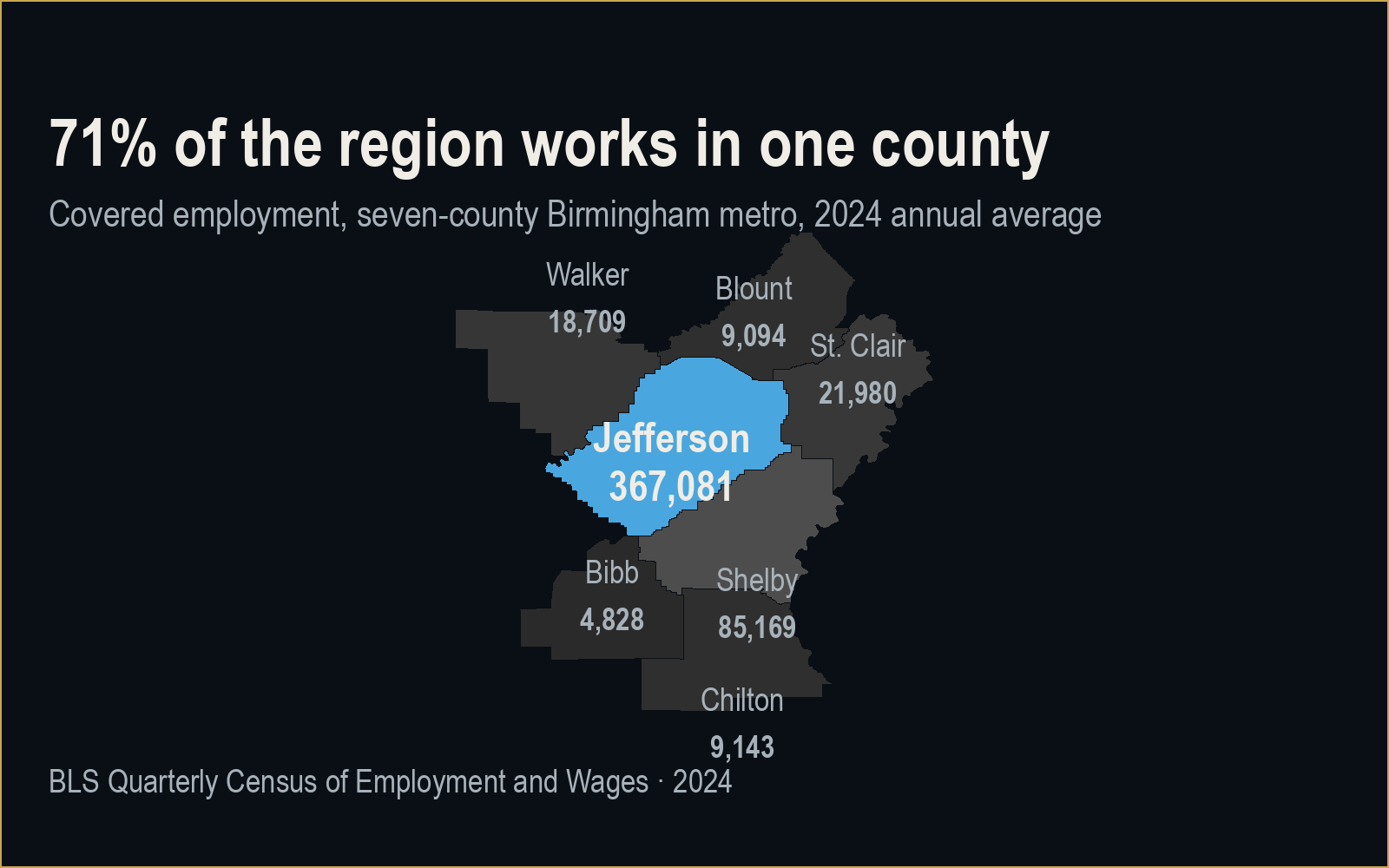
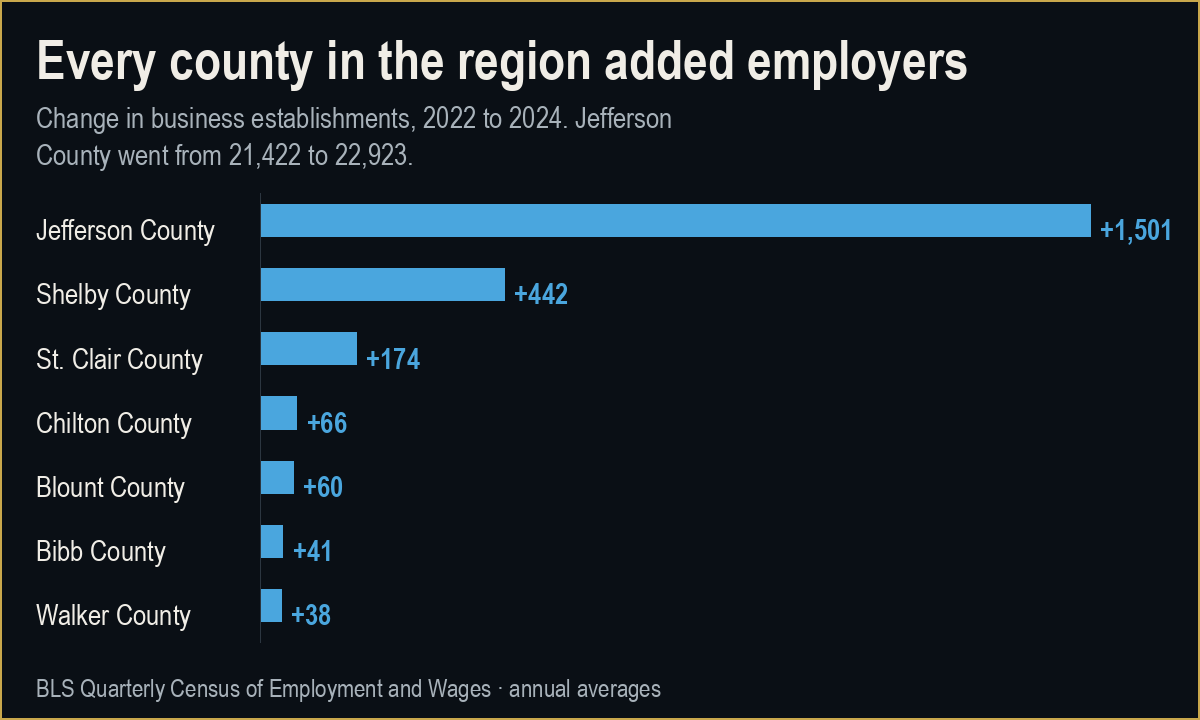
Recent federal data show that Jefferson County remains the jobs anchor for the region. In 2024, the county recorded an annual average of 367,081 covered jobs, up from 356,742 in 2022 and 362,788 in 2023, according to the U.S. Bureau of Labor Statistics’ Quarterly Census of Employment and Wages (QCEW).1 The number of business establishments has also been climbing, from 21,422 in 2022 to 22,923 establishments by 2024.1
Those additional employers and jobs have been accompanied by rising pay. The average weekly wage in Jefferson County reached $1,376 in 2024, up from $1,276 in 2022 and $1,331 in 2023.1 For property-market observers, this combination—more employers, more jobs, and higher wages—typically underpins both demand for commercial space and the income base that supports housing.
How surrounding counties fit into the regional picture
The Greater Birmingham Region is defined by the Birmingham Business Alliance (BBA) as a unified network of organizations across seven central Alabama counties that work together on economic development, talent recruitment and tourism.2 While the BBA document does not name all seven in the excerpt available, QCEW data for several counties surrounding Jefferson provide a window into how the regional economy is distributed.
- Shelby County had 85,169 covered jobs in 2024, slightly down from 86,332 in 2022 and 85,595 in 2023.3 Even with that modest employment slippage, the number of establishments increased from 6,809 in 2022 to 7,251 in 2024,3 and the average weekly wage rose from $1,223 to $1,284 over the same period.3
- St. Clair County added jobs and firms. Covered employment climbed from 19,970 in 2022 to 21,980 in 2024,4 while business establishments increased from 1,769 to 1,943.4 Average weekly wages improved as well, from $920 to $989 between 2022 and 2024.4
- Blount County saw employment rise from 8,726 to 9,094 jobs between 2022 and 2024,5 with establishments increasing from 896 to 956.5 Wages moved from $825 to an average of $879 per week over that span.5
- Chilton County recorded 9,047 covered jobs in 2022 and 9,143 in 2024,6 while establishments grew from 856 to 922.6 The county’s average weekly wage rose from $854 in 2022 to $915 in 2024.6
- Bibb County employment has held essentially flat—4,836 jobs in 2022 and 4,828 in 20247—even as the number of establishments increased from 404 to 445.7 Average weekly wages in Bibb County nevertheless increased from $932 to $1,020 over the same period.7
- Walker County experienced job and wage growth. Covered employment rose from 17,790 in 2022 to 18,709 in 2024,8 while establishments moved from 1,498 to 1,536.8 Average weekly wages climbed from $867 to $936 between 2022 and 2024.8
Taken together, these data points confirm a gradual broadening of the business base in the counties around Jefferson, with most showing both more establishments and higher wages by 2024. That supports the BBA’s description of a region-wide network working to strengthen economic development and talent recruitment, even though the provided excerpt does not break out sector-level detail.2
Logistics and global connectivity as regional assets
The BBA highlights connectivity as one of the Greater Birmingham Region’s competitive advantages. According to the alliance, five major interstate corridors intersect in Birmingham, connecting the region to key Southeast markets and to 78% of the U.S. population within a two-day drive.2 Routes including I‑20/59, I‑65, and I‑22 provide direct access to Atlanta, Nashville, Memphis, and the Gulf Coast, placing many major markets within a single driver shift.2
The same source notes that the region is home to more than 100 foreign-based companies from over 20 countries, underscoring its role as a node in international investment and supply chains.2 While the available excerpt does not link those firms to specific submarkets or property types, this level of foreign corporate presence is consistent with a metro that competes for advanced manufacturing, logistics, and professional-services projects.
Smucker’s McCalla plant: A billion-dollar industrial catalyst
One of the most concrete recent industrial wins for the region is The J.M. Smucker Co.’s decision to build a manufacturing plant in the Jefferson County community of McCalla. According to a release from the Alabama Governor’s Office, the facility represents a total financial investment of $1.1 billion and is planned over three construction and production phases.9 The project is expected to create up to 750 jobs as those phases build out.9
The state reports that construction was expected to begin no later than January 2022, with production commencing in calendar year 2025.9 Smucker indicated that financial investments and job creation would align with each phase and are contingent on approvals of tax and business incentives and the closing of the land transaction.9 The available documentation does not specify the current status of construction or hiring, so any assessment of direct local employment impact as of 2026 would be speculative.
Even with that caveat, the scale of the planned capital expenditure is large relative to Jefferson County’s existing manufacturing base, and the timing—moving into production in 2025—matters for near-term industrial absorption, workforce demand, and infrastructure planning around McCalla.
City of Birmingham: jobs, skills, and inclusive growth
At the city level, Birmingham’s Department of Innovation and Economic Opportunity explicitly links economic development to resident outcomes. The department states that its mission is to prioritize the residents of Birmingham by creating quality jobs, preparing workers for those jobs, and ensuring access to skill development opportunities.10 It also emphasizes empowering residents and business owners with “essential tools and resources” to foster an inclusive and resilient economy, aiming to make Birmingham a model for innovation and economic development.10
The department’s own narrative describes Birmingham’s economic evolution: after steel mills closed and storefronts were shuttered, the city adapted as a robust financial center, and “beyond the Great Recession” it emerged as a hub for life sciences and entrepreneurs of all types.10 The evidence excerpt does not quantify the scale of specific sectors or identify particular employers, but it does affirm a deliberate policy focus on diversification and entrepreneurship.
As part of that strategy, the City has invited proposals for its 2027–2028 Building Opportunities for Lasting Development (BOLD) funding program.10 The excerpt does not detail the size of the BOLD fund or its eligible uses, but the solicitation signals that Birmingham is planning a pipeline of projects into the latter half of the decade.
Federal Recompete funding and labor-force participation
Federal policy is also targeting some of Birmingham’s most distressed neighborhoods. The U.S. Economic Development Administration (EDA) reports that the Reinvest Birmingham Recompete Plan, led by the City of Birmingham, will receive approximately $20 million to support the persistently distressed neighborhoods of North Birmingham, Northside, Pratt, and Smithfield.11 The applicant-defined region for this plan covers 19 census tracts spanning those four communities.11
The EDA notes that northwest Birmingham has experienced significant challenges over the years that contributed to a lack of prime-age residents participating in the labor force.11 Addressing that participation gap is central to the Recompete strategy. According to the agency, Recompete funding will provide in-demand workforce training to residents in the target neighborhoods through a partnership with Lawson State Community College.11 The available excerpt does not specify the occupational focus of the training or the number of participants targeted, so it is not yet possible to connect the funding to specific job counts or to foresee exact implications for local commercial demand.
Establishment counts rose in every county in the region between 2022 and 2024, and average weekly wages rose in all of them too. Job creation is not confined to Jefferson County's core.
None of these sources break out commuting patterns. So the figures cannot say how much of the outer-county growth serves residents there and how much is extended employment space for the Birmingham core.
Regional coordination and what to watch
Across these layers—county employment trends, regional connectivity, major industrial investments, city-led funding programs, and federal Recompete dollars—a consistent theme is coordination. The BBA frames the Greater Birmingham Region as a unified network aiming to strengthen economic development, talent recruitment, and tourism across seven counties.2 Birmingham’s own economic-development department emphasizes inclusive job creation and skill-building for residents.10 Federal EDA resources are being directed specifically to neighborhoods with historically weak labor-force participation, backed by a community college partner for training.11
Several implications and open questions emerge for market participants:
- Industrial and logistics demand: The planned $1.1 billion Smucker facility in McCalla is a tangible symbol of industrial momentum in Jefferson County, but the evidence available does not yet show how fully that capacity has come online or how it has translated into occupied square footage or spin-off development.9
- Workforce and inclusion: Rising wages across most counties in the region, combined with targeted workforce training in northwest Birmingham, suggest a concerted push to connect residents to better-paying jobs.1,3,4,5,6,7,8,11 However, without participation-rate data at the tract level in this evidence set, the scale of the remaining gap is not quantifiable here.
- Cross-county dynamics: Establishment growth in counties such as Shelby, St. Clair, Walker, Chilton, Blount, and Bibb indicates that job creation is not limited to Jefferson County’s core.3,4,5,6,7,8 The available sources do not break out commuting patterns, so we cannot say how much of that growth is serving local residents versus functioning as extended employment space for the Birmingham core.
Within the limits of the evidence, the picture that emerges is of a metro area where Jefferson County’s growing job and wage base is increasingly embedded in a multi-county strategy, supported by large-scale private investment and targeted public funding. For property investors and planners, the key questions now are about execution: whether projects like the McCalla plant, the BOLD program, and the Reinvest Birmingham Recompete Plan meet their job and training targets, and how those outcomes translate into long-term demand for industrial, office, and housing across the Greater Birmingham Region.
Sources
- U.S. Bureau of Labor Statistics. Quarterly Census of Employment and Wages, annual averages — Jefferson County, Alabama. 2024 View source
- Birmingham Business Alliance. Economic development View source
- U.S. Bureau of Labor Statistics. Quarterly Census of Employment and Wages, annual averages — Shelby County, Alabama. 2024 View source
- U.S. Bureau of Labor Statistics. Quarterly Census of Employment and Wages, annual averages — St. Clair County, Alabama. 2024 View source
- U.S. Bureau of Labor Statistics. Quarterly Census of Employment and Wages, annual averages — Blount County, Alabama. 2024 View source
- U.S. Bureau of Labor Statistics. Quarterly Census of Employment and Wages, annual averages — Chilton County, Alabama. 2024 View source
- U.S. Bureau of Labor Statistics. Quarterly Census of Employment and Wages, annual averages — Bibb County, Alabama. 2024 View source
- U.S. Bureau of Labor Statistics. Quarterly Census of Employment and Wages, annual averages — Walker County, Alabama. 2024 View source
- Office of the Governor of Alabama. Governor ivey announces the j m smucker co to build alabama manufacturing plant creating up to 750 jobs in birmingham View source
- City of Birmingham. Department innovation economic opportunity View source
- U.S. Economic Development Administration. Reinvest Birmingham Recompete Plan View source