
Memphis sits at the center of a tri-state labor market that already supports hundreds of thousands of jobs. Around that base, Tennessee and its local partners are using targeted grants, infrastructure plans and park and library projects to pull in more employers and make specific neighborhoods easier to live and work in. The public record now makes much of that strategy visible in a way it was not a decade ago.
What Tennessee is trying to buy with its grants
Tennessee’s economic agencies are explicit about what they are aiming to do with incentive dollars. The state’s grant programs are described as tools to support “strategic investments that drive job creation, strengthen communities and advance long-term economic growth” 1. Officials say they “work hand in hand” with companies to offer “competitive tax incentives and cash grants” to help bring projects to the state 1. That framing is promotional, but it does tell us how the programs are supposed to function.
Under the hood, grants are not handed out at random. Awards are based on factors “such as job creation, wages, capital investment and overall community impact” 1. In other words, the state is trying to tilt funding toward projects that promise new jobs, higher pay, visible investment and spillover benefits for the surrounding area.
FastTrack: a visible funnel for company projects
One of the most important levers in this system is the Tennessee Department of Economic and Community Development’s FastTrack program. The department says FastTrack “assists Tennessee communities in attracting companies, jobs and capital investment” 2 and that it helps companies with “relocation and training of new employees” while also helping communities build public infrastructure for expanding or relocating firms 2. There are three distinct FastTrack programs: Job Training Assistance, Infrastructure Development and the Economic Development Fund 2.
FastTrack Job Training Assistance, for example, provides grants “directly to new or expanding companies to support the training of net new full-time employees” 1. That makes training a negotiable part of an expansion package rather than an afterthought.
Crucially for anyone trying to understand where and how this money is being used, Tennessee has built a public database of FastTrack projects. The state says this resource includes “all located projects since 2018 that have one or more contracted FastTrack grants” and notes that capital grants or projects without FastTrack support are excluded 3. At the time captured in the evidence, the database listed 641 records 3, with each grant amount defined as “the value of the award per the initial grant contract” 3.
On top of the project-level database, Tennessee law requires the department to post quarterly FastTrack reports that include the name of the recipient, the amount received, the number of jobs to be created and the project’s location 2. That legal requirement turns what is often opaque in other states into something closer to a running ledger of who is being backed, with what scale of money, and for how many promised jobs.
Rural communities get their own funding map
Beyond major corporate projects, the state’s rural development arm maintains a separate, searchable directory of funding opportunities. Tennessee and partner organizations offer “many funding opportunities – including grants, loans, tax credits, and technical assistance – to rural communities” 4. The intended users are broad: “community member, business, nonprofit, or local leader” are all invited to use the directory to find resources available to them 4.
A printable version of this rural grants database is updated over time; one captured file is titled “Printable Grants List July 2026” 4, which at least shows the state is still refreshing the listing. For specific questions, people are directed to follow links or email Rural.TN@tn.gov 4. The evidence does not say which rural projects have been funded near Memphis, or at what dollar level, but it does confirm that a formal channel exists for communities to seek state support.
The current job base around Memphis
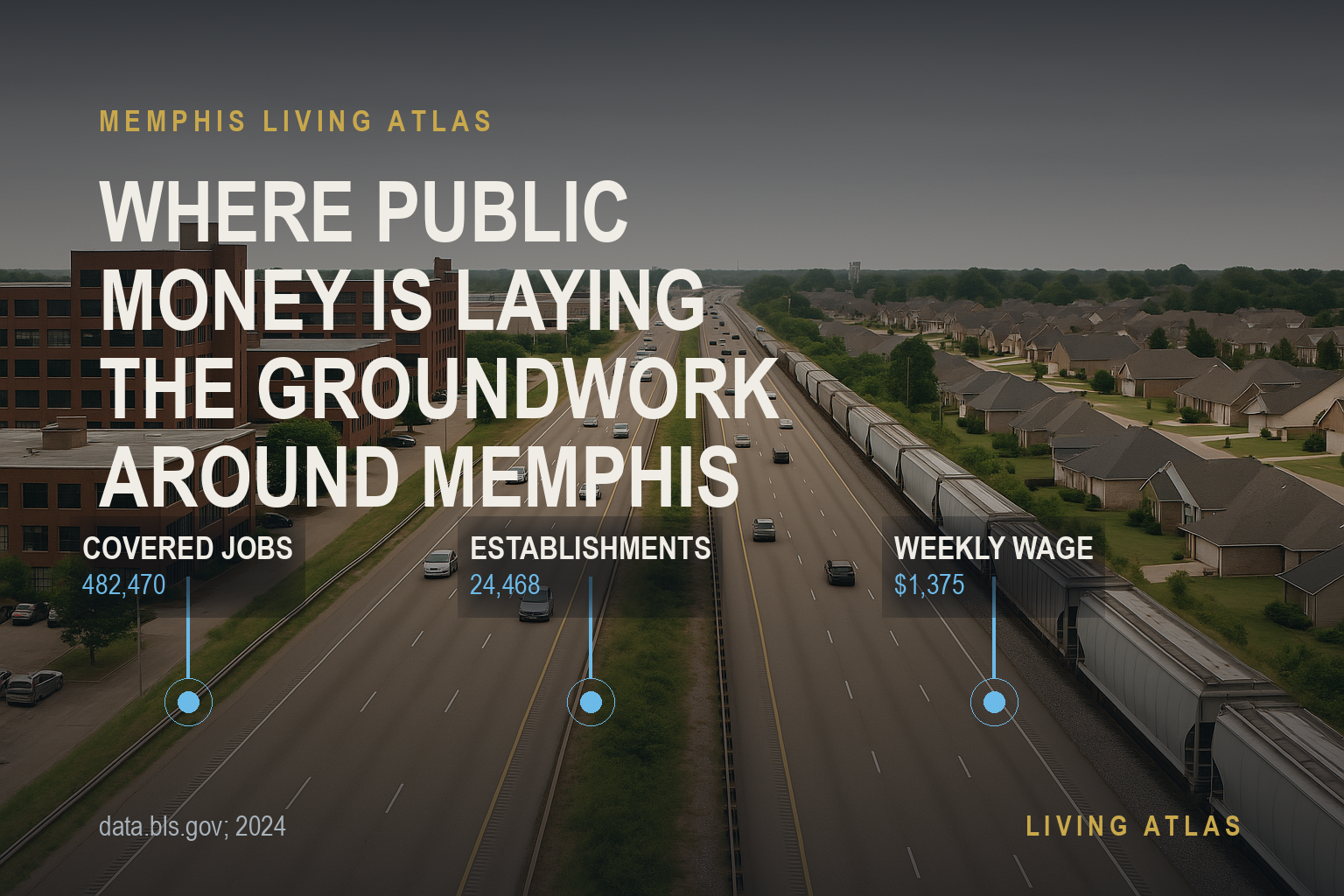
The Bureau of Labor Statistics’ Quarterly Census of Employment and Wages provides a snapshot of the labor market that state programs are trying to reshape. On the Tennessee side of the Memphis metro, Shelby County carries the bulk of the job base, with an annual average of 482,470 covered jobs in 2024 5 and 24,468 business establishments 5. Average weekly pay was $1,375 in 2024 5.
Adjacent Tennessee counties are much smaller but still material in regional terms. Fayette County had 8,093 covered jobs and 823 establishments in 2024, with an average weekly wage of $1,098 666. Tipton County reported 11,848 covered jobs, 962 establishments and an average weekly wage of $967 777.
Across state lines, the closest Mississippi and Arkansas counties add a significant ring of employment around Memphis. DeSoto County, Mississippi, had 72,666 covered jobs and 3,754 establishments in 2024, with an average weekly wage of $879 888. Marshall County, Mississippi, recorded 11,291 jobs, 566 establishments and a $935 weekly average wage 999. Tunica County, Mississippi, had 5,799 jobs, 270 establishments and an average weekly wage of $802 101010. On the Arkansas side, Crittenden County posted 16,197 covered jobs, 1,096 establishments and an average weekly wage of $919 in 2024 111111.
The pattern is straightforward: Shelby County dominates the job base and pays the highest average wages among the counties listed, while DeSoto County is the largest secondary employment center. The other surrounding counties form a much smaller but still important ring of jobs and businesses.
Local capital planning: how Shelby County sequences big projects
At the county level, Shelby’s capital planning documents show how local government prioritizes major physical investments that can shape development patterns. The county “annually prepares a five-year Capital Improvement Plan (CIP) for capital expenditures” 12. One captured CIP covers “Fiscal Years 2022 through 2026” 12.
To build that plan, “each elected official and division director is asked to evaluate their capital needs for the next five years and to submit their requests for inclusion” 12. Even though the full five-year CIP is approved, “only the budget for the first year is actually adopted as the Capital Improvement Budget” 12. That structure means out-year projects are more like a pipeline of intent than a guaranteed schedule; local execution risk is part of the story.
City life infrastructure: parks and libraries as neighborhood anchors
Alongside job-focused incentives and large capital plans, Memphis institutions are making smaller but visible changes to the places people use every day.
At Overton Park, years of controversy over parking on the central lawn are giving way to a different configuration. The park conservancy reports that “after three decades of overflow parking, the Greensward is being permanently returned to public use” 13. The Memphis Zoo is relocating its maintenance area “to the park’s southeast corner, freeing up space for designated parking” 13. Once this work is complete, “overflow parking will cease” 13, and the conservancy plans to remediate the Greensward and build “a walking path around its perimeter” 13. The evidence does not give a completion date, but it does confirm the direction of change: less asphalt on the lawn, more dedicated facilities and pedestrian space.
In the Old Forest State Natural Area, the same conservancy and its partners are preparing to undo a long-standing physical barrier. A 2025 announcement titled “New trail opens in the Old Forest” 14 is dated November 5, 2025 14. It states that Overton Park Conservancy, the Memphis Zoo and the City of Memphis “are excited to announce that after nearly 40 years, the fence is coming down in the Old Forest” 14. A brand-new trail was scheduled to open on Thursday, November 13 at 11:00 a.m. 14. The fence removal and new path physically reopen parts of the forest that had been divided for decades.
In Orange Mound, the story is about bringing an important building back into use. The Historic Melrose School “shut its doors” more than 40 years ago 15. After sitting “boarded up and empty for decades,” the Orange Mound Library and Genealogy Center is now open to the public in that space 15. The library system reports that hundreds of people from the community attended the grand opening 15, and that the new branch is open Monday through Saturday from 10 a.m. to 6 p.m. 15. The evidence does not specify the renovation cost or funding sources, but the reuse of a long-vacant historic school as a library and genealogy center is a clear neighborhood-scale investment.
Memphis’s library system also has deep roots that frame these newer openings. The history of public libraries in the city begins at 236 Front Street, where Cossitt Library first opened its doors in 1893 16. The original Cossitt opened on April 12, 1893 16. Today, the Benjamin L. Hooks Central Library is the largest facility in the Memphis Public Library and Information Center system 16, even though the system’s story dates back to a $75,000 gift in the 1880s from the estate of merchant Frederick Cossitt to build a public library 16. The Hooks library itself opened in 2001 16, well after the original Cossitt, underscoring how civic infrastructure evolves in layers.
How these pieces fit together – and what’s still unknown
Taken together, the evidence shows a few things clearly. Tennessee has formalized a set of grant and incentive tools aimed at job creation, wages, capital investment and community impact, and it has made its FastTrack program unusually transparent through public databases and quarterly reports 11332. Rural communities, including those around Memphis, have a dedicated directory to search for grants, loans, tax credits and technical assistance 44. Shelby County and its neighbors form a regional labor market anchored by nearly half a million jobs in Shelby alone, with DeSoto County as the largest secondary node 58.
At the same time, local capital planning and project evidence highlight investments that affect quality of life directly: restoring Overton Park’s Greensward, opening new trails, taking down a long-standing fence in the Old Forest, and turning a long-vacant school into the Orange Mound Library and Genealogy Center 131313131415.
The record does not yet connect specific FastTrack awards or rural grants to these park and library projects, nor does it tie particular state incentives to individual employers in the Memphis area within this evidence set. It also does not establish how many of the jobs announced in FastTrack reports have actually materialized. Those are open questions for further reporting.
But the pattern is visible: state-level incentives and transparency requirements, a sizable existing employment base, and a series of local moves to improve parks and civic spaces. Whether those pieces compound into a different trajectory for the Memphis metro will depend on how much announced investment actually builds out – and where.

Sources
- comptroller.aem.tn.extglb.tn.gov. Incentives View source
- www.tn.gov. Fasttrack baseline and performance reports View source
- www.tn.gov. Fasttrack project database View source
- www.tn.gov. Search for grants resources View source
- U.S. Bureau of Labor Statistics. Quarterly Census of Employment and Wages, annual averages — Shelby County, Tennessee. 2024 View source
- U.S. Bureau of Labor Statistics. Quarterly Census of Employment and Wages, annual averages — Fayette County, Tennessee. 2024 View source
- U.S. Bureau of Labor Statistics. Quarterly Census of Employment and Wages, annual averages — Tipton County, Tennessee. 2024 View source
- U.S. Bureau of Labor Statistics. Quarterly Census of Employment and Wages, annual averages — DeSoto County, Mississippi. 2024 View source
- U.S. Bureau of Labor Statistics. Quarterly Census of Employment and Wages, annual averages — Marshall County, Mississippi. 2024 View source
- U.S. Bureau of Labor Statistics. Quarterly Census of Employment and Wages, annual averages — Tunica County, Mississippi. 2024 View source
- U.S. Bureau of Labor Statistics. Quarterly Census of Employment and Wages, annual averages — Crittenden County, Arkansas. 2024 View source
- www.shelbycountytn.gov. Capital Improvement Plan CIP View source
- overtonpark.org. Park projects View source
- overtonpark.org. New trail opens in the old forest View source
- www.memphislibrary.org. Orange mound library grand opening View source
- www.memphislibrary.org. Libraryhistory View source