
Birmingham is in the middle of a quiet capital build‑out led less by office towers and more by labs, hospitals and specialty manufacturing. That investment is clustering in and around Jefferson County, while the counties that ring Birmingham still look like smaller, lower‑wage labor markets.
The contrast between those two tracks – a growing institutional core and more modest job bases on the periphery – frames the next phase of the region’s economy.
Jefferson and Shelby carry the job base – and the highest wages
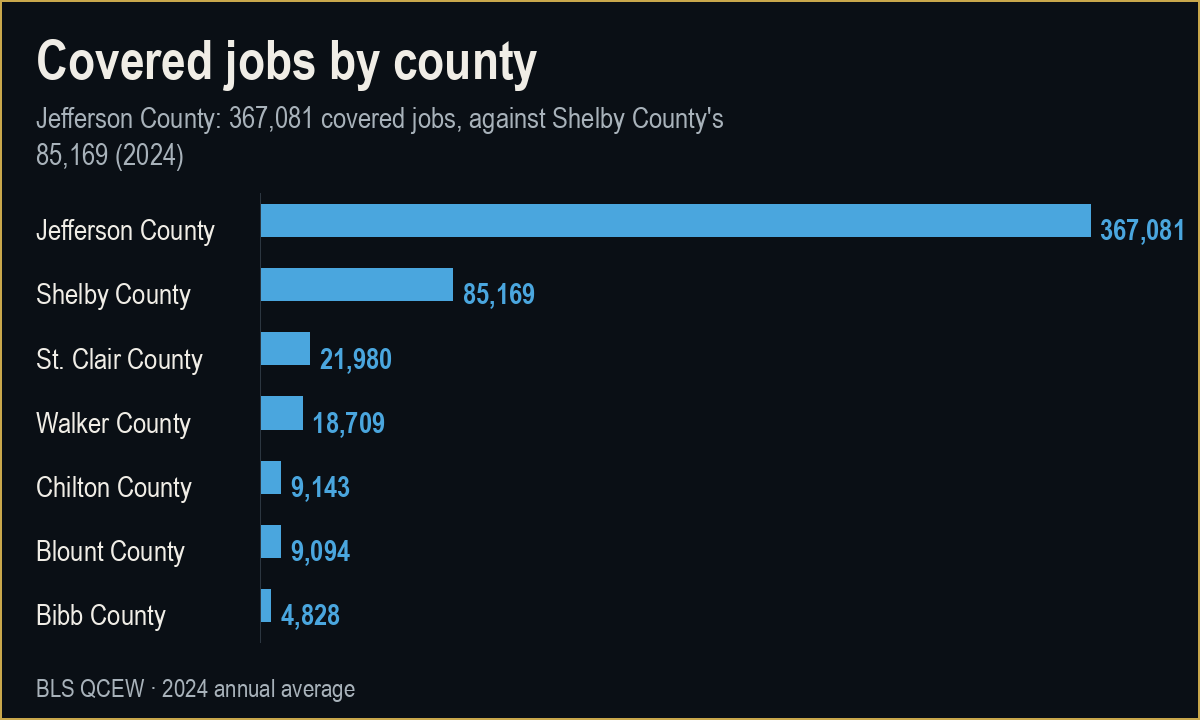
Jefferson County remains the region’s anchor. It averaged 367,081 covered jobs in 2024, according to federal QCEW data, with an average weekly wage of $1,376.11 Shelby County, directly south, supports another 85,169 covered jobs at an average weekly wage of $1,284.22
Those two counties also host the densest business ecosystems in the evidence. Jefferson County logged 22,923 business establishments in 2024, while Shelby reported 7,251.12 Together they form a core where employers, institutions and services are already concentrated.
By contrast, surrounding counties operate at a much smaller scale. St. Clair County carried 21,980 covered jobs at $989 a week on average,33 and Walker County 18,709 jobs at $936 a week.44 Blount and Chilton counties each support just over 9,000 covered jobs, with average weekly wages of $879 and $915, respectively.5566
At the smallest end of the spectrum, Bibb County’s 4,828 covered jobs are spread across 445 establishments, with an average weekly wage of $1,020.777 The pattern is clear: employment and establishments fall off quickly outside the Jefferson–Shelby core, and wage levels generally follow.
A $1.1 billion manufacturing bet on the metro’s freight spine
Against that backdrop, announced industrial projects test how much more employment the job core can absorb. One of the largest is The J.M. Smucker Co.’s planned facility in McCalla, in Jefferson County. The company said it would invest $1.1 billion and create up to 750 jobs at a manufacturing plant built in three phases.88
Construction was expected to begin no later than January 2022, with production slated to start in 2025.8 The company tied the actual build‑out and hiring to the approval of tax and business incentives and to closing on the site.8 That makes the McCalla project an announced plan, not a completed outcome: the investment and the up‑to‑750 jobs become real only if the phased construction and incentive package proceed as described.
If Smucker executes on the full plan, a 750‑job industrial employer would represent a meaningful increment against Jefferson County’s existing job base, even if it is small relative to the county’s nearly 370,000 covered jobs.18 It could matter more for nearby housing, warehousing and trucking along the freight corridor than for the county‑wide employment rate.
UAB is turning research and health care into long‑cycle capital
Health care and research are the other large pieces of committed or in‑flight capital in the evidence, all clustered in Birmingham.
On the clinical side, UAB has opened a $156.7 million inpatient rehabilitation pavilion, outfitted with 134 patient beds.9 Alabama’s governor publicly framed that expansion as an “investment in vital public services” and backed allocation of funds to expand emergency services.9 Separately, UAB Hospital is expanding its Emergency Department, with plans to grow to more than 115 treatment and triage spaces – more than doubling ED capacity – and add a 30‑bed inpatient observation unit.10
The ED expansion is being built out with new equipment, including CT scanners, X‑ray machines and echo ultrasound, along with a ceiling lift for bariatric patients, a more streamlined teleadmission process and enhanced security features.10 UAB’s own careers material ties current hiring to this expansion and notes that start dates for related roles could run through August 2026, explicitly linking staffing needs to construction timelines.1010
On the research side, UAB and its partners are stacking several large projects:
- The Altec/Styslinger Genomic Medicine and Data Sciences Building is funded through a mix of philanthropic gifts, $50 million from the state of Alabama via the Public School and College Authority, $5 million from Jefferson County, $1 million from the City of Birmingham and additional institutional funds.11
- A Biomedical Research and Psychology Building is budgeted at $190 million, supported by $152 million in federal funding plus dollars from the Heersink School of Medicine and the College of Arts and Sciences. UAB reports that it broke ground in June 2024 and expects completion in summer 2026.11
- Southern Research’s Biotechnology Building carries a stated value of $98 million, with $45 million coming from the state education fund.11
UAB describes a broader strategy behind these builds: new and renovated research buildings bring state‑of‑the‑art technology, help retain current investigators and support hiring new ones, and open up additional private and public funding opportunities.12 State leaders have explicitly tied at least one of these investments to economic outcomes. Governor Kay Ivey called one such state‑funded project a “signature investment” expected to have “a real impact on our economy” and to stimulate further advances in science and medicine, adding that it should attract new external funding and “additional world‑class faculty” to the university.1313
Those characterizations are political and institutional claims, not measurable outcomes yet. The verified facts in the record are the project budgets, the identified funding sources and the construction timelines.
City Hall is trying to connect those anchors to neighborhoods
The City of Birmingham is also articulating a role for itself in shaping where opportunity lands. The city’s Department of Innovation and Economic Opportunity says it is “connecting our people, businesses, assets, and opportunities to the markets and investments that drive sustainable growth” and that it focuses resources where they have “the highest multiplier effect,” particularly for businesses ready to scale and industries ready to invest.1414 It describes its work as strengthening homegrown businesses, attracting and retaining high‑growth industries, cultivating a skilled workforce and positioning Birmingham for new investment and development.14
Those are agency statements about intent, not independently verified results. One concrete initiative that does show up in the record is in transportation. In 2023, the city applied for a federal RAISE grant to support plans to reconnect the Graymont and Smithfield neighborhoods to downtown.15 City documents describe a reimagined route that would create new connections to public transit, employment opportunities, green space and public health resources,15 and note that although much of downtown has begun to revitalize, many nearby low‑income neighborhoods have not seen similar investment in transportation or public spaces.15
If funded and delivered as described, that kind of transportation project could make it easier for residents of underserved neighborhoods to reach the medical, research and downtown employment anchors under construction. The evidence does not yet show how much of that connection will actually be built out or how it would alter commute patterns.
What this could mean for the wider labor market
Pulling back to the regional job map, several themes emerge from the verified evidence:
- The core counties already pay more. Average weekly wages in Jefferson and Shelby counties sit well above those in Walker, Blount, Chilton and St. Clair.124563 If new jobs cluster where wages are already higher, the income gap between core and periphery could widen.
- Institutional capital is concentrated. Every major healthcare and research project in the evidence is located in Birmingham and funded by a combination of state, local, federal, philanthropic and institutional dollars.11111191313 That points to a long‑term bet on the city as a medical and research hub.
- Peripheral counties have smaller, more fragile bases. With employment in the 9,000–22,000 range and business establishments below 2,000 in each county,3355664477 shocks or single‑employer decisions may matter more there than in Jefferson.
If the announced and funded projects – from the Smucker plant to UAB’s research and clinical expansions – proceed as described, they could deepen Birmingham’s role as an employment center for the region. That would imply more commuting into Jefferson and Shelby from surrounding counties and potential spillover demand for housing and services along the main corridors. The evidence here does not quantify those second‑order effects; it shows the capital and employment base those scenarios would build upon.
What to watch next
Several concrete milestones will determine how much this wave of investment reshapes the regional job map:
- Smucker’s build‑out pace in McCalla. Ground‑truthing announced construction phases, the status of incentive approvals and how many jobs actually materialize relative to the “up to 750” figure.888
- Delivery of UAB’s research projects. Whether the Biomedical Research and Psychology Building and the genomic medicine and data sciences building open on the stated timelines and how quickly they are staffed.111112
- Healthcare hiring tied to the ED and rehab expansions. How many net new positions UAB adds as it fills out the expanded Emergency Department, observation unit and rehabilitation pavilion.9101010
- Funding outcomes for the Birmingham Civil Rights Crossroads / RAISE application. Whether federal dollars are awarded and, if so, how much new transit and street infrastructure is actually delivered in Graymont and Smithfield.151515
- Shifts in county‑level employment and wage data. Future QCEW releases will show whether employment and wages in the core counties pull further ahead of their neighbors or whether growth diffuses more evenly across the region.1234657
Those datapoints will do more than any single headline number to show whether Birmingham’s current wave of institutional and industrial investment is reinforcing its role as the region’s job center – or beginning to pull its neighbors along with it.
Sources
- U.S. Bureau of Labor Statistics. Quarterly Census of Employment and Wages, annual averages — Jefferson County, Alabama. 2024 View source
- U.S. Bureau of Labor Statistics. Quarterly Census of Employment and Wages, annual averages — Shelby County, Alabama. 2024 View source
- U.S. Bureau of Labor Statistics. Quarterly Census of Employment and Wages, annual averages — St. Clair County, Alabama. 2024 View source
- U.S. Bureau of Labor Statistics. Quarterly Census of Employment and Wages, annual averages — Walker County, Alabama. 2024 View source
- U.S. Bureau of Labor Statistics. Quarterly Census of Employment and Wages, annual averages — Blount County, Alabama. 2024 View source
- U.S. Bureau of Labor Statistics. Quarterly Census of Employment and Wages, annual averages — Chilton County, Alabama. 2024 View source
- U.S. Bureau of Labor Statistics. Quarterly Census of Employment and Wages, annual averages — Bibb County, Alabama. 2024 View source
- Office of the Governor of Alabama. Governor ivey announces the j m smucker co to build alabama manufacturing plant creating up to 750 jobs in birmingham View source
- University of Alabama at Birmingham. Uab hospital now fifth largest in the nation View source
- careers.uabmedicine.org. Uab hospital ED expansion View source
- University of Alabama at Birmingham. Uab continues to transform through 14 new construction and renovation projects View source
- University of Alabama at Birmingham. Uab s 12 new construction and renovation projects transforming campus supporting strategic initiatives View source
- University of Alabama at Birmingham. How strategic investments in people technology and space are advancing uab research excellence View source
- City of Birmingham. Department innovation economic opportunity View source
- City of Birmingham. Project description phases View source