One plant or one research building will not remake a metro economy. But a cluster of long‑horizon investments, supported by public incentives and a growing employment base, can start to change what is possible in a region. Around Birmingham, several of those pieces are now on the board — from new manufacturing to data centers, research funding and neighborhood infrastructure — and the question is how much they might reinforce one another.
What is actually committed?
On the industrial side, the most concrete new bet is The J.M. Smucker Co.’s facility in the Jefferson County community of McCalla. The company and state officials describe it as a three‑phase project representing a total financial investment of $1.1 billion, with plans to create up to 750 jobs as the phases build out.1,2 Construction was expected to begin no later than January 2022, with production scheduled to commence in calendar year 2025 — timelines that, if met, put the facility into the current planning horizon for housing, labor and suppliers.3
At the other end of the spectrum is a data‑center bet with a much longer runway. According to an Industrial Development Board resolution summarized in local reporting, Nebius is projected to invest nearly $35.9 billion at its Birmingham‑area site over the next 30 years.4 The same reporting notes expectations of 78 jobs with an average salary of more than $90,000 — a small headcount but at compensation levels that could matter for higher‑end housing and spending in whichever neighborhoods those workers choose.5
To secure the Nebius project, the Birmingham Industrial Development Board voted on May 29, 2026 to approve a tax‑abatement package that sharply reduces certain local tax burdens while preserving education revenue. The package includes a 65% abatement on non‑education property taxes and an 80% abatement on construction‑related sales and use taxes for up to 30 years.6 When non‑abated education taxes are factored in, the effective overall rates drop to roughly 32% on property tax and 72% on sales and use tax according to the same report.7 Those terms signal how aggressively the region is willing to compete for long‑run capital.
A regional base of employers and establishments
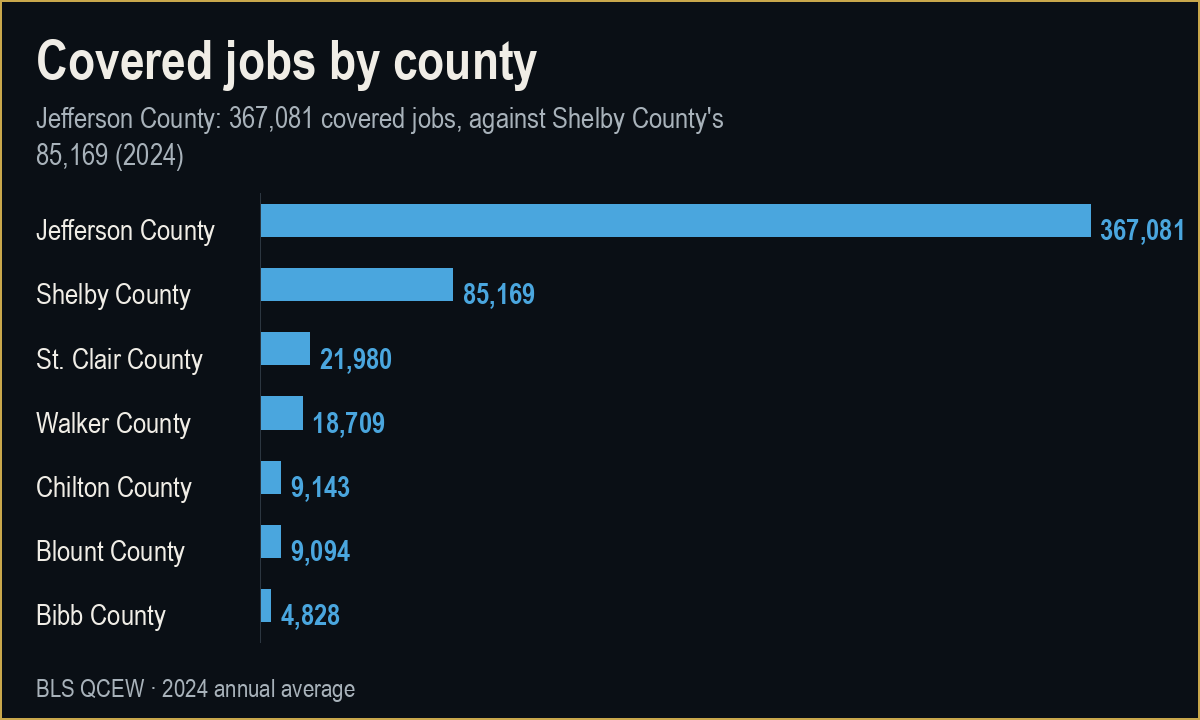
These projects sit on top of an economy that is already substantial, particularly in Jefferson County. Bureau of Labor Statistics Quarterly Census of Employment and Wages (QCEW) data show Jefferson County with 367,081 covered jobs in 2024 and an average weekly wage of $1,376.8,9 The county also hosted 22,923 business establishments that year, up from 21,422 in 2022.10 That combination — a large employment base, rising establishment count and relatively high wages for Alabama — is the platform new investments are joining.
The surrounding counties add a ring of smaller but material employment centers that could absorb supplier activity, commuting workers or spillover demand. In 2024, Shelby County reported 85,169 covered jobs across 7,251 establishments, with an average weekly wage of $1,284.11,12,13 St. Clair County had 21,980 covered jobs, 1,943 establishments and a weekly wage of $989.14,15,16 To the north and west, Blount and Walker counties each supported around 9,000–18,700 jobs and between 956 and 1,536 establishments, with weekly wages in the $879–$936 range.17,18,19,20,21 Southward, Chilton and Bibb counties added roughly 9,143 and 4,828 covered jobs respectively, with under 1,000 establishments each and weekly wages of $915 and $1,020.22,23,24,25,26,27
Together, those figures support a reasonable inference: there is enough existing employment and firm activity across the Birmingham region that large projects like Smucker’s McCalla plant or Nebius’s data center are plugging into a real economic network, not a greenfield. The precise local impact, however, will depend on where suppliers locate, where workers live and how infrastructure and land‑use decisions channel that activity.
Research and innovation as an economic lever
Another pillar in the region’s growth story is the University of Alabama at Birmingham (UAB) and its research commercialization arm. UAB’s Harbert Institute for Innovation and Entrepreneurship notes that research tools “quietly make up a significant part” of its annual revenue, indicating that licensing and commercialization of research instruments are not just scientific wins but recurring income streams.28
To move ideas from lab to market, UAB operates several structured programs. The Blazer Bridge Fund is described as an early‑stage translational fund for UAB innovators, aimed at supporting work that is not yet ready for traditional commercial capital.29 The institution also publishes a Startup Guide intended to help UAB entrepreneurs who have developed intellectual property using university resources and want to launch a startup based on that IP.30 Complementing those is the Blazer App Accelerator, which helps UAB inventors test potential ideas for further product development or as the basis for start‑ups.31
At the state level, UAB leadership and state officials explicitly frame appropriations as economic strategy. In one institutional report, UAB’s president is quoted saying that funds appropriated by the state to UAB — particularly for research — reflect a shared commitment to “improving lives” and “driving economic growth,” and are understood by legislators as investments that deliver positive returns across Alabama.32 In the same document, Alabama’s governor describes a specific UAB‑related investment as a “signature investment for the state” that will have “a real impact on our economy” and serve as “a wise investment with a great return.”33 The report also states that this state‑funded investment is expected to attract new external funding and additional world‑class faculty to UAB.34
Those are statements of intent and expectation, not outcomes. But if UAB does draw more external research funding and higher‑profile faculty around major state‑backed projects, it could deepen Birmingham’s position in biomedical and health‑related industries and increase the number of spin‑outs looking for local lab, office and housing space.
How city policy is trying to connect the dots
Inside City Hall, Birmingham’s Department of Innovation and Economic Opportunity presents itself as an effort to connect existing assets to markets and capital. The department says its mission is to shape the city’s future “by connecting our people, businesses, assets, and opportunities to the markets and investments that drive sustainable growth.”35 It lists core activities that include strengthening homegrown businesses, attracting and retaining high‑growth industries, cultivating a skilled and competitive workforce and positioning Birmingham for new investment and development.36
The department’s own description of its strategy is to align local strengths with regional and global opportunities in order to build what it calls “a resilient, opportunity‑rich economy” where businesses can grow and talent can thrive.37 It also states that it focuses resources where they have the highest multiplier effect — specifically, on businesses ready to scale and industries ready to invest.38 Those phrases are promotional, but they do tell us where the city says it is trying to concentrate dollars and staff time: on scaling firms, targeted sectors and external capital attraction.
The broader state incentive environment is aligned with that focus. Under the Alabama Jobs Act, one tool highlighted by regional business organizations is the Jobs Credit, which offers annual cash payments of up to 3% of the prior year’s payroll for new employees, available for up to 10 years for qualifying industrial and commercial projects.39,40 The same summary notes that the amounts are paid as refunds of taxes for utility services and are not dependent on utility taxes actually owed or paid.41 Eligibility is described as starting at 50 new jobs with an average wage of at least $14 per hour for industrial and commercial projects.42 While those figures come from a regional business group’s materials rather than statute, they illustrate how Alabama uses direct payroll‑linked incentives to compete for employers like Smucker’s or Nebius.
Infrastructure, neighborhoods and uneven benefits
Large employers and research labs are only part of a growth story; the rest is about where the benefits land. On that front, Birmingham’s Department of Transportation is explicit about gaps. In a description of the Birmingham Civil Rights Crossroads project, the city notes that “while much of downtown Birmingham has started to revitalize, many low‑income and underserved neighborhoods surrounding downtown have not experienced the same level of investment in transportation or public spaces.”43
The same project documentation says the plan is to “reconnect” neighborhoods such as Graymont and Smithfield to downtown — and that the city applied in 2023 for a federal RAISE grant to support those reconnection efforts.44 The reimagined route, the city says, is intended to foster “a healthier community with new connections to public transit, employment opportunities, green spaces, and public health resources” and to help in “reconnecting our communities and creating a vibrant corridor.”45,46
Those are announced plans and aspirations rather than measured results. If they move forward as described, they could become a key link between downtown job centers, nearby institutions, and historically underserved neighborhoods — which would matter for whether projects like Nebius’s data center or new UAB facilities translate into accessible jobs and small‑business demand beyond the core.
The growth case — and what has to go right
Put together, the evidence supports a conditional “bull case” for Birmingham’s next cycle:
- There is already a meaningful employment and establishment base across Jefferson and surrounding counties, with Jefferson County alone at more than 367,000 covered jobs and nearly 23,000 establishments in 2024.8,10,11–27
- At least two sizable long‑term private investments — a $1.1 billion Smucker’s facility and a decades‑long, multibillion‑dollar Nebius data‑center project — are formally in motion with specific capital, job and abatement commitments.1–7
- UAB and the state are explicitly using research funding and associated infrastructure as economic tools, with complementary commercialization programs (funds, accelerators, startup guidance) that can produce new companies if they hit their marks.28–34
- City and state economic‑development arms say they are targeting high‑growth industries, scale‑ready firms and payroll‑linked incentives, while transportation planners are attempting to physically reconnect neighborhoods that have not shared downtown’s recent investment.35–38,39–46
If those pieces execute in the way the announcing parties describe, one plausible scenario over the next decade is that Birmingham sees:
- More mid‑ to high‑wage jobs tied to data, advanced manufacturing and health‑related research, albeit from a modest number of large employers.
- Incremental supplier and services demand in nearby counties with available land and lower wage bases, particularly in Shelby, St. Clair, Walker, Chilton, Bibb and Blount counties.
- Increased commercialization activity and local startup formation around UAB, drawing on its translational funds and accelerators.
- Targeted infrastructure upgrades that, if funded and built as described, could improve transit and public‑space access for neighborhoods currently missing out on downtown’s gains.
The risks to that scenario are straightforward and material. Smucker’s and Nebius still have to build, staff and operate at the levels they have announced; capital plans can be delayed, scaled back or reprioritized. UAB’s ability to translate state appropriations into external grants, faculty recruitment and startup formation depends on execution and on national funding conditions. City‑level transport and neighborhood investments depend on winning competitive federal grants and then delivering complex projects on time and on budget. And even if all of that goes well, the benefits may remain concentrated in a few corridors unless land‑use, housing and small‑business policies are aligned.
What to watch next
For readers trying to gauge whether Birmingham is actually entering a new growth phase rather than adding isolated projects, several concrete milestones will be telling:
- Whether Smucker’s McCalla facility reaches production as scheduled around 2025 and how hiring compares with the “up to 750 jobs” plan.2,3
- How quickly Nebius begins near‑term construction spending under its 30‑year, $35.9 billion investment plan, and where its relatively small but high‑paid workforce chooses to live.4,5
- The scale and frequency of new UAB‑linked startups and licensing deals, especially those benefiting from the Blazer Bridge Fund, Startup Guide and Blazer App Accelerator.28–31
- Outcomes of Birmingham’s 2023 RAISE grant application and any subsequent funding decisions for the Civil Rights Crossroads and related connectivity projects.44
- Trends in establishment counts and covered employment across Jefferson and neighboring counties as these projects ramp, relative to their 2022–2024 baselines.8,10–27
Those data points will show whether today’s commitments are combining into something larger — or simply adding a few more bright spots to an otherwise steady landscape.