
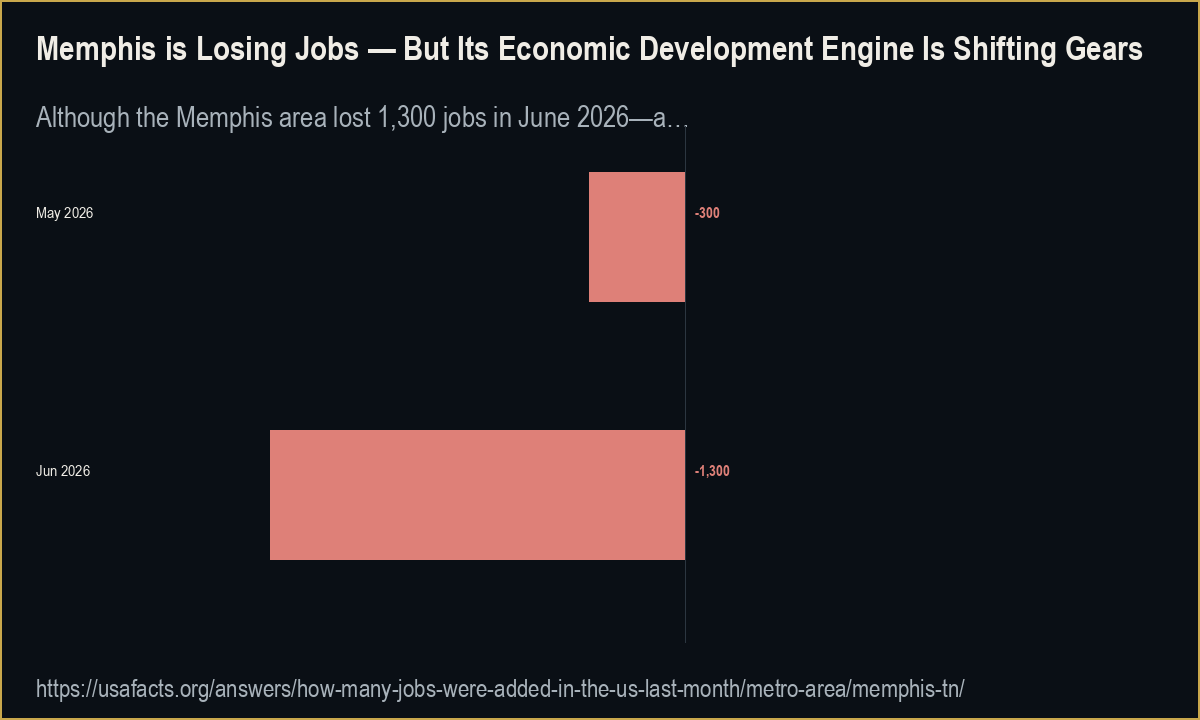
Memphis lost 1,300 jobs in June 2026. That’s not a rounding error; it’s a real hit for a metro the size of Memphis. And it came right after May’s loss of 300 jobs, so two straight months went in the wrong direction. If you’re a worker looking for stability, or an employer planning your next expansion, that feels like the ground is shifting.
But when you zoom out, the picture changes. Over the last five years, the Memphis metro has added jobs in 31 out of 60 months and averaged about 153 new jobs a month. That’s not a boom, but it’s also not a slide into a long collapse. The tension is this: short-term losses that are uncomfortable, inside a longer trend that’s choppy but not clearly broken.

Two Bad Months, Not Yet a Downward Spiral
The Memphis area shed 1,300 jobs in June 2026. For anyone counting payrolls—employers, landlords, lenders—that’s 1,300 fewer paychecks circulating through rent, groceries, and local services.
June’s loss was bigger than May 2026, when the area lost 300 jobs. So the direction has been negative for two months, and the pain is accelerating, not easing. If you’re a worker on the margin of the labor market, this raises the odds that job searches take longer or that offers come in on weaker terms.
For property investors and local governments, two consecutive months of losses don’t immediately change the tax base. But they do raise questions: is this a blip tied to a few big employers, or the start of a longer cooling that would hit leasing, sales, and service demand?
31 of the last 60 months have seen job gains in the Memphis metro, with an average of about 153 new jobs a month.
Five years of choppy but net-positive job growth
Five Years of Up-and-Down, Not Straight Down
Step back from May and June. From July 2021 to June 2026, the Memphis metro gained jobs in 31 of 60 months. That means just over half the months were positive. For workers, that’s a labor market that has more good months than bad—but not by a wide margin.
Over those same five years, the area averaged about 153 new jobs a month. That’s modest growth, not a surge. For employers and site selectors, it says Memphis has been adding jobs slowly, which can mean steadier labor supply but not the kind of rapid expansion you see in hotter metros.
For people planning careers or investments here, the takeaway is nuance. The June drop matters because it’s larger than the recent norm. The five-year record matters because it shows the underlying trend is mixed, not clearly in free fall.
Who Should Be Paying Closest Attention?
Property investors should care because job counts drive occupancy and rent performance. A loss of 1,300 jobs in a single month, after 300 the month before, increases the risk of softer demand for apartments, retail, and some office space if the pattern continues.
Employers should care because a cooling job market can change bargaining dynamics. With average gains of about 153 jobs a month over five years, Memphis hasn’t been overheated. If losses stack up, recruiting may become easier, but retention and wage growth could look different than they did in recent expansion years.
Workers should care because the mix of positive and negative months—31 gains out of 60—means conditions can shift quickly. A strong job market in one quarter doesn’t lock in security for the next. Planning for retraining, side income, or mobility becomes more relevant in a stop-and-go environment.
Economic Development Is Active, But It’s Not a Magic Shield
Memphis does have institutions trying to bend the curve. The Economic Development Growth Engine for Memphis and Shelby County (EDGE) was created in 2011 by a joint resolution of the Memphis City Council and the Shelby County Commission and serves as the economic development agency for the city and county, coordinating public resources to drive growth. That matters for employers and investors who want to know whether there’s a public partner at the table.
The City of Memphis and EDGE launched a marketing campaign and initiative to support and elevate entrepreneurs across the city. For workers and small-business owners, that signals a bet on homegrown firms rather than relying only on big outside employers.
EDGE’s Small Business Loan Program has provided more than 120 businesses with more than $2.7 million in forgivable loans since the program’s launch. That’s real money for people trying to hire a first employee, sign a lease, or buy equipment—even if it’s still small relative to the entire metro job base.
A recent Small Business Loan Expo brought together dozens of small-business owners, aspiring entrepreneurs, and economic development partners to explore resources such as EDGE’s Small Business Loan Program. For workers considering entrepreneurship, that’s one of the few structured ways to plug into capital and advice.
Regional Recruiters Are Still Chasing New Jobs
The Greater Memphis Chamber describes itself as the region’s lead economic development organization and the “Voice of Memphis Business” on local, state, and national issues. For large employers and outside investors, that’s the primary door into the region.
The Chamber says its mission includes economic and workforce development and pro-growth advocacy. For workers and training providers, that mission matters because it helps determine whether recruitment of new employers is matched with efforts to prepare local talent for those jobs.
The Chamber’s Board and staff say they will continue to focus on economic development, workforce initiatives, and supporting the business community across Greater Memphis. That continuity is important for employers thinking in five- to ten-year cycles rather than reacting to one bad month of data.
One concrete example: Silver Hills Bakery, a Canadian-based manufacturer of sprouted grain bakery products, selected Rossville for its first major U.S. manufacturing presence, representing a $48.5 million foreign direct investment. That’s a sizable bet that the Greater Memphis region can support new production, logistics, and related jobs, even as the monthly numbers fluctuate.
What This Story Can’t Tell You Yet
There’s a hard limit to what these numbers reveal. We know the Memphis metro lost 1,300 jobs in June 2026 and 300 in May 2026, gained jobs in 31 of 60 months over five years, and averaged about 153 new jobs a month over that period. We don’t see from this data which industries are adding or cutting jobs in those specific months, which neighborhoods feel the changes first, or how wages and hours are shifting alongside headcounts.
We also don’t have here the full breakdown of the labor force, unemployment rates, or sector-specific employment from the same period, even though those measures are tracked for the Memphis TN-MS-AR metro. Without that context, anyone making big decisions—about opening a plant, signing a long lease, or changing careers—should treat this as an early signal, not a complete diagnosis.
What to Watch Before You Change Your Plans
For property investors and lenders, watch whether job losses continue for several more months or swing back toward the five-year average of roughly 153 new jobs a month. A return to modest growth would support the idea that May and June were disruptions, not a regime change.
Employers should track whether economic development wins, like the $48.5 million investment by Silver Hills Bakery, translate into actual hiring over the next 12–24 months. If incoming projects offset recent losses, the mixed picture may hold. If they don’t, the balance tilts more clearly toward a weaker labor market.
Workers and small-business owners should keep an eye on whether local initiatives—from EDGE’s forgivable loans to Chamber-led recruitment—show up as concrete opportunities: posted jobs, contracts, and openings for new firms. If those channels stay active while the headline numbers wobble, the story remains complicated but not catastrophic.
The conclusion changes if we see sustained monthly job losses, a drop in new investments, and stalled support for entrepreneurs at the same time. Until then, Memphis is navigating through a bumpy, mixed trend line—uneasy, but not yet a collapse.