
Central Alabama’s core counties are posting measurable wage gains while layering in significant new public and private investment. For property stakeholders, the data suggests a market where the job base is broadening beyond its industrial roots and where income growth is increasingly concentrated in and around Birmingham.
Wages: Jefferson sets the regional ceiling
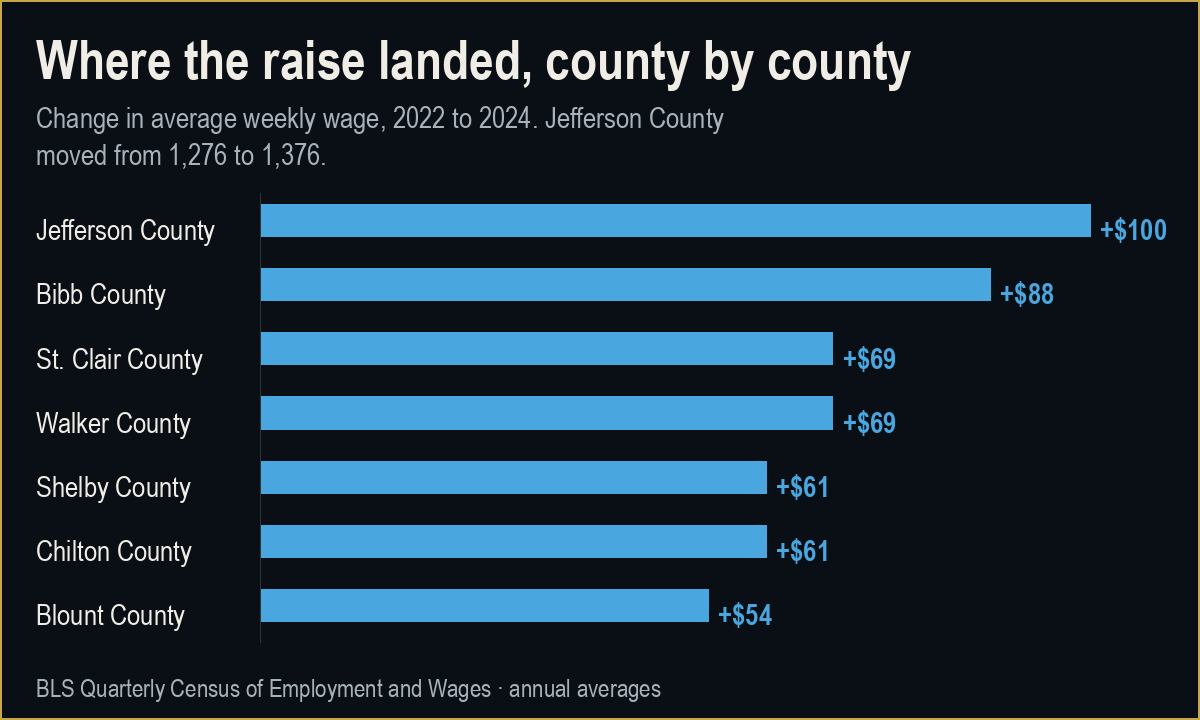
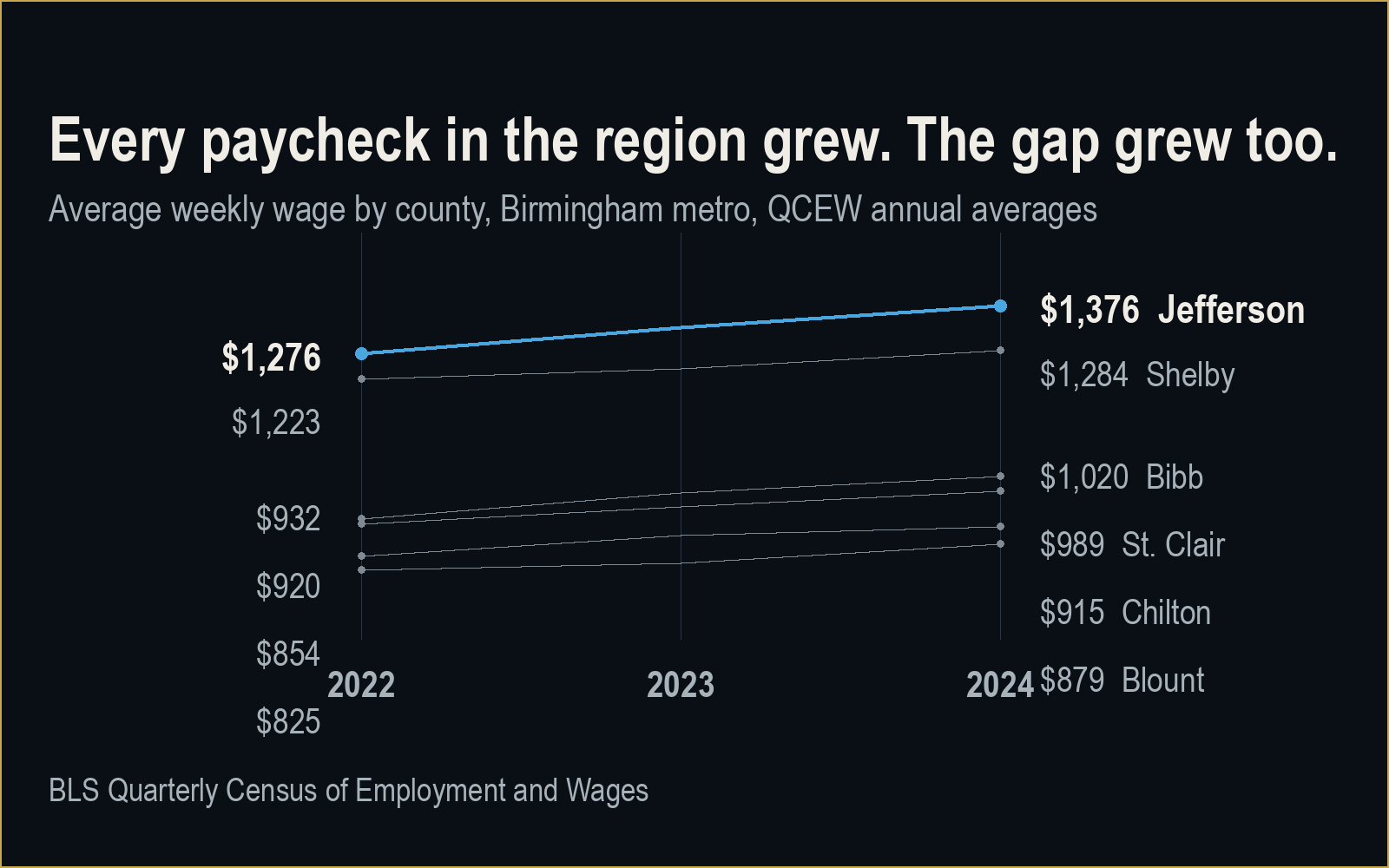
Annual averages from the federal Quarterly Census of Employment and Wages show Jefferson County at the top of the local pay scale in 2024. The county’s average weekly wage reached $1,376 in 2024, up from $1,276 in 2022 and $1,331 in 20231. That trend matters for both residential and commercial real estate: it defines the upper bound of local earning power and supports higher rent and price levels near Birmingham’s employment centers.
Shelby County, a major suburban employment hub south of Birmingham, trails Jefferson but still posts comparatively strong pay. Its average weekly wage rose from $1,223 in 2022 to $1,246 in 2023 and $1,284 in 20242. Northwest and exurban counties show lower wage levels but similar upward trajectories. Bibb County’s average weekly pay increased from $932 in 2022 to $986 in 2023 and $1,020 in 20243, while Blount County advanced from $825 to $840 to $879 over the same period4. St. Clair County climbed from $920 in 2022 to $957 in 2023 and $989 in 20245, and Walker County moved from $867 to $903 to $9366.
These figures confirm a regional wage ladder with Jefferson and Shelby at the top and surrounding counties offering lower but rising pay. For investors comparing submarkets, the data supports a view that income-dependent demand will be densest in Jefferson and Shelby, with more value-oriented positioning in the fringe counties.
Employment base and business density
Wage growth is occurring alongside a substantial employment and establishment base in Jefferson County. Covered employment in the county reached 367,081 jobs in 2024, up from 356,742 in 2022 and 362,788 in 20231. Business establishments grew from 21,422 in 2022 to 22,427 in 2023 and 22,923 in 20241. That expansion indicates incremental diversification and densification of the job base, consistent with a market that can support a range of office, industrial and service-oriented space.
Surrounding counties show smaller but notable employment platforms. Shelby County averaged 85,169 covered jobs in 2024, down modestly from 86,332 in 2022 but roughly stable year to year, while establishments rose from 6,809 in 2022 to 7,251 in 20242. St. Clair County’s covered employment increased from 19,970 in 2022 to 21,980 in 2024, and establishments from 1,769 to 1,943 over the same span5. Blount County’s job count edged up from 8,726 in 2022 to 9,094 in 2024, with establishments rising from 896 to 9564. Bibb and Chilton Counties each sustained covered employment around 4,800 and 9,100 jobs respectively in 2024, while both increased their establishment counts between 2022 and 20243,7. Walker County maintained a mid-sized base, with 18,709 covered jobs and 1,536 establishments in 2024, both up from 20226.
The distribution of jobs and establishments confirms Jefferson as the region’s core employment engine, with Shelby as a major suburban node and St. Clair, Walker, Blount, Bibb and Chilton forming a ring of smaller but gradually expanding labor markets. For developers, this pattern can guide decisions on where to prioritize employment-adjacent multifamily and convenience retail versus more speculative or value-focused plays.
Institutional and corporate investments reshaping the landscape
Alongside organic labor market growth, Birmingham is seeing targeted investments in both manufacturing and knowledge-sector infrastructure. In Jefferson County’s McCalla community, a manufacturing facility planned by The J.M. Smucker Co. carries a total projected financial investment of $1.1 billion, to be constructed in three phases and creating up to 750 jobs as production milestones are met8. The company and state officials indicated construction was expected to begin no later than January 2022, with production commencing in calendar year 20258. Smucker stated that construction and production will occur over multiple years in three phases and that both investment and job creation are contingent on tax and business incentives and the closing of the property transaction8. For nearby industrial and logistics property, the project outlines a multi-year arc of potential demand tied to its build-out schedule and incentive structure.
On the institutional side, the University of Alabama at Birmingham (UAB) is using new construction and renovations to advance a strategic plan that explicitly links facilities to economic development. UAB describes its current building program as part of implementing its strategic and campus master plans, with new and renovated spaces intended to “enhance opportunities for success” across its mission pillars, including “research innovation and economic development” among others9. This framing positions campus projects as economic infrastructure as well as academic and clinical assets.
Several flagship projects carry notable public and philanthropic funding. The Altec/Styslinger Genomic Medicine and Data Sciences Building is funded by a combination of private gifts and public support, including $50 million from the state of Alabama via the Public School and College Authority, $5 million from Jefferson County, and $1 million from the City of Birmingham, alongside other institutional funds10. Another project, the Biomedical Research and Psychology Building, is a $190 million effort supported by $152 million in federal funding as well as resources from the Heersink School of Medicine and the College of Arts and Sciences10. In the affiliated research sphere, Southern Research opened its flagship biotech center on August 12, anchoring the development of 150,000 square feet of space over four floors and a basement, including new wet lab space for life sciences tenants10.
Taken together, these projects consolidate Birmingham’s role in higher-wage, research-driven employment, supporting demand for specialized lab and office space while reinforcing incomes that can sustain higher-value residential and urban mixed-use product nearby.
Public-sector strategy and targeted neighborhood reinvestment
City government describes its economic role in explicitly job- and skill-focused terms. Birmingham’s Department of Innovation and Economic Opportunity states that its mission is “to prioritize the residents of Birmingham by creating quality jobs, preparing workers for those jobs, and ensuring access to skill development opportunities”11. The department characterizes itself as “the driving force behind Birmingham’s growth and prosperity”11 and says it aims to foster “an inclusive and resilient economy, making Birmingham a model for innovation and economic development”11. In its own narrative, the city notes that after steel mills closed and storefronts shuttered, Birmingham “adapted as a robust financial center”11, positioning today’s initiatives as a diversification beyond heavy industry.
At the neighborhood scale, the federal government has committed substantial support to specific distressed areas. Through the U.S. Economic Development Administration’s Recompete Pilot Program, the “Reinvest Birmingham Recompete Plan” identifies 19 census tracts across four communities—North Birmingham, Northside, Pratt and Smithfield—as the target region12. The plan, led by the City of Birmingham, is slated to receive approximately $20 million “to support the persistently distressed neighborhoods of North Birmingham, Northside, Pratt, and Smithfield”12. The application notes that northwest Birmingham has faced “significant challenges over the years that contributed to a lack of prime-age residents participating in the labor force”12. The funding is therefore aimed at raising labor force attachment in areas that lag the broader metro, which could incrementally increase local housing demand if successful.
Birmingham’s Department of Community Development plays a complementary role on the housing and small-business side. The department administers the city’s federal Housing and Urban Development (HUD) grants, applies for additional funding, and “implements strategic community plans”13. Its stated portfolio includes programs focused on improving “housing, neighborhoods, and local businesses”13, with offerings that include “small business loans and economic development initiatives”13. Community Development Block Grant (CDBG) funds are described as usable for a wide variety of housing, community and economic development activities, with up to 90 different categorical “matrix codes” depending on how localities choose to apply them13. For owners and developers in qualifying tracts, this toolbox can affect project feasibility through gap financing or neighborhood infrastructure improvements.
Regional connectivity and global links
Birmingham’s position within a larger seven-county economic region also matters for occupier and investor decisions. The Birmingham Business Alliance describes the Greater Birmingham Region as “a unified network of organizations across seven central Alabama counties, working together to strengthen economic development, talent recruitment and tourism”14. According to the Alliance, the region hosts “100+ foreign-based companies representing 20+ countries”14, indicating an established base of international employers.
Transport connectivity is another competitive factor. The Alliance notes that “five major interstate corridors intersect in Birmingham,” linking the region to key Southeast markets and to “78% of the U.S. population within a two-day drive”14. It also highlights the Birmingham Inland Port (Birmingport) as a multimodal logistics asset about 20 miles from downtown, providing direct access to Gulf Coast deepwater ports and global markets14. These attributes support industrial and distribution site selection, especially in submarkets with convenient highway or inland port access.
Statewide capital flows and macro context
At the state level, reported capital flows into economic development are sizable. The Birmingham Business Journal has summarized that Alabama economic development activity “reaches $14B,” as reported in an article on the Department of Commerce’s 2025 annual report15. While that figure aggregates investments statewide rather than isolating Greater Birmingham, it underscores that the region is operating within a broader high-investment environment, with potential spillover competition and collaboration among Alabama metros.
What the evidence implies for the property market
Within the limits of the available data, several patterns stand out for property stakeholders:
- Income and wage support – Jefferson and Shelby counties’ higher and rising average weekly wages1,2 underpin demand for higher-rent residential and office product near major job nodes, while lower-wage but growing fringe counties may favor more affordability-focused development.
- Diversifying employment – Growth in covered employment and business establishments across Jefferson and neighboring counties between 2022 and 20241,2,3,4,5,6,7 signals an expanding economic base that can support a variety of property types.
- Anchor projects with long lead times – The planned $1.1 billion Smucker facility in McCalla with up to 750 projected jobs8 and UAB’s major research and genomic buildings backed by state, federal and philanthropic dollars10 represent multi-year drivers of construction, specialized space demand and secondary services.
- Targeted neighborhood and small-business tools – The approximately $20 million Reinvest Birmingham Recompete Plan for 19 census tracts12 and HUD/CDBG-backed community development programs13 may, over time, shift conditions in historically underperforming neighborhoods, with implications for both risk and upside in those submarkets.
- Regional and global connectivity – Interstate convergence, broad population reach within two days’ trucking and the Birmingham Inland Port’s access to deepwater Gulf ports14 continue to support logistics and manufacturing site selection, supplementing wage and workforce considerations.
The evidence base here is strongest on wages, employment counts and specific capital commitments; it is thinner on outcomes such as realized job creation, occupancy or rent performance. Readers should therefore treat these signals as inputs into broader underwriting and strategy work rather than definitive forecasts of property returns.
Every county in the region raised its average weekly wage between 2022 and 2024. Income-dependent demand should be densest in Jefferson and Shelby, with more value-oriented positioning available in the fringe counties.
These are nominal averages, not inflation-adjusted, and an average weekly wage moves when the mix of jobs changes, not only when pay rises. A county that added higher-paying work will look like a raise for everyone.
Sources
- U.S. Bureau of Labor Statistics. Quarterly Census of Employment and Wages, annual averages — Jefferson County, Alabama. 2024 View source
- U.S. Bureau of Labor Statistics. Quarterly Census of Employment and Wages, annual averages — Shelby County, Alabama. 2024 View source
- U.S. Bureau of Labor Statistics. Quarterly Census of Employment and Wages, annual averages — Bibb County, Alabama. 2024 View source
- U.S. Bureau of Labor Statistics. Quarterly Census of Employment and Wages, annual averages — Blount County, Alabama. 2024 View source
- U.S. Bureau of Labor Statistics. Quarterly Census of Employment and Wages, annual averages — St. Clair County, Alabama. 2024 View source
- U.S. Bureau of Labor Statistics. Quarterly Census of Employment and Wages, annual averages — Walker County, Alabama. 2024 View source
- U.S. Bureau of Labor Statistics. Quarterly Census of Employment and Wages, annual averages — Chilton County, Alabama. 2024 View source
- Office of the Governor of Alabama. Governor ivey announces the j m smucker co to build alabama manufacturing plant creating up to 750 jobs in birmingham View source
- University of Alabama at Birmingham. Uab s 12 new construction and renovation projects transforming campus supporting strategic initiatives View source
- University of Alabama at Birmingham. Uab continues to transform through 14 new construction and renovation projects View source
- City of Birmingham. Department innovation economic opportunity View source
- U.S. Economic Development Administration. Reinvest Birmingham Recompete Plan View source
- City of Birmingham. Community development View source
- Birmingham Business Alliance. Economic development View source
- Birmingham Business Journal. Department commerce annual report 2025 View source