
Memphis’s core county still dominates the region’s job base, but the suburban counties around it are no longer rounding errors. As EDGE’s Industrial Development Board heads into its August 19, 2026 meeting with an update from the Shelby County Suburban Alliance on the agenda, the numbers show a metro where most covered jobs are in Shelby County — and where smaller counties are slowly building their own employment and wage footprints. 111
The hook for that conversation is not a statistic; it is a coordination problem. A worker or employer experiences Memphis as one labor market. Incentives, sites and infrastructure are still largely organized by county line. EDGE and the Suburban Alliance are, in effect, being asked whether the institutional structure can catch up to the geography of work.
Shelby County is still the job engine
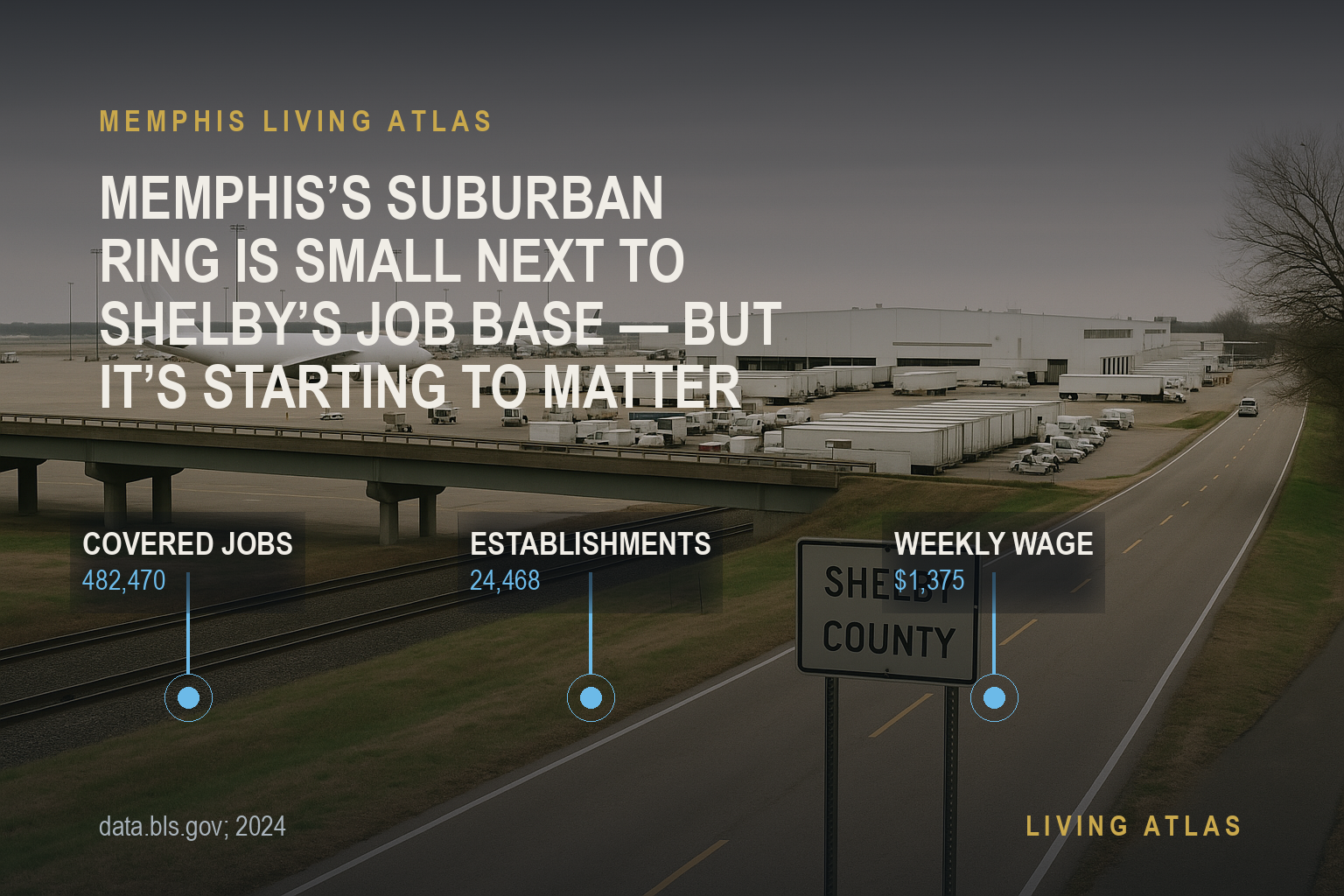
Shelby County accounts for the overwhelming majority of covered employment in the region, with roughly 480,000 covered jobs in 2024 and more than 24,000 business establishments. 22 Average weekly wages in Shelby reached $1,375 that year, the highest verified level among the surrounding counties in this evidence set. 2
Those figures sit on top of a broader labor market of just over 630,000 people in the Memphis, TN–MS–AR metro area’s civilian labor force in mid‑2026, with employment a little above 600,000 and an unemployment rate around four to five percent, depending on the month. 3333 The point is directional: most of the region’s workers and jobs are still in or closely tied to Shelby County, and wage levels there set an anchor for what employers around the metro have to pay to compete.
The freight backbone is getting a multibillion-dollar refresh
Underneath these labor trends sits a logistics asset that remains central to any growth story: the FedEx Express World Hub in Memphis. FedEx and state officials have announced an additional $450 million investment to accelerate the hub’s modernization and expansion, bringing the total project size to more than $1.5 billion. 4 FedEx describes the Memphis World Hub as the largest sort facility in its global network, with 11,000 team members and 163 aircraft gates, and cites growing customer demand as the reason for further investment. 4 The company also characterizes the spending as a reflection of its continued commitment to Memphis and Tennessee. 4
This is committed capital, not a generic promise. If FedEx executes on the full hub modernization plan as announced, the facility’s long‑term viability and throughput could remain a defining anchor for high‑wage logistics and related services in the region. That would reinforce the logic for suppliers, transportation firms and distribution‑heavy employers to stay tethered to the Memphis airport and interstate network rather than peeling away to competing hubs. That is a reasonable inference from the scale and nature of the investment; it is not yet a measured outcome.
Suburban counties are small, but they are not static
Around Shelby, the suburban counties remain much smaller in absolute job terms, but several are quietly adding establishments and, in some cases, paying wages that are competitive with or above parts of the metro.
- DeSoto County, Mississippi has more than 72,000 covered jobs and 3,754 business establishments as of 2024, with an average weekly wage of $879. 555 That makes it the largest suburban employment base in this evidence set by a significant margin.
- Marshall County, Mississippi is much smaller, with about 11,000 covered jobs and 566 establishments in 2024, and an average weekly wage of $935. 666
- Tipton County, Tennessee has just under 12,000 covered jobs and 962 establishments, with an average weekly wage of $967 in 2024. 777
- Fayette County, Tennessee shows about 8,000 covered jobs across 823 establishments, and an average weekly wage of $1,098 in 2024 — notably high for its size, and above DeSoto, Tipton, Marshall, Tunica and Crittenden in this set. 888
- Tunica County, Mississippi has roughly 5,800 covered jobs, 270 establishments and an average weekly wage of $802. 999
- Crittenden County, Arkansas reports around 16,200 covered jobs, 1,096 establishments and an average weekly wage of $919 in 2024. 101010
The pattern is clear without narrating every cell in the table: Shelby dominates the job count and wage ceiling. DeSoto and Crittenden are emerging as secondary employment centers by sheer job volume. Fayette, though smaller, stands out for its relatively high average wage. Tipton and Marshall form a mid‑tier, with wage levels close to or slightly under $1,000 per week. Tunica is smaller and lower‑wage on average in this set, though its casino and tourism footprint is not visible in detail in the evidence here.
These numbers are annual averages, not real‑time counts, and they do not directly tell us which industries are driving the differences between counties. They do establish that multiple suburban counties now host thousands to tens of thousands of covered jobs and hundreds of establishments each — large enough that any metro‑scale growth thesis has to treat them as meaningful, not peripheral.
Why this matters for property and growth strategy
The Shelby County Suburban Alliance’s annual update, listed on the EDGE board’s agenda under administrative issues, is one small sign that institutional players are trying to coordinate across these county lines. 1 The question for investors, developers and employers is whether that coordination will be sufficient if several trends begin reinforcing each other: FedEx’s hub investment, wage pressure in Shelby, and the relatively lower absolute job counts — and in some cases, higher wages — in nearby counties.
A few reasonable inferences follow if current patterns continue and if announced investments like the FedEx hub modernization are fully executed:
- Labor and wage competition will not stop at the county border. Employers in DeSoto, Tipton, Fayette, Crittenden and Marshall are already operating within the same commuting shed as Memphis. If Shelby’s wage anchor around $1,375 per week holds or rises with hub‑adjacent logistics and services, suburban employers may need to keep narrowing their wage gap to attract and retain workers, especially in higher‑skill roles. 257810
- Industrial and commercial demand could tilt toward sites that balance access and cost. DeSoto’s 70‑plus thousand jobs and nearly 3,800 establishments suggest that some of this is already happening. 55 If the FedEx hub becomes even more efficient and remains a magnet for freight‑intensive activity, users that prize quick airport and interstate access but are sensitive to occupancy cost may continue exploring sites in DeSoto, Crittenden or Fayette as complements, not substitutes, for Shelby.
- Smaller, higher‑wage Fayette is an interesting outlier. With fewer than 10,000 covered jobs but an average weekly wage around $1,100, Fayette may be hosting a mix of employers or occupations that pay above the suburban norm. 88 Without industry‑level data in this evidence set, we cannot say which sectors are responsible. It is a place where closer site‑level and industry‑level research would be warranted before drawing strong conclusions.
These are inferences conditioned on execution and continuity; they are not guarantees. A slowdown in freight volumes, automation that reduces headcount needs at the hub, or policy friction around permitting and infrastructure could all blunt the impact of the investments described here. Those would be risks to any scenario in which Memphis’s logistics backbone catalyzes a broader regional growth cycle.
The bull case, with caveats
A plausible bull case for the Memphis region, based on this evidence, would run as follows: If the FedEx hub modernization is completed at the announced $1.5 billion‑plus scale, preserving Memphis’s role in time‑sensitive freight, and if suburban counties continue to add establishments and jobs off a relatively low base, the metro could see a period where logistics, advanced distribution and related services compound across county borders rather than concentrating solely in Shelby. 45876910
In that scenario, property demand would not be limited to one county’s industrial parks or one jurisdiction’s incentives. It would involve a mesh of industrial, office‑adjacent and service‑sector sites across the ring, each competing on a mix of access, power, permitting, and labor draw. However, this outcome would require more than one company’s capital plan. It would need consistent execution on infrastructure, land use and coordination among actors like EDGE and the Suburban Alliance, whose meeting notice is one of the few visible signs in this evidence set of that kind of regional governance architecture. 111
What we do not have in this evidence is a forecast from any agency that Memphis will add a specific number of jobs or residents over a given horizon, or that wages will grow at a particular rate. Any story that depends on, for example, 50,000 additional jobs in a decade would be a separate, explicitly modeled scenario with its own data and assumptions, not something that can be read off this snapshot.
What to watch next
- Execution milestones at the FedEx World Hub: construction phases, capacity upgrades and any disclosed changes in staffing levels at the Memphis facility. 44
- Shifts in covered employment and establishment counts by county: updates to QCEW data for Shelby, DeSoto, Crittenden, Fayette, Tipton, Marshall and Tunica will show whether the suburban ring is gaining share or holding steady. 25108769
- Average weekly wage trends: whether Fayette retains its current wage premium and whether suburban wages converge toward Shelby’s or remain meaningfully lower. 28756910
- Regional unemployment and labor‑force participation: changes in the Memphis MSA’s labor‑force size, employment and unemployment rates will indicate how tight the regional labor market is as investments come online. 3333
- Suburban Alliance and EDGE decisions: any published outcomes from the August 19, 2026 EDGE board meeting and subsequent sessions that affect incentives, infrastructure, or cross‑county coordination. 11
Those indicators will not, on their own, settle the question of whether Memphis is on the verge of a new growth cycle. They will, however, show whether committed capital and a broadening employment base are beginning to change how and where work actually happens in the region.

Sources
- www.shelbycountytn.gov. PublicNotice EDGE81926 View source
- U.S. Bureau of Labor Statistics. Quarterly Census of Employment and Wages, annual averages — Shelby County, Tennessee. 2024 View source
- U.S. Bureau of Labor Statistics. Tn memphis msa View source
- newsroom.fedex.com. Fedex express announces additional 450 million in memphis hub investment View source
- U.S. Bureau of Labor Statistics. Quarterly Census of Employment and Wages, annual averages — DeSoto County, Mississippi. 2024 View source
- U.S. Bureau of Labor Statistics. Quarterly Census of Employment and Wages, annual averages — Marshall County, Mississippi. 2024 View source
- U.S. Bureau of Labor Statistics. Quarterly Census of Employment and Wages, annual averages — Tipton County, Tennessee. 2024 View source
- U.S. Bureau of Labor Statistics. Quarterly Census of Employment and Wages, annual averages — Fayette County, Tennessee. 2024 View source
- U.S. Bureau of Labor Statistics. Quarterly Census of Employment and Wages, annual averages — Tunica County, Mississippi. 2024 View source
- U.S. Bureau of Labor Statistics. Quarterly Census of Employment and Wages, annual averages — Crittenden County, Arkansas. 2024 View source