
Birmingham is trying to change what gets built on its land at the same time the wider region’s job base is quietly diversifying. The question for investors and developers is whether new zoning rules and neighborhood initiatives will redirect more of that growth into the city’s existing corridors rather than farther out.
Jefferson still dominates the jobs map, but the edge counties are busy
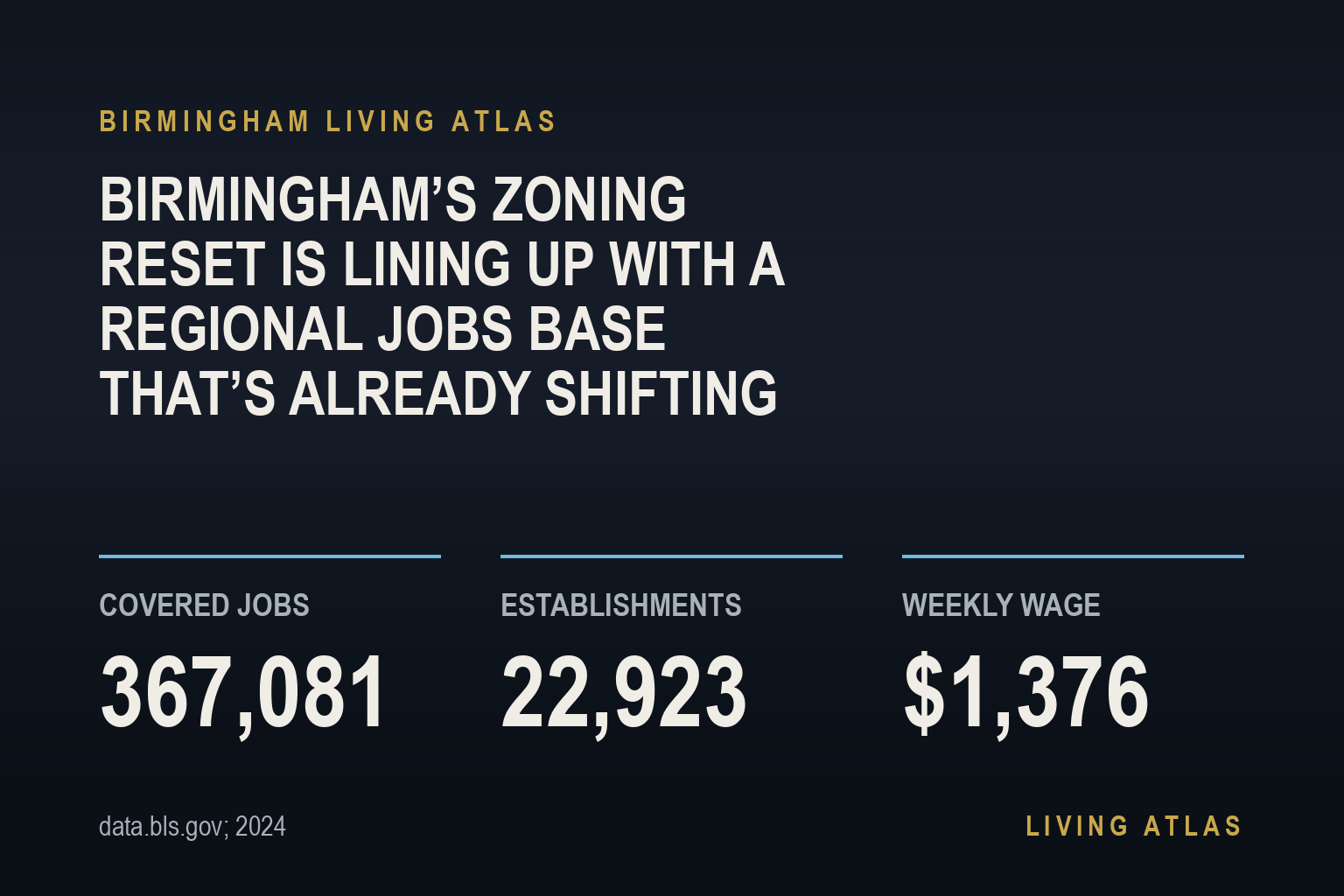
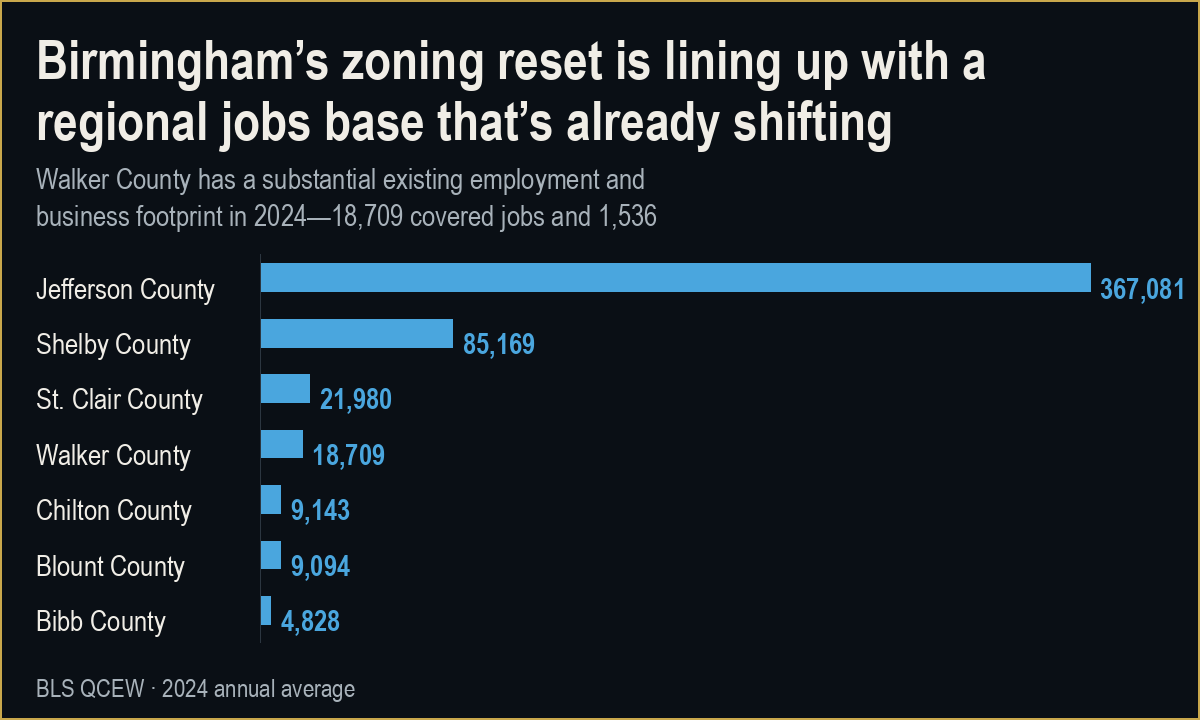
Jefferson County remains the economic center of the region by a wide margin, with just over 367,000 covered jobs in 2024 and nearly 23,000 business establishments on the books.1 Average weekly pay there reached $1,376, the highest wage base in the central Alabama counties covered by this data.1
But several neighboring counties are adding employers and jobs at a smaller, steady scale:
- Shelby County supported about 85,000 covered jobs in 2024, with business establishments rising to 7,251 and average weekly wages of $1,284.2
- St. Clair County grew its covered employment to 21,980 jobs and 1,943 establishments, with weekly pay averaging $989.3
- Walker County reached 18,709 covered jobs and 1,536 establishments, with wages averaging $936 per week.4
- Blount County carried 9,094 covered jobs across 956 establishments, with an average weekly wage of $879.5
- Chilton County had 9,143 covered jobs, 922 establishments, and average weekly wages of $915.6
- Bibb County accounted for 4,828 covered jobs and 445 establishments, with weekly wages averaging $1,020.7
This pattern suggests Jefferson remains the primary employment and wage center, while surrounding counties function as smaller job nodes with lower average pay, apart from Bibb County’s slightly higher weekly wages. That gap in wages and job density is one of the levers Birmingham is trying to use: if the city can offer buildable, well-zoned land plus infrastructure, it can make a case for keeping more of the next wave of employers inside Jefferson and within city limits rather than watching them disperse outward.
Birmingham is rewriting its zoning map, starting with key corridors
The city’s Long Range Planning Team is in the middle of a rezoning effort that explicitly targets several key areas, including the Southern Area, Eastern Area, Pratt–Ensley, and Northside–Southside communities.8 The city frames this as an implementation step for the 2013 Comprehensive Plan, which it says outlines its vision for growth and development.8
According to the planning division, the primary goals of this citywide rezoning initiative include:
- Implementing mixed-use districts
- Downzoning heavy industrial areas where appropriate
- Downzoning vacant or deteriorating multifamily properties
- Establishing an Urban Neighborhood district intended to support “vibrant, sustainable communities”8
The city describes its zoning districts as a tool to guide growth and development by supporting specific building types, land uses, and community needs.8 In practice, that means the regulatory baseline for what can be built in older industrial and residential areas is changing at the same time as regional employers are sorting out where to expand next.
Data centers get their own rulebook — with community protections attached
The most visible sign of Birmingham’s new posture on land use is a zoning ordinance specifically addressing hyperscale data centers. The Birmingham City Council has approved a package of 20 protective conditions for these facilities, and the city’s own description is that this positions Birmingham as “a national leader in responsible data center regulation.”9
The city also argues that its strong electrical grid, industrial infrastructure, and comparatively affordable land make it attractive to data center developers, which it presents as the rationale for having “clear, protective local standards” in place.9 The ordinance is framed as a response to what the city calls a rapid national expansion of large-scale data centers whose impacts have outgrown older ordinances.9
For property owners and investors, the key point is not the label the city gives itself but the fact that large, power-intensive uses now come with a dedicated set of rules and conditions. If hyperscale deployments do materialize, this framework will shape where they can go and what mitigation they must provide nearby.
Brownfields and neighborhood revitalization: trying to turn legacy sites into assets
Zoning is only one lever the city is using. The Department of Planning, Engineering & Permits describes its role as assisting daily in Birmingham’s neighborhood revitalization efforts, working with other agencies and the mayor’s office to improve service standards.10
One concrete program is a new brownfields effort in North Birmingham. The city says it is inviting residents to help shape the future of underused and abandoned properties through a program focused on identifying redevelopment opportunities and supporting neighborhood revitalization.10 That focus on contaminated or idle sites matters to the development math: if the city can de-risk or clarify former industrial parcels, it potentially widens the set of locations that can absorb new employers or mixed-use projects instead of pushing everything to greenfield sites at the fringe.
The same department also represents Birmingham in regional forums on transportation, watershed management, air quality, emergency response, land-use planning, and business recruitment and retention.10 That positions it as a bridge between local zoning decisions and regional infrastructure and employer needs.
Big-ticket industrial investment is already landing in Jefferson County
The zoning and revitalization work is unfolding alongside sizable private manufacturing commitments in Jefferson County. In late 2021, Alabama’s governor announced that The J. M. Smucker Co. would build a new manufacturing plant in the Jefferson County community of McCalla, describing it as a facility that could create up to 750 jobs in Birmingham.11
The state’s release put the total investment at $1.1 billion, to be built in three phases.11 Construction was expected to begin no later than January 2022, with production planned to start in calendar year 2025.11 Those jobs are an announced plan rather than a fully observed outcome in this dataset, but if hiring materializes at or near the stated level, it would represent a non-trivial share of new employment relative to the existing manufacturing base in Jefferson County.
That kind of project illustrates the tension Birmingham is managing. Large, modern plants and data-heavy facilities want power, land, and logistics access — advantages the region already has.9,11 The open question is how much of their value can be steered into existing communities and commercial corridors rather than bypassing them.
Economic development is being framed around connecting local strengths to outside capital
Inside City Hall, the Department of Innovation and Economic Opportunity describes its mission as connecting Birmingham’s people, businesses, assets, and opportunities to markets and investments that “drive sustainable growth.”12 It says it works to strengthen homegrown businesses, attract and retain high-growth industries, cultivate a skilled workforce, and position the city for new investment and development.12
The department’s own goal statement is to build what it calls a resilient, opportunity-rich economy and to help Birmingham compete as a destination for innovation and economic opportunity.12 Those are the city’s aspirations rather than observed outcomes, but they provide context for why zoning, brownfields work, and specialized ordinances are moving now: they are the policy tools the city is choosing to deploy to try to align its land use with those aims.
One small example of how this shows up operationally is the Reinvest BHM initiative. The department has issued a Request for Proposals for a Workforce Development Technical Assistance Contractor, under the Reinvest BHM banner, with a release date of August 17, 2026, and proposals due by September 18, 2026.12 That kind of technical support is less visible than a factory groundbreaking, but it is part of the city’s attempt to make sure local workers and small firms can participate when large projects like Smucker’s or potential data centers move from announcement to hiring and procurement.
One scenario: what happens if these pieces start to reinforce each other?
Pulling the threads together, several facts are clear:
- Jefferson County holds by far the largest job and wage base in central Alabama.1
- Adjacent counties are adding employers and covered jobs from much smaller starting points.2,3,4,5,6,7
- Birmingham is actively rezoning core areas, introducing a dedicated data center ordinance, and targeting brownfield and neighborhood revitalization work.8,9,10
- At least one billion-dollar-plus industrial facility is already committed for the county, with hundreds of announced jobs attached.11
If that combination of regulatory clarity, site reuse, and committed capital compels more employers to locate in or near Birmingham’s existing neighborhoods, one plausible outcome is tighter demand for nearby industrial and logistics space, pressure for mixed-use and residential infill in rezoned districts, and more value in underused sites that can be brought back through brownfields work. If, instead, large projects continue to favor greenfield locations on the fringe with limited ties to older commercial corridors, the gains could remain geographically narrow even as headline job numbers grow.
What to watch next
- Actual siting of hyperscale data centers: whether any such projects file applications under the new 20-point ordinance, and where they choose to locate within city limits, if at all.9
- Build-out and hiring at the Smucker facility: construction and production milestones versus the original 2025 production target, and how many of the up-to-750 announced jobs are ultimately filled in Jefferson County.11
- Adoption and impact of the Urban Neighborhood district: how often it is applied in rezoning decisions, and whether it coincides with measurable increases in mixed-use or infill development in the Southern, Eastern, Pratt–Ensley, and Northside–Southside areas.8
- Brownfields project pipeline: the number and size of underused or abandoned properties in North Birmingham that move into active redevelopment via the brownfields program.10
- Trends in county employment and establishments: whether Jefferson’s share of regional covered employment and new establishments grows, stays flat, or declines relative to faster-growing edge counties.1,2,3,4,5,6,7
Those markers will help show whether Birmingham’s current round of zoning and economic development work is simply keeping pace with regional change or beginning to redirect it.
Sources
- U.S. Bureau of Labor Statistics. Quarterly Census of Employment and Wages, annual averages — Jefferson County, Alabama. 2024 View source
- U.S. Bureau of Labor Statistics. Quarterly Census of Employment and Wages, annual averages — Shelby County, Alabama. 2024 View source
- U.S. Bureau of Labor Statistics. Quarterly Census of Employment and Wages, annual averages — St. Clair County, Alabama. 2024 View source
- U.S. Bureau of Labor Statistics. Quarterly Census of Employment and Wages, annual averages — Walker County, Alabama. 2024 View source
- U.S. Bureau of Labor Statistics. Quarterly Census of Employment and Wages, annual averages — Blount County, Alabama. 2024 View source
- U.S. Bureau of Labor Statistics. Quarterly Census of Employment and Wages, annual averages — Chilton County, Alabama. 2024 View source
- U.S. Bureau of Labor Statistics. Quarterly Census of Employment and Wages, annual averages — Bibb County, Alabama. 2024 View source
- City of Birmingham. Community rezoning plans View source
- City of Birmingham. City birmingham approves alabamas toughest zoning ordinance establishing 20 point community protections data center deve View source
- City of Birmingham. Pep View source
- Office of the Governor of Alabama. Governor ivey announces the j m smucker co to build alabama manufacturing plant creating up to 750 jobs in birmingham View source
- City of Birmingham. Department innovation economic opportunity View source