Across the Birmingham area, a series of public, institutional and private commitments is reshaping where money and jobs may land over the next several years. The projects range from neighborhood-scale workforce programs to billion‑dollar industrial and research investments. Together, they help explain why central Alabama’s core counties show relatively dense employment and wage bases compared with their neighbors—though the data also highlight gaps and uncertainty.
Jefferson County as the investment anchor
Jefferson County remains the region’s economic center by covered employment and pay. In 2024, the county averaged 367,081 covered jobs, up from 356,742 in 2022 and 362,788 in 2023, according to the U.S. Bureau of Labor Statistics Quarterly Census of Employment and Wages (QCEW). The average weekly wage reached $1,376 in 2024, up from $1,276 in 2022 and $1,331 in 2023.
Part of the recent story in Jefferson County is large‑scale industrial investment at the urban fringe. The State of Alabama reports that The J.M. Smucker Co. is building a manufacturing facility in the Jefferson County community of McCalla with a total financial investment of $1.1 billion. The facility is to be constructed in three phases and is expected to create up to 750 jobs, with construction anticipated to begin no later than January 2022 and production expected to commence in calendar year 2025. The public announcement does not specify wage levels, supplier impacts or exact project timing beyond those expectations, so any broader claims about its eventual regional economic effect would be speculative.
Institutional construction and research‑driven capital
Downtown, the University of Alabama at Birmingham (UAB) is using capital projects to expand its research footprint. UAB states that new research buildings and renovations bring state‑of‑the‑art technology, support retention and hiring of investigators, expand its research portfolio and impact, and allow for additional private and public funding opportunities. In a separate overview of 14 construction and renovation projects, the university links this work to its mission pillars, including economic development. These are institutional claims about intent and expected outcomes; the material provided does not include independent measures of downstream job or income effects.
One flagship example is the Altec/Styslinger Genomic Medicine and Data Sciences Building. UAB describes the project as located on Seventh Avenue South between 19th and 20th streets, at the former site of the Kracke Building and the Pittman Center for Advanced Medical Studies. The university says the project is funded through a mix of philanthropy and public money: philanthropic gifts from donors including the Altec/Styslinger Foundation and Marnix and Mary Heersink; $50 million from the State of Alabama via the Public School and College Authority; and $5 million from Jefferson County. A later UAB summary adds that the project includes $1 million from the City of Birmingham and other institutional funds.
These figures show how local, state and county governments are co‑investing alongside private donors in research infrastructure. The available evidence does not quantify how this spending translates into construction jobs, permanent positions or commercial spinoffs, only that UAB sees these facilities as enabling additional funding and investigator recruitment.
Neighborhood‑scale intervention in Northwest Birmingham
Not all recent capital flows are concentrated in the urban core. The U.S. Economic Development Administration (EDA) has awarded approximately $20 million to the Reinvest Birmingham Recompete Plan, led by the City of Birmingham, to support what it calls the persistently distressed neighborhoods of North Birmingham, Northside, Pratt and Smithfield. The EDA notes that Northwest Birmingham has experienced significant challenges that contributed to a lack of prime‑age residents participating in the labor force.
According to EDA’s description, Recompete funding will provide in‑demand workforce training to residents in the target neighborhoods via a partnership with Lawson State Community College. The program is also expected to offer support for entrepreneurs who face disparities in training and access to capital, and to expand and improve transportation and accessible childcare in those neighborhoods. The documentation does not yet provide quantified job placement outcomes, business formations, or infrastructure projects emerging from this award, so at this stage it is best understood as a defined funding commitment with specified focus areas rather than a measured result.
How local government describes its role
The City of Birmingham’s Department of Innovation and Economic Opportunity casts itself as a coordinating hub. On its public page, the department says it is “shaping Birmingham’s future by connecting our people, businesses, assets, and opportunities to the markets and investments that drive sustainable growth.” It outlines four main activities: strengthening homegrown businesses, attracting and retaining high‑growth industries, cultivating a skilled and competitive workforce, and positioning Birmingham for new investment and development.
The department further states that it aims to align local strengths with regional and global opportunities to build what it calls “a resilient, opportunity‑rich economy,” and that it is “dedicated to building pathways toward economic mobility” so that the city’s growth “translates into tangible opportunities for every neighborhood.” These are policy goals and self‑descriptions, not third‑party evaluations. The evidence presented does not include independent metrics that would confirm whether these goals have been met.
A seven‑county region with uneven baselines
Birmingham’s role sits within a broader seven‑county framework often described by the Birmingham Business Alliance as the Greater Birmingham Region. The Alliance characterizes this region as a unified network of organizations across seven central Alabama counties that work together on economic development, talent recruitment and tourism. It also states that the region is home to more than 100 foreign‑based companies representing more than 20 countries. The organization’s website does not, in the material provided here, break down those foreign investments by county or industry.
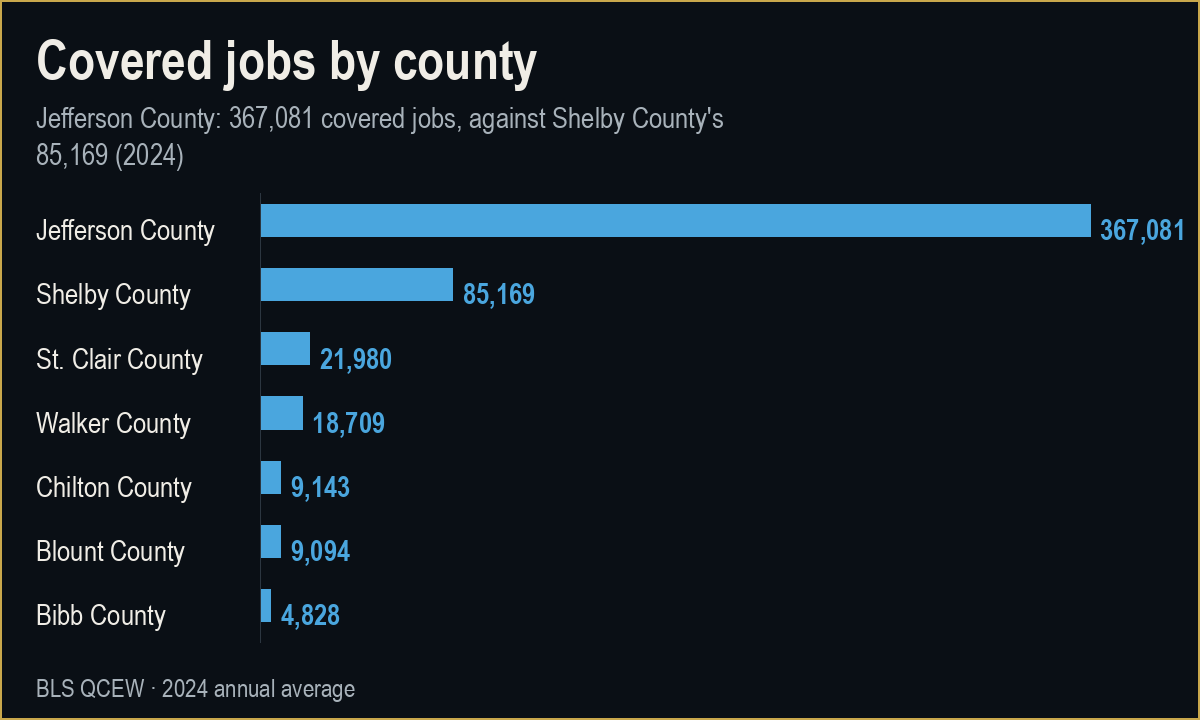
QCEW data do, however, show how employment and business density differ across some of these counties. In 2024, Jefferson County’s 367,081 covered jobs were supported by 22,923 establishments. Neighboring Shelby County averaged 85,169 covered jobs and 7,251 business establishments, with an average weekly wage of $1,284 in 2024, up from $1,223 in 2022 and $1,246 in 2023.
Other nearby counties operate from smaller bases:
- St. Clair County recorded 21,980 covered jobs and 1,943 establishments in 2024, with an average weekly wage of $989, up from $920 in 2022 and $957 in 2023.
- Blount County reported 9,094 covered jobs and 956 establishments in 2024, with an average weekly wage of $879, compared with $825 in 2022 and $840 in 2023.
- Bibb County had 4,828 covered jobs and 445 establishments in 2024, with an average weekly wage of $1,020, up from $932 in 2022 and $986 in 2023.
- Chilton County documented 9,143 covered jobs and 922 establishments in 2024, with an average weekly wage of $915, versus $854 in 2022 and $897 in 2023.
- Walker County showed 18,709 covered jobs and 1,536 establishments in 2024, with an average weekly wage of $936, up from $867 in 2022 and $903 in 2023.
These figures indicate that Jefferson and Shelby counties together account for the bulk of covered employment among the counties cited here, and that wages have been rising in all of them over the 2022–2024 period covered by the data. The QCEW series does not attribute these trends to particular projects, nor does it identify the sectors or sub‑areas within the counties where gains are concentrated.
Logistics links and regional coordination
Physical infrastructure complements these employment patterns. The Birmingham Business Alliance notes that the Birmingham Inland Port, also called Birminghamport, provides multimodal logistics by connecting barge, rail and truck transport. The facility is about 20 miles from downtown Birmingham and, according to the Alliance, offers direct access to the Gulf Coast’s deepwater ports and global markets via inland waterways and major freight corridors. The materials cited here do not provide cargo volumes, tenant lists or recent investment levels for the port.
Regional organizations are also trying to convene public‑ and private‑sector actors. One example is the Central Alabama Economic Development Summit, which a Birmingham Business Alliance video describes as taking place on October 15 at The BJCC and being presented by the Birmingham Business Alliance, the West Alabama Chamber of Commerce and ONE East Alabama. The clip does not specify the year, agenda, or measurable outcomes of this event, only that it is a gathering of leaders from across the region.
What this adds up to—and what’s missing
Considered together, these strands point to several layers of economic activity:
- Large, single‑site bets such as the $1.1 billion J.M. Smucker facility in McCalla, with an announced target of up to 750 jobs.
- University‑driven research capital, notably UAB’s genomics and data sciences building, backed by state, county, city, philanthropic and institutional funds.
- Neighborhood‑focused federal investment through the $20 million Recompete award to North Birmingham, Northside, Pratt and Smithfield, aimed at workforce, entrepreneurship, transportation and childcare gaps.
- Ongoing regional coordination and logistics positioning via the Greater Birmingham Region network and the Birmingham Inland Port.
At the same time, there are important limits to what can be inferred. The available evidence documents committed or described investments and programs, as well as county‑level employment and wage trends. It does not yet link specific projects to observed changes in job counts, wages, property markets or tax bases, nor does it provide project‑level performance data. For investors, developers and local officials, the key questions going forward will be whether these announced initiatives translate into durable employment growth, whether they narrow disparities between high‑ and lower‑employment counties, and how far neighborhood‑scale programs in Northwest Birmingham move the needle on labor‑force participation.