Jefferson County’s job base and pay levels are edging higher, even as surrounding counties add employers and diversify. At the same time, Birmingham and its institutional partners are directing tens of millions of dollars into life sciences, workforce training and neighborhood reinvestment. Together, these trends suggest a metro economy leaning into its role as a financial, biomedical and logistics hub—though the benefits are not yet evenly shared across the region.
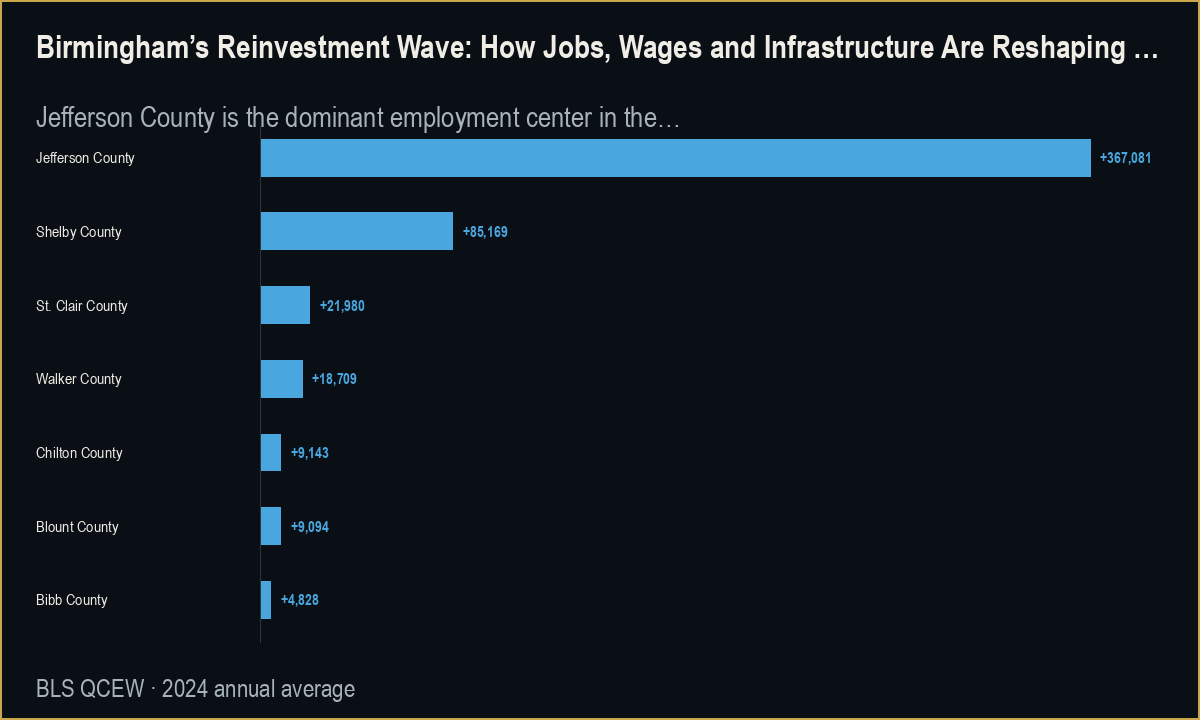
Jefferson County extends its employment and wage lead
New Quarterly Census of Employment and Wages (QCEW) data show Jefferson County, which includes the city of Birmingham, as the clear employment anchor for Central Alabama. In 2024, the county averaged 367,081 covered jobs and 22,923 business establishments on an annual basis, according to the U.S. Bureau of Labor Statistics.1,2 That marks steady expansion from 2022 levels of 356,742 jobs and 21,422 establishments, and from 2023 levels of 362,788 jobs and 22,427 establishments.1,2
Pay has also moved higher. Jefferson County’s average weekly wage reached $1,376 in 2024, up from $1,276 in 2022 and $1,331 in 2023.3 Within the metro, that wage level outpaces nearby counties:
- Shelby County: average weekly wage of $1,284 in 2024, up from $1,223 in 2022 and $1,246 in 2023.11
- St. Clair County: $989 in 2024, up from $920 in 2022 and $957 in 2023.14
- Walker County: $936 in 2024, up from $867 in 2022 and $903 in 2023.20
- Bibb County: $1,020 in 2024, up from $932 in 2022 and $986 in 2023.23
- Blount County: $879 in 2024, up from $825 in 2022 and $840 in 2023.17
- Chilton County: $915 in 2024, up from $854 in 2022 and $897 in 2023.26
All of these counties show rising wages over the 2022–2024 period, but Jefferson County’s absolute pay levels are the highest among the counties for which wage data are provided, reinforcing its position as the metro’s primary high-wage employment center.1–3,11,14,17,20,23,26
Suburban counties add employers and jobs
While Jefferson County remains the core, surrounding counties are also expanding their employer bases. From 2022 to 2024:
- Shelby County business establishments grew from 6,809 to 7,251, with covered employment essentially stable, edging from 86,332 in 2022 to 85,169 in 2024.8,9
- St. Clair County establishments increased from 1,769 to 1,943, while covered employment rose from 19,970 to 21,980 jobs.12,13
- Walker County establishments grew from 1,498 to 1,536, with employment rising from 17,790 to 18,709 jobs.4,18,19
- Blount County establishments rose from 896 to 956, and employment increased from 8,726 to 9,094 jobs.6,15,16
- Bibb County establishments climbed from 404 to 445, while employment held roughly steady, moving from 4,836 to 4,828 jobs.7,21,22
- Chilton County establishments increased from 856 to 922, with employment changing modestly from 9,047 to 9,143 jobs over the same span.5,24,25
These figures point to a broad-based expansion of the business footprint across the metro, even where employment levels are flat or only modestly higher. For real estate investors and employers, that dispersion of establishments may signal opportunities in secondary submarkets tied to, but not confined within, Jefferson County’s core employment engine.
Birmingham’s economic strategy: from steel to finance and life sciences
The city of Birmingham’s own account of its economic trajectory underscores a structural shift away from heavy industry. The city notes that after steel mills closed and storefronts were shuttered, Birmingham “adapted as a robust financial center.”27 It further states that beyond the Great Recession, Birmingham “emerged as a hub for life sciences and entrepreneurs of all types.”28 These claims come from a municipal description of the Department of Innovation and Economic Opportunity’s role and are best understood as the city’s characterization of its evolution rather than an independent ranking of sector strengths.
The same department describes itself as “the driving force behind Birmingham’s growth and prosperity,” with a mission that includes creating quality jobs, preparing workers for those jobs, and ensuring access to skill development opportunities for residents.29,30 This framing is consistent with the wage and establishment growth evident in the QCEW data, but the municipal language is promotional by nature, and the available evidence does not quantify the city’s standing relative to other U.S. markets.
Targeted reinvestment in distressed neighborhoods
Even as the regional numbers improve, federal economic development documents highlight significant localized challenges. The U.S. Economic Development Administration describes northwest Birmingham as having “significant challenges over the years that contributed to a lack of prime-age residents participating in the labor force.”32
In response, the Reinvest Birmingham Recompete Plan, led by the City of Birmingham, is slated to receive approximately $20 million in Recompete funding to support persistently distressed neighborhoods in North Birmingham, Northside, Pratt and Smithfield.31 According to the EDA, that funding will provide in-demand workforce training to residents of the target neighborhoods through a partnership with Lawson State Community College; it will also support entrepreneurs facing disparities in training and capital access and fund the expansion and improvement of transportation and accessible childcare in those areas.33,34
These commitments suggest a policy focus on reconnecting underutilized labor to the wider regional job market and on lowering practical barriers to work, such as mobility and childcare. The QCEW data themselves do not show neighborhood-level effects, so it will take time and additional evidence to assess how far this $20 million investment shifts labor-force participation or incomes in the specific communities named.
Life sciences build-out backed by state and institutional capital
Birmingham’s life sciences narrative is reinforced by large bricks-and-mortar investments documented by the University of Alabama at Birmingham (UAB). One flagship example is the Altec/Styslinger Genomic Medicine and Data Sciences Building, which UAB reports is funded through a blend of philanthropic and public sources: philanthropic gifts from UAB donors including the Altec/Styslinger Foundation and Marnix and Mary Heersink, plus $50 million from the state of Alabama via the Public School and College Authority, $5 million from Jefferson County, $1 million from the City of Birmingham, and additional institutional funds.35
UAB also notes that Southern Research, a UAB affiliate, has opened a flagship biotech center that “anchors the development of 150,000 square feet of space” across four floors and a basement, including new wet lab space for life sciences.36 The institution reports that the facility is worth $98 million, with $45 million coming from the state education fund.37
These figures substantiate the scale of current life sciences construction and public co-investment in the Birmingham market. What they do not yet show is the downstream job creation, company formation or commercial occupancy patterns that will follow; those would require additional data beyond what is provided here.
Global connectivity and logistics advantages
Regional business advocates emphasize Birmingham’s connectivity to national and international markets. The Birmingham Business Alliance reports that the region is home to 100+ foreign-based companies representing 20+ countries, indicating a base of international corporate investment, though the underlying list of firms is not provided in the evidence here.38
On the logistics side, the Alliance notes that five major interstate corridors intersect in Birmingham, connecting the region to key Southeast markets and 78% of the U.S. population within a two-day drive.39 Routes including I‑20/59, I‑65 and I‑22 are described as providing direct access to Atlanta, Nashville, Memphis and the Gulf Coast, placing many major markets within a single driver shift.39 The group also highlights the Birmingham Inland Port (“Birmingport”), which it says provides multimodal logistics connecting barge, rail and truck transport and sits 20 miles from downtown Birmingham, offering direct access to Gulf Coast deepwater ports and global markets via inland waterways and freight corridors.40
Air connectivity rounds out the picture. According to the same source, the region’s international airport offers 20 nonstop destinations nationwide and is located about 8 minutes from downtown.41 The Alliance also cites a 21.5‑minute average metro commute and TSA wait times averaging about 16 minutes as markers of an “efficient travel experience.”41 These are promotional metrics but, taken at face value, they support the argument that Birmingham couples relatively easy access within the metro with multi-modal reach across national and global markets.
What to watch
Current evidence supports a few grounded conclusions for property and economic-development observers:
- Jefferson County is growing its job base, establishment count and wages, maintaining its role as the metro’s primary employment and high-wage center.1–3
- Surrounding counties are adding establishments and, in most cases, jobs, suggesting a widening footprint of economic activity around Birmingham.4–6,8,10,12,13,15,16,18,19,21,22,24,25
- The city and its partners are investing heavily in life sciences and workforce infrastructure, as demonstrated by documented funding for the Altec/Styslinger building, Southern Research’s biotech center and the Reinvest Birmingham Recompete Plan.31,33–37
- Despite regional gains, federal documentation of low labor-force participation in northwest Birmingham underscores persistent inequities the new investments are explicitly designed to address.32
The available data do not yet quantify project-level job creation, long-term wage impacts, or specific real estate absorption outcomes tied to these initiatives. As those numbers emerge, they will provide a clearer test of whether Birmingham’s current wave of reinvestment translates into broad-based, durable growth across its urban core and surrounding counties.