
Memphis’s core job engine is still Shelby County, but the wage map around it is starting to pull in different directions. For property investors and employers, the question is less where the jobs are today than where the best-paid ones are starting to cluster.
Shelby County still carries the regional job base
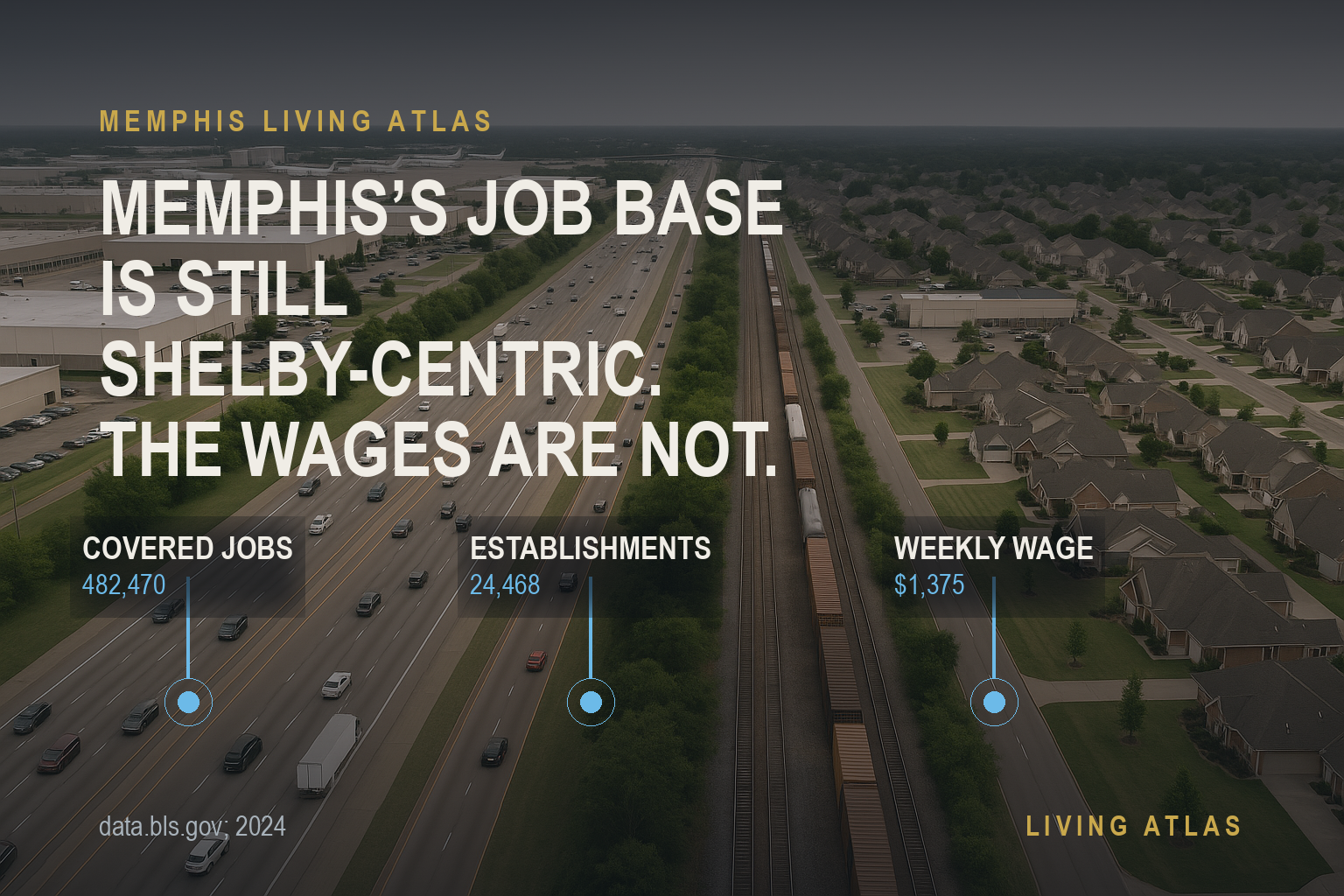
The covered employment picture is unambiguous: Shelby County, Tennessee accounts for the overwhelming majority of jobs in the Memphis metro’s core counties. In 2024, it held 482,470 covered jobs on an annual-average basis, with 24,468 business establishments operating in the county 11.
That dwarfs the employment bases of its neighbors. DeSoto County, Mississippi, just south of the state line, is the largest secondary node with 72,666 covered jobs and 3,754 establishments in 2024 22. Crittenden County, Arkansas to the west had 16,197 covered jobs and 1,096 establishments 33. Tipton and Fayette counties in Tennessee, along with Marshall and Tunica in Mississippi, are much smaller labor markets, each with on the order of five to twelve thousand covered jobs and well under 1,000 establishments apiece 44556677.
Put differently: the metro’s daily economic gravity still pulls toward Shelby County, with DeSoto as the clear second tier and the rest functioning as smaller satellites.
Wages rise at the core, but a Tennessee collar is emerging
Wages tell a more nuanced story than job counts. In 2024, Shelby County’s covered workers earned an average weekly wage of $1,375, on an annual-average basis 1. That is the region’s pay anchor.
But the highest-wage counties around Memphis are not uniformly the largest. Fayette County, east of Shelby on the Tennessee side, posted an average weekly wage of $1,098 in 2024, despite having only 8,093 covered jobs 55. Tipton County to the north averaged $967 a week on 11,848 covered jobs 44.
Across the state line, the pattern shifts. DeSoto County’s much larger job base pays materially less on average, at $879 a week in 2024 2. Marshall County, also in Mississippi, averaged $935 a week, while Tunica County’s covered workers earned $802 on average 67. Crittenden County, Arkansas sat roughly in the middle of this spread at $919 a week 3.
The pattern this data supports is a high-wage core in Shelby, a relatively higher-wage collar in its Tennessee neighbors, and a lower but still meaningful wage tier just across the Mississippi River and Mississippi state line.
Labor-market backdrop: a metro with depth, not a jobs spike
Metro-level labor data underscores that Memphis is a sizable but not red-hot labor market. For the Memphis, TN–MS–AR area, the Bureau of Labor Statistics reports a civilian labor force just under the mid-600,000s in early to mid-2026, with monthly values such as 629.2 and 630.2 (in thousands) over the February–May 2026 period 889. Employment ran only modestly lower, around 599.5 to 604.4 over the same months 89.
That gap translated into an unemployment rate fluctuating in the low- to mid-4 percent range, with reported values like 4.7, 4.2 and 4.1 percent across several 2026 months 9. Total nonfarm employment was reported in the high-600,000s—figures such as 648.8, 651.7 and 652.2 (in thousands) across early 2026 9.
This evidence supports the view that Memphis has a substantial, diversified employment base rather than a single shock of new jobs. It does not, on its own, show a breakout surge; instead it points to steady employment with unemployment rates that are neither extremely tight nor elevated.
A multibillion-dollar freight hub upgrade sits on top of this base
Layered on this labor and wage structure is a major capital project at one of the metro’s anchor employers. FedEx reports that it has approved an additional $450 million investment to accelerate modernization and expansion at the FedEx Express World Hub in Memphis, bringing the total value of the project announced since March 2018 to more than $1.5 billion 10.
According to the company, the Memphis World Hub currently employs about 11,000 team members and operates 163 aircraft gates, making it the largest sort facility in the FedEx Express network 10. FedEx attributes the additional spending to “growing customer demand” for its services 10. Tennessee Governor Bill Lee’s participation in the announcement underscores that state leadership is treating the hub’s expansion as a statewide economic priority 10.
These facts collectively establish that a large logistics employer is committing over a billion dollars of capital into an already dominant job center, rather than into a greenfield site elsewhere in the region.
Why this matters for where growth could show up next
If the FedEx hub modernization follows through at the announced scale, it reinforces the weight of high-wage jobs in and around Shelby County. The hub’s 11,000 existing roles sit on top of a county that already accounts for nearly half a million covered jobs and the highest average weekly wages in the region 1110.
One reasonable inference is that, if modernization increases throughput or shifts the skill mix toward higher-value roles, it could deepen the concentration of logistics, aviation and related services in Shelby County. That, in turn, could make nearby higher-wage Tennessee collars like Fayette and Tipton counties more attractive for industrial and residential development, given their combination of relatively strong wages and smaller existing job bases 5454.
A different, also plausible, scenario is that lower-wage but sizable counties such as DeSoto and Crittenden capture additional back-office, warehouse and supplier activity that values cheaper land or labor more than proximity to the highest-wage clusters 23. In that case, the wage gap visible in the 2024 data could widen even as total employment grows across the region.
In both scenarios, the FedEx hub project functions as an anchor: a confirmed, multi-year capital program at a single, extremely large employment site in the middle of a labor market with hundreds of thousands of existing jobs 11010. The open question is how far beyond the airport fence its effects will reach.
What this does not prove yet
The available evidence shows committed capital at the FedEx hub, current headcount there, and current wages and job counts across the core counties. It does not establish that thousands of additional jobs will materialize, that the Memphis metro is on the verge of a high-growth decade, or that any particular county will become the dominant next corridor for development. Those outcomes would require additional, future evidence such as sustained job growth, new employer announcements, or significant shifts in the wage distribution by county.
Any bull case for the region has to remain conditional on execution: that the hub upgrades are completed on time, that customer demand stays strong enough to support expanded operations, and that complementary investment in suppliers, housing and infrastructure actually follows.
What to watch next
- Hub modernization milestones. Construction progress, operational changes, or new equipment tied to the more than $1.5 billion FedEx investment would show how quickly the capital is turning into on-the-ground capacity 10.
- County-level wage shifts. Future QCEW releases will show whether average weekly wages in Fayette, Tipton, DeSoto and Crittenden counties move closer to—or further from—Shelby’s levels as the hub project advances 15423.
- Employment growth patterns. Changes in covered employment across the smaller counties, especially DeSoto, Marshall, Fayette and Tipton, would indicate whether new activity is dispersing or re-concentrating around the core 2654.
- Metro unemployment and labor force trends. Sustained tightening of the unemployment rate from its recent low- to mid-4 percent range, or a significant increase in the civilian labor force, would signal that the region is absorbing more workers rather than simply reshuffling existing ones 999.
- New employer and supplier announcements. Additional logistics, manufacturing or services projects that explicitly cite proximity to the Memphis hub or to Shelby County’s job base would provide concrete evidence of second-order effects.

Sources
- U.S. Bureau of Labor Statistics. Quarterly Census of Employment and Wages, annual averages — Shelby County, Tennessee. 2024 View source
- U.S. Bureau of Labor Statistics. Quarterly Census of Employment and Wages, annual averages — DeSoto County, Mississippi. 2024 View source
- U.S. Bureau of Labor Statistics. Quarterly Census of Employment and Wages, annual averages — Crittenden County, Arkansas. 2024 View source
- U.S. Bureau of Labor Statistics. Quarterly Census of Employment and Wages, annual averages — Tipton County, Tennessee. 2024 View source
- U.S. Bureau of Labor Statistics. Quarterly Census of Employment and Wages, annual averages — Fayette County, Tennessee. 2024 View source
- U.S. Bureau of Labor Statistics. Quarterly Census of Employment and Wages, annual averages — Marshall County, Mississippi. 2024 View source
- U.S. Bureau of Labor Statistics. Quarterly Census of Employment and Wages, annual averages — Tunica County, Mississippi. 2024 View source
- U.S. Bureau of Labor Statistics. Economy at a Glance View source
- U.S. Bureau of Labor Statistics. Tn memphis msa View source
- newsroom.fedex.com. Fedex express announces additional 450 million in memphis hub investment View source