
The Birmingham metro is adding large, specific anchors: a $1.1 billion food manufacturing complex at McCalla on the west side of Jefferson County and a growing cluster of research and medical projects anchored by UAB downtown. Together they sit on top of a labor market that is still concentrated in a few counties and pays noticeably more in the core than on its edges.
The story is not that a single factory or lab building will transform the region. It is whether these projects, if they execute as announced, start to pull opportunity into adjacent neighborhoods and counties that currently have smaller job bases and lower wages.
Jefferson and Shelby dominate the job base
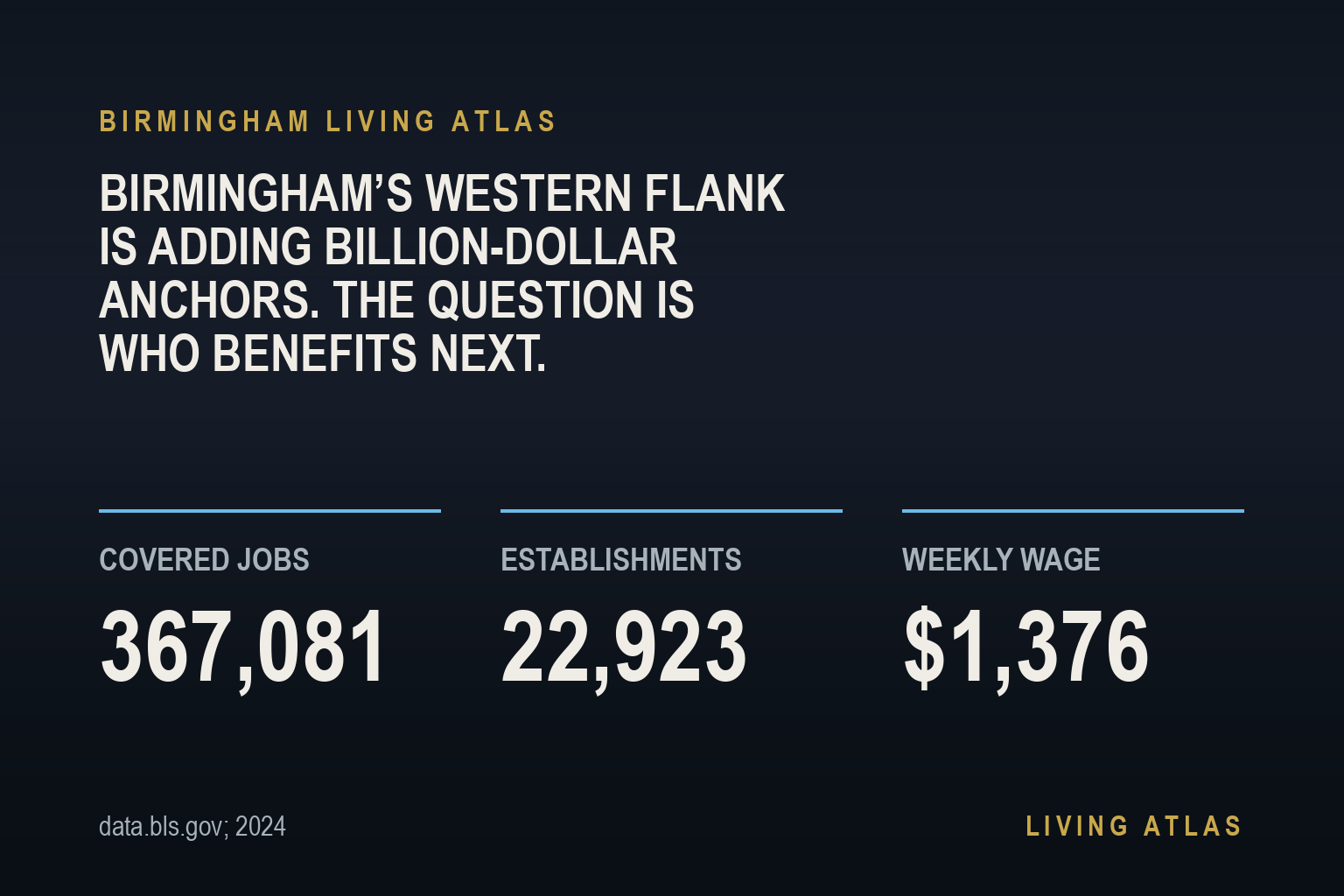
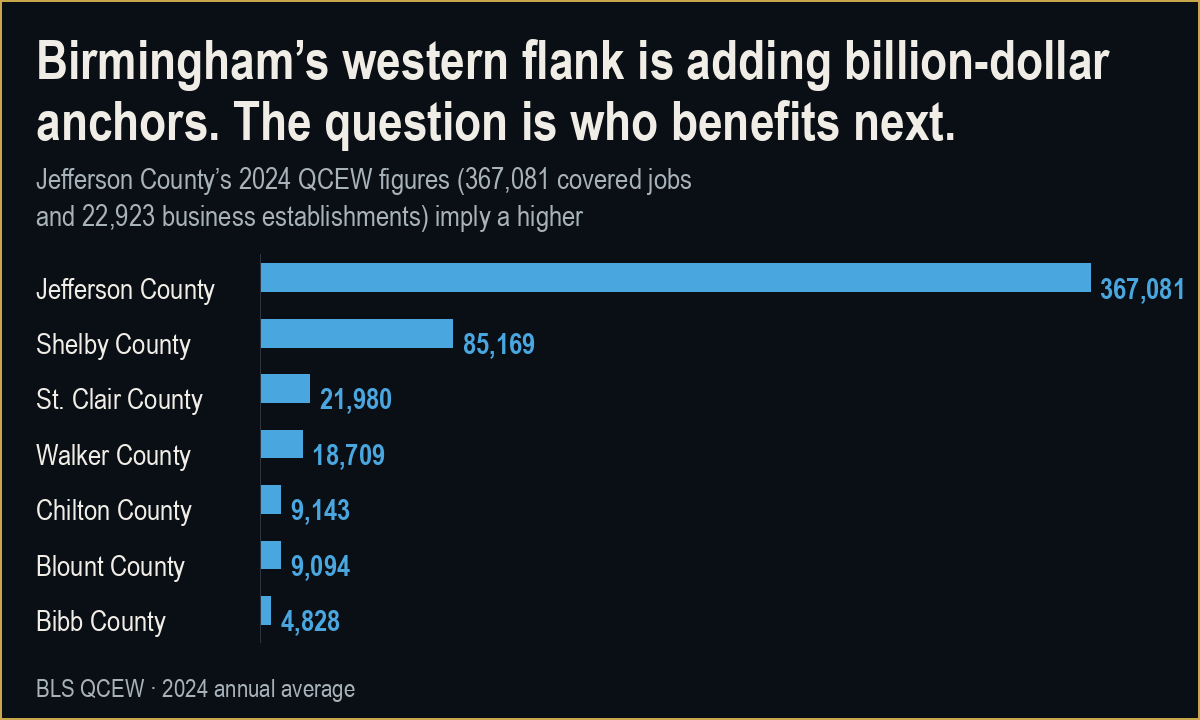
The Birmingham region’s employment is still heavily concentrated in Jefferson and Shelby counties. Jefferson County accounts for more than 360,000 covered jobs on an annual average basis in 2024, with 367,081 positions and nearly 23,000 business establishments. 11 Shelby County adds another mid‑80,000 jobs, at 85,169, and just over 7,200 establishments. 22
Those two counties together make up the overwhelming share of the metro’s formal employment base. The surrounding counties in the commuter shed are much smaller in comparison:
- St. Clair County has just under 22,000 covered jobs and about 1,900 establishments. 33
- Walker County is under 19,000 jobs, with roughly 1,500 establishments. 44
- Blount and Chilton counties each have on the order of 9,000 covered jobs and fewer than 1,000 establishments. 5566
- Bibb County — also within the broader orbit of Birmingham — has under 5,000 covered jobs and 445 establishments. 77
This pattern matters for real estate and development: most new capital will initially land where the jobs, employers and institutions already are. The question for investors and local governments is whether the next wave extends beyond Jefferson and Shelby or keeps reinforcing the existing core.
A $1.1 billion plant at McCalla tests the western edge
On the industrial side, one of the largest announced projects in Jefferson County is The J.M. Smucker Co.’s planned manufacturing facility in the McCalla area. According to the governor’s office, the company has announced a total financial investment of $1.1 billion for a facility to be built in three phases, with plans to create up to 750 jobs. 8
The timeline is staged. The company said construction was expected to begin no later than January 2022, with production planned to commence during calendar year 2025. 8 It also stated that investment and job creation would align with production milestones for each phase. 8 That places the project firmly in the announced plan category: there is a clear capital number, a schedule and a hiring target, but the realized headcount will depend on execution and demand at each stage.
If the facility ultimately reaches the stated 750 jobs, that would be material at the county level. Compared with Jefferson County’s existing 367,081 jobs, the plant on its own would represent roughly two‑tenths of one percent of today’s job base. 18 The impact is more visible when you zoom into the western side of the county and into neighboring Bibb and Walker, which currently have far smaller employment bases and fewer employers; a cluster of suppliers, logistics firms and services drawn to McCalla could move their numbers more meaningfully, even if the core countywide statistics barely budge at first.
UAB’s research build‑out reinforces the medical and academic core
Downtown, UAB is stacking up its own set of projects that combine state, local and institutional capital. One example is the Altec/Styslinger Genomic Medicine and Data Sciences Building. UAB reports that this project is funded through a mix of philanthropic gifts and public money: $50 million from the state of Alabama via the Public School and College Authority, $5 million from Jefferson County and $1 million from the city of Birmingham, alongside other institutional funds. 9
Another is the Biomedical Research and Psychology Building, described as a $190 million project supported by $152 million in federal funding, with the balance coming from UAB’s Heersink School of Medicine and the College of Arts and Sciences. 9 These are not direct jobs programs, but they are sizable physical commitments that lock in specialized uses in the urban core for years.
UAB links these buildings directly to its research and talent strategy. The university says that new and renovated research space brings state‑of‑the‑art technology, helps retain existing investigators and hire new ones, and opens additional public and private funding opportunities. 10 It also states that development of the physical campus affects recruitment and retention of students, faculty and staff by providing updated spaces to live, study and work. 10
On the health‑care side, UAB Hospital is reporting sustained pressure on its emergency department. The hospital says UED patient volume has grown 20 percent over the last five years and that it expects further growth in the next five. 11 In response, temporary expansion renovations began in June 2023 to create nine new exam rooms and temporary waiting space within the North Pavilion. 11 In August 2023, UAB planned to install two leased mobile treatment units along 18th Avenue South, adding 16 treatment spaces. 11
Together, these research and clinical projects illustrate a pattern: public and institutional dollars are thickening an already dense medical and academic district in the center of the city. The likely effects include more construction, specialized office and lab demand, and continued pull for high‑skill workers into the urban core, rather than a spreading out of that activity.
Wage gaps show why the location of growth matters
Average weekly wage data underline how different parts of the region participate in growth today. In 2024, the average covered worker in Jefferson County earns $1,376 per week, and Shelby County workers average $1,284. 12
Neighboring counties sit noticeably lower:
- St. Clair County’s average weekly wage is $989. 3
- Walker County averages $936 a week. 4
- Chilton County averages $915. 6
- Blount County averages $879. 5
- Bibb County, despite its smaller job base, is at $1,020. 7
Those gaps mean a job created in Jefferson or Shelby is, on average, a higher‑wage job than one created in many of the surrounding counties. If McCalla’s industrial build‑out and UAB’s research complex continue to concentrate growth inside Jefferson County lines, wage convergence with outlying counties is not automatic. On the other hand, if suppliers, logistics firms and service providers begin to locate in places like Bibb, Walker or St. Clair to serve these anchors, the wage floor in those counties could move up from a relatively low base.
City economic policy is trying to connect people and projects
The City of Birmingham’s Department of Innovation and Economic Opportunity presents itself as a connector between residents, businesses and investment. The department says it is “shaping Birmingham’s future by connecting our people, businesses, assets, and opportunities to the markets and investments that drive sustainable growth.” 12 It lists its activities as strengthening homegrown businesses, attracting and retaining high‑growth industries, cultivating a skilled workforce and positioning Birmingham for new investment and development. 12
In terms of outcomes, the department describes a goal of “a resilient, opportunity‑rich economy where businesses can grow, talent can thrive” and Birmingham can compete for innovation‑driven activity. 12 For residents, it states a commitment to “building pathways toward economic mobility” and trying to ensure that citywide growth leads to tangible opportunities across neighborhoods. 12
This is aspirational language from the agency itself, not a measurement of results. What the verified data show is the current map of employment and wages; whether that mission translates into more even distribution of job growth will show up over time in the same county‑level numbers now available for 2024.
What a next phase of growth could look like — and what has to go right
If the Smucker’s complex is built out through all three phases as announced, and if UAB continues to land large research and health‑care projects, one plausible scenario is that Birmingham’s west‑side industrial corridor and downtown medical district become mutually reinforcing anchors. In that case, we would expect to see:
- Supplier and logistics activity around McCalla, with spillover hiring pressure into Bibb, Walker and western Jefferson.
- Continued expansion of construction, lab and clinical employment around UAB’s campus.
- Incremental wage growth in lower‑wage counties that capture satellite facilities, distribution centers or services.
For that scenario to materialize, several conditions would need to hold. The Smucker’s facility would need to reach its planned production milestones and hiring levels. 888 UAB would need to complete and program its new buildings in a way that attracts and retains the investigators and students it is targeting. 1010 Local governments would have to maintain infrastructure and permitting conditions that make adjacent sites viable for private investors.
If announced industrial and research investments stall, automate more heavily than expected, or remain geographically isolated from lower‑wage counties, the gap in wages and employment density across the region could persist or widen. The county‑level job and wage data used here provide a baseline against which to test how inclusive the next decade of capital deployment actually becomes.
What to watch next
- Smucker’s hiring ramp: Actual job counts at the McCalla facility relative to the “up to 750 jobs” target, and the timing of each phase versus the 2025 production timeline. 888
- Supplier announcements around McCalla: New industrial, logistics or food‑processing tenants within a short drive of the plant, especially in Bibb, Walker and western Jefferson.
- Delivery of UAB capital projects: Construction milestones, openings and tenanting for the Genomic Medicine and Data Sciences Building and the Biomedical Research and Psychology Building. 99
- County wage convergence (or divergence): Changes in average weekly wages for St. Clair, Walker, Blount, Bibb and Chilton relative to Jefferson and Shelby over the next several QCEW releases. 1234657
- UAB Hospital demand pressure: Whether UED volumes continue to grow beyond the reported 20 percent five‑year increase, and how that translates into permanent space, staffing and nearby development. 111111
Sources
- U.S. Bureau of Labor Statistics. Quarterly Census of Employment and Wages, annual averages — Jefferson County, Alabama. 2024 View source
- U.S. Bureau of Labor Statistics. Quarterly Census of Employment and Wages, annual averages — Shelby County, Alabama. 2024 View source
- U.S. Bureau of Labor Statistics. Quarterly Census of Employment and Wages, annual averages — St. Clair County, Alabama. 2024 View source
- U.S. Bureau of Labor Statistics. Quarterly Census of Employment and Wages, annual averages — Walker County, Alabama. 2024 View source
- U.S. Bureau of Labor Statistics. Quarterly Census of Employment and Wages, annual averages — Blount County, Alabama. 2024 View source
- U.S. Bureau of Labor Statistics. Quarterly Census of Employment and Wages, annual averages — Chilton County, Alabama. 2024 View source
- U.S. Bureau of Labor Statistics. Quarterly Census of Employment and Wages, annual averages — Bibb County, Alabama. 2024 View source
- Office of the Governor of Alabama. Governor ivey announces the j m smucker co to build alabama manufacturing plant creating up to 750 jobs in birmingham View source
- University of Alabama at Birmingham. Uab continues to transform through 14 new construction and renovation projects View source
- University of Alabama at Birmingham. Uab s 12 new construction and renovation projects transforming campus supporting strategic initiatives View source
- University of Alabama at Birmingham. Uab hospital emergency department to expand with state support View source
- City of Birmingham. Department innovation economic opportunity View source