
Memphis’s labor market is still defined by Shelby County, but the economic story is broader than one county line. New automation at the FedEx World Hub and a slowly widening ring of employers in nearby Tennessee, Mississippi and Arkansas counties suggest a freight-centered region that is modernizing even as core employment growth in Shelby has been flat to slightly negative.
Shelby County remains the center of gravity
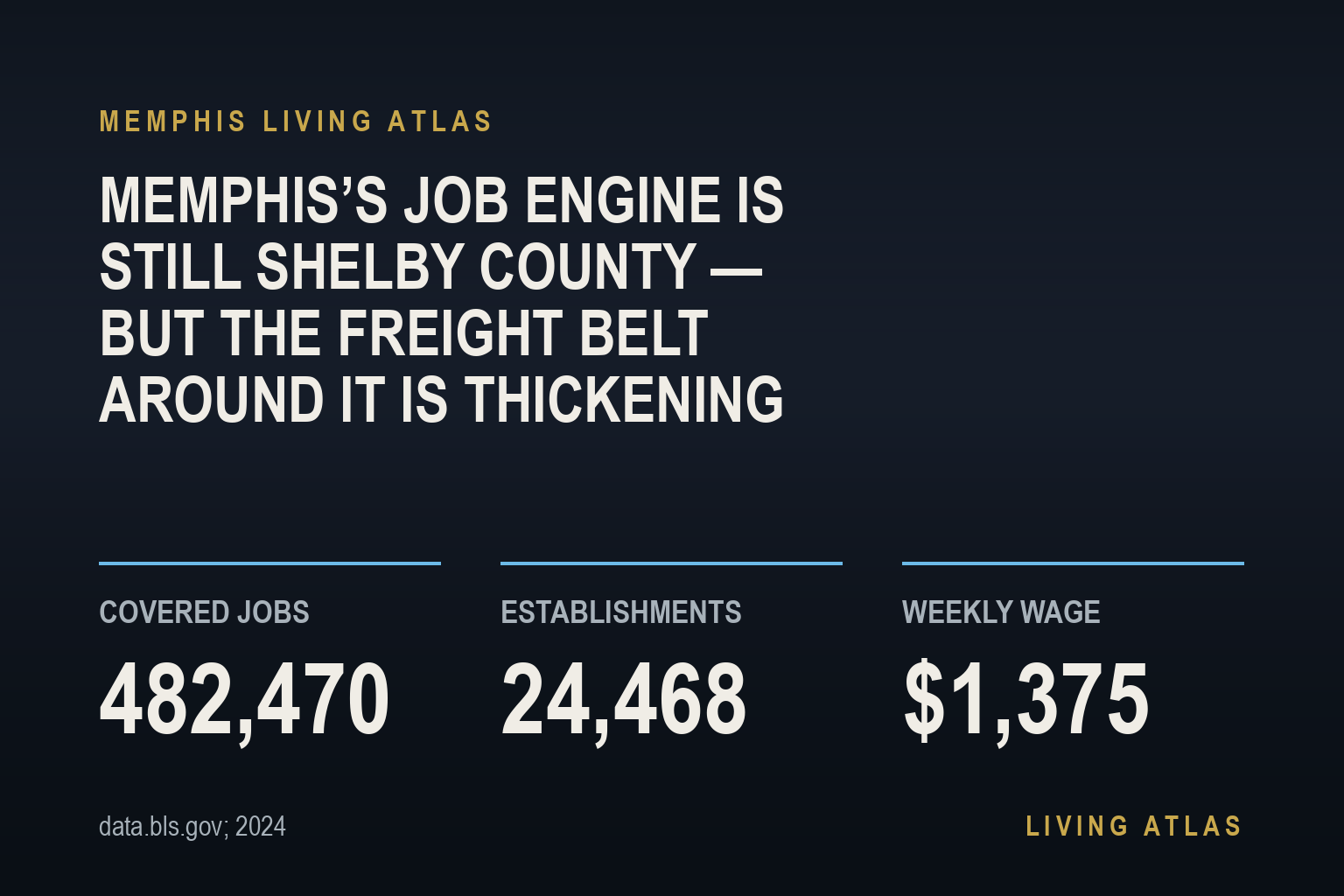
Shelby County carries the overwhelming share of covered employment in the Memphis area: in 2024 it supported 482,470 covered jobs and 24,468 business establishments on average, according to QCEW data from the Bureau of Labor Statistics 11. Average weekly pay in the county reached $1,375, up from $1,291 in 2022, signaling wage growth even as the job count edged down over the same period 11.
The broader Memphis metro labor market in 2026 shows a civilian labor force of just under 630,000 people between February and May, with roughly 600,000 employed and unemployment in the high‑20‑thousands to low‑30‑thousands range, producing unemployment rates around 4–5 percent 2222. Those metro‑level figures reinforce that Shelby County’s employment base is the backbone of the region’s day‑to‑day labor market.
The job ring around Memphis is small but present
Outside Shelby County, employment is much thinner but not negligible. On the Tennessee side, Tipton County supported 11,848 covered jobs and 962 establishments in 2024, with workers earning an average weekly wage of $967 333. Fayette County, directly east of Shelby, had 8,093 covered jobs, 823 establishments, and an average weekly wage of $1,098 444.
Across the Mississippi line, DeSoto County stands out as the single strongest suburban employment base around Memphis. By 2024 it accounted for 72,666 covered jobs and 3,754 business establishments, with average weekly wages of $879 555. Marshall County, east of DeSoto, is smaller but growing on a lower base; its covered employment rose from 10,660 in 2022 to 11,291 in 2024, alongside an increase in establishments from 511 to 566 and a move in average weekly wage from $865 to $935 666.
Further south, Tunica County’s employment base is modest: 5,799 covered jobs and 270 establishments in 2024, with average weekly pay of $802 777. To the west, Crittenden County in Arkansas supported 16,197 covered jobs, 1,096 establishments, and a $919 average weekly wage in 2024 888.
The pattern is clear from these numbers: Shelby is the dominant job center; DeSoto has emerged as a substantial secondary node; Crittenden, Tipton, Marshall, Fayette and Tunica round out a thinner but real commuter and employer belt around the core.
FedEx’s hub automation raises a key question: more throughput, but how many jobs?
One of the most concrete recent changes to the region’s logistics infrastructure is inside the Memphis World Hub. FedEx has brought a new automated sorting facility online there, described by the company as a LEED‑certified building spanning 1.3 million square feet across four levels, with 11 miles of conveyor belt and a sorting capacity of 56,000 packages per hour 9. The company states that this facility alone can handle more than half the volume from the primary sort, reducing sort times and allowing packages to be processed in one building during weather events 99.
FedEx frames the project as part of a broader effort to modernize the hub and, in its words, to support customers with what it calls a flexible and efficient logistics network 9. Those are the company’s claims, not independently verified outcomes. What the facts do establish is a step‑change in the technical capacity and automation level at one of Memphis’s anchor facilities.
From a regional development perspective, that creates a tension the data does not yet resolve: higher throughput does not automatically mean more jobs. The QCEW figures show modest declines in Shelby County covered employment from 2022 to 2024, even as wages rose 11. Without specific headcount data tied to the new facility, it remains uncertain whether hub modernization will drive net employment growth, shift job roles toward higher‑skill positions, or primarily increase capital intensity without large hiring waves.
Why this matters for the next cycle of growth
The surrounding counties’ employment and establishment trends offer some clues to where spillover effects could land if Memphis’s logistics and manufacturing base continues to modernize.
- DeSoto County’s combination of more than 70,000 covered jobs, rising establishment counts, and mid‑range weekly wages positions it as a key suburban employment center linked to Memphis’s freight and distribution economy 555.
- Marshall County’s steadily growing job and employer base on a smaller scale suggests it may be picking up industrial and logistics activity that does not fit in higher‑cost or more built‑out areas closer to the core 66.
- Crittenden County’s roughly 16,000 covered jobs and 1,096 establishments illustrate a meaningful but still secondary Arkansas‑side role in the regional labor market 88.
If additional logistics, manufacturing or supplier investments follow FedEx’s hub modernization, one reasonable inference is that demand for industrial sites and labor could grow both in Shelby County and along these adjacent corridors. That in turn could tighten nearby housing markets and support more neighborhood‑scale retail and services. However, the current evidence set does not quantify any such next‑round investments or their timing, so this remains a conditional scenario rather than a documented trend.
What would have to go right for a broader Memphis freight corridor to emerge?
The existing data supports a narrow but testable thesis: Memphis already has a large, wage‑growing core employment base in Shelby County, a substantial secondary base in DeSoto County, and a set of smaller but non‑trivial employment nodes in neighboring counties 1583476. FedEx has materially upgraded its hub infrastructure with a highly automated facility capable of processing a large share of its primary sort volume 99.
For this to compound into a broader regional growth story over the coming decade, several things would need to happen beyond what the evidence currently shows:
- Additional employers in freight‑linked sectors would need to commit and build, using the hub’s enhanced capabilities as part of their location case. The present evidence does not document such commitments.
- Headcount and payroll at existing facilities would need to grow in ways that measurably change the QCEW employment and wage profiles by county. At this point, the most recent QCEW data shows Shelby County employment slightly down and neighboring counties growing only on modest bases 16.
- Housing, retail and services in the path of this activity would need to respond, which would show up in building permits, housing starts and new establishment counts. The current evidence only captures the employer side through 2024, not the built environment response.
Absent those steps, the region may see efficiency and resilience gains from hub automation without a corresponding acceleration in job creation or broad‑based real estate pressure.
What to watch next
Several concrete indicators would help confirm or challenge the idea that Memphis is building toward a stronger freight‑driven growth cycle:
- QCEW employment and establishment trends after 2024. Do Shelby, DeSoto, Crittenden, Marshall, Fayette, Tipton and Tunica counties show a noticeable upshift in covered jobs or employer counts relative to their 2022–2024 trajectories? 1586347
- Average weekly wages by county. Do wages continue to rise in Shelby and surrounding counties, and does that wage growth begin to correlate with new industrial and logistics activity rather than just inflation or compositional shifts? 1586347
- Labor‑force and unemployment data for the Memphis MSA. Do the civilian labor force and employment counts in 2026 and beyond break out of their current range and push unemployment below recent 4–5 percent levels in a sustained way? 2222
- Documented supplier, warehouse and manufacturing projects tied to the hub. Future evidence of committed facilities that explicitly cite the modernized Memphis World Hub as a reason to locate would strengthen the case that hub investments are catalyzing broader regional development.
- Housing and land‑use responses in DeSoto, Marshall and Crittenden counties. While we do not yet have those data here, a future rise in residential permits and local services would be a visible marker that job growth is translating into neighborhood‑level change.
For now, the numbers show a large, wage‑growing employment core in Shelby County, a meaningful freight‑linked suburban belt, and a major logistics facility that has become more automated and capable. Whether that combination marks the start of a different growth cycle, or simply a more efficient version of the status quo, is a question the next few years of data will have to answer.

Sources
- U.S. Bureau of Labor Statistics. Quarterly Census of Employment and Wages, annual averages — Shelby County, Tennessee. 2024 View source
- U.S. Bureau of Labor Statistics. Economy at a Glance View source
- U.S. Bureau of Labor Statistics. Quarterly Census of Employment and Wages, annual averages — Tipton County, Tennessee. 2024 View source
- U.S. Bureau of Labor Statistics. Quarterly Census of Employment and Wages, annual averages — Fayette County, Tennessee. 2024 View source
- U.S. Bureau of Labor Statistics. Quarterly Census of Employment and Wages, annual averages — DeSoto County, Mississippi. 2024 View source
- U.S. Bureau of Labor Statistics. Quarterly Census of Employment and Wages, annual averages — Marshall County, Mississippi. 2024 View source
- U.S. Bureau of Labor Statistics. Quarterly Census of Employment and Wages, annual averages — Tunica County, Mississippi. 2024 View source
- U.S. Bureau of Labor Statistics. Quarterly Census of Employment and Wages, annual averages — Crittenden County, Arkansas. 2024 View source
- newsroom.fedex.com. Fedex unveils new automated sorting facility at memphis world hub View source