
Birmingham is starting to redraw its industrial map not with a factory announcement, but with paperwork, environmental tests and a long-ignored stretch of riverfront.
The city has secured a $2 million grant from the State of Alabama to begin turning its Western Corridor into what officials describe as a major logistics and manufacturing center. The money comes through the SEEDS Act, a state program that “helps prepare large sites for economic development.” 11
On its face, $2 million is modest in a metro that supports hundreds of thousands of covered jobs. The significance is where it lands and what it is allowed to pay for.
Turning a former steel works and a river port into developable land
The grant’s first phase is tightly scoped: the city will create a master plan and conduct environmental studies for roughly 500 acres at the former U.S. Steel Ensley Works site, and make improvements at the Birmingport facility on the Black Warrior River. 1 Those are preparatory steps, not shovels in the ground, but they are often what determine whether private capital can move later.
City materials say the goal is to build on Birmingham’s transportation network — interstates, rail lines, air travel and waterways — to attract new businesses. 1 That is an announced plan, not yet an outcome, but it does locate the Western Corridor squarely in the region’s freight and manufacturing story rather than treating it as a separate, distressed geography.
The job base today: concentrated in Jefferson, thin but spreading around it
Any claim that the Western Corridor could matter for the broader metro has to start with where the jobs already are.
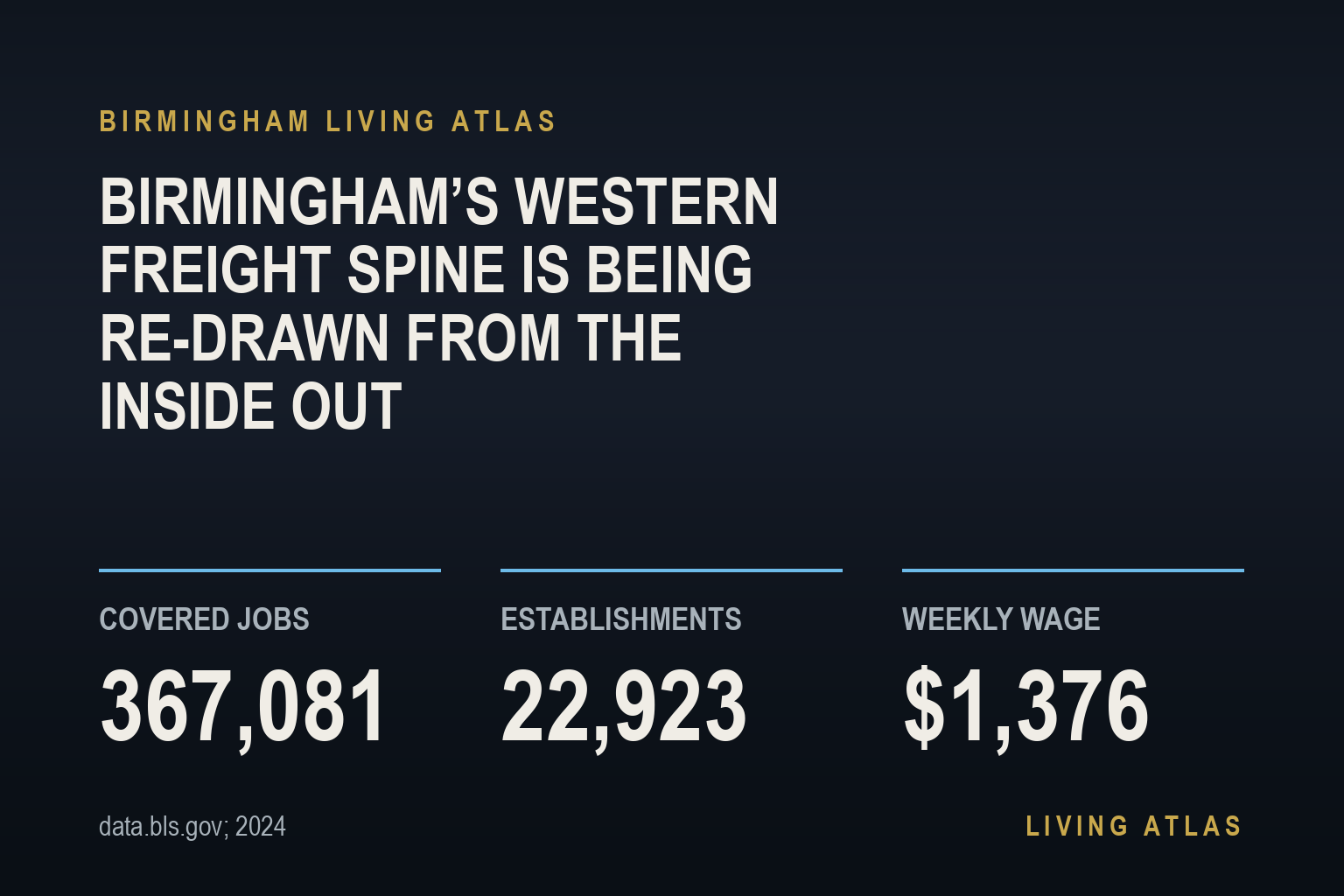
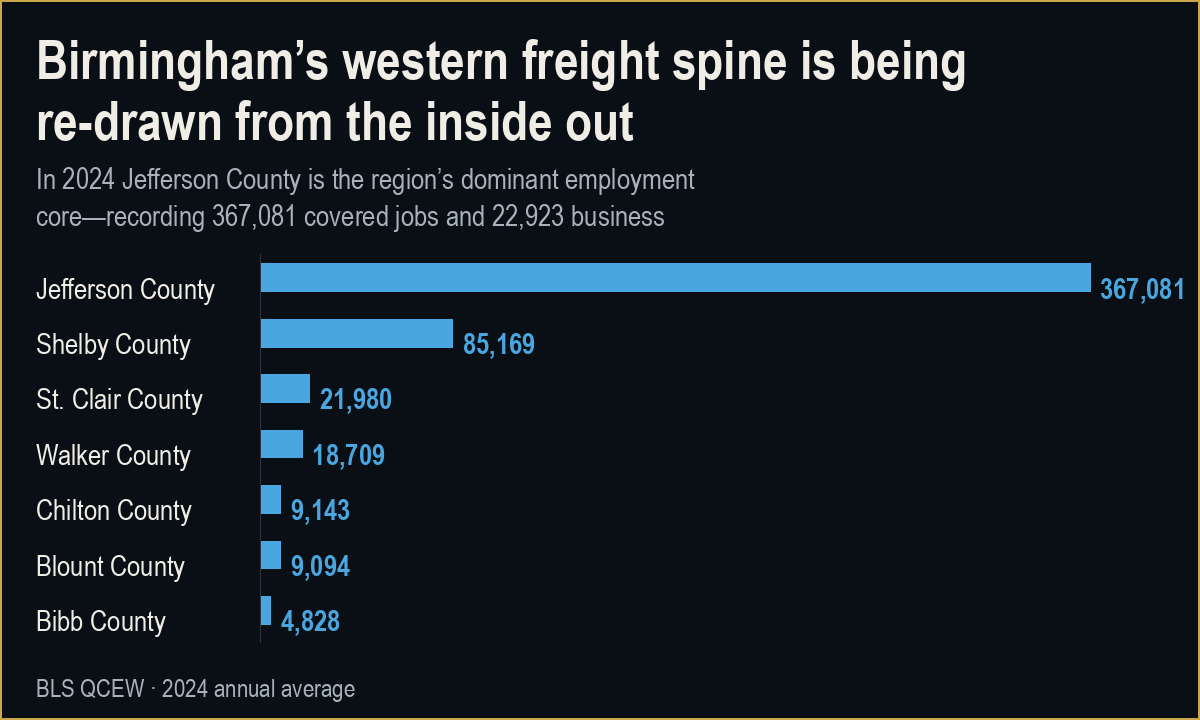
Jefferson County, which includes Birmingham, accounts for the overwhelming share of covered employment in the region. In 2024, it supported 367,081 covered jobs and 22,923 business establishments. 22 Average weekly wages there were $1,376. 2
A ring of smaller counties forms the rest of the metro’s employment picture:
- Shelby County had 85,169 covered jobs in 2024 and 7,251 establishments, with an average weekly wage of $1,284. 333
- St. Clair County supported 21,980 covered jobs and 1,943 establishments, with an average weekly wage of $989. 444
- Walker County had 18,709 covered jobs and 1,536 establishments, paying an average of $936 per week. 555
- Blount County recorded 9,094 covered jobs and 956 establishments, with an average weekly wage of $879. 666
- Chilton County had 9,143 covered jobs and 922 establishments, with an average weekly wage of $915. 777
- Bibb County supported 4,828 covered jobs and 445 establishments, with an average weekly wage of $1,020. 888
The pattern is clear: Jefferson County dominates the job base, Shelby is the largest secondary node, and the other counties operate at a much smaller scale. The Western Corridor initiative is happening inside Jefferson, but its freight connections and river access mean any new industrial or logistics activity there could spill into supplier, warehousing or service demand in those smaller counties over time. That is an inference, not a measured effect; the current data only establish today’s distribution of jobs and wages.
Site prep as the quiet precondition for private investment
The SEEDS Act funding is not itself a factory, a warehouse or a research building. It pays for the work investors often insist on before they will commit: environmental due diligence, master planning and basic infrastructure. 11
If those steps are completed as described, one reasonable scenario is that the 500-acre Ensley site and Birmingport become “shovel-ready” in a way they are not today. That could lower the barrier for logistics operators, manufacturers or large tenants who require assembled land, clear environmental status and documented transport connections. Whether that scenario materializes will depend on decisions that have not happened yet — including how the plan zones and services the land, and whether the region can compete for projects relative to other prepared sites in Alabama.
How this links back to Birmingham’s research and healthcare engine
The Western Corridor grant sits alongside a different but related kind of investment: new and renovated research facilities at the University of Alabama at Birmingham.
UAB describes its current wave of construction and renovation as a way to bring “state-of-the-art technology” to campus, retain existing researchers, hire new investigators, expand its research portfolio and impact, and create additional public and private funding opportunities. 9 That is UAB’s own framing of its strategy, not an assurance of specific economic outcomes, but it underscores that the campus is actively increasing its research capacity.
A plausible connection between these two threads is that a stronger research and healthcare complex in the urban core, combined with a prepared industrial-and-logistics corridor to the west, gives the metro a more complete value proposition for certain industries — for example, life-science manufacturing, specialized medical supplies, or data-heavy services that need both research proximity and freight access. The evidence here supports the inputs (site prep work and research expansion), not the downstream projects; any such link remains a scenario until specific tenants or plants are announced.
What this implies for property and corridor strategy
For property owners, developers and operators, the near-term impact of the Western Corridor grant is mostly directional rather than immediate:
- The Ensley and Birmingport areas are entering a multi-year planning and entitlement process funded by the state, which is a concrete signal that these locations are being positioned for future industrial and logistics uses. 11
- Jefferson County’s role as the dominant employment hub — with higher average weekly wages than neighboring counties — suggests that any successful redevelopment there has an outsized potential to shape the region’s wage and job mix. 22
- Smaller surrounding counties show steady but modest employment and establishment counts; Walker, St. Clair, Blount, Chilton and Bibb together still host far fewer jobs than Jefferson alone. 54678 If the Western Corridor eventually lands large-scale employers, those counties could see follow-on demand, but the data do not yet show such an effect.
Because this is early-stage site preparation, the risk side is straightforward: if no significant private projects follow, the Western Corridor remains largely what it is today, and Jefferson’s employment dominance continues without a new logistics-manufacturing node on its western flank.
What to watch next
The story here is not that Birmingham has already converted its western edge into a new industrial powerhouse — the evidence does not support that claim. The story is that the city and state are spending real money to make that outcome possible, in a metro where jobs are heavily concentrated in a single county and a major research institution is expanding its footprint.
Concrete indicators that will show whether this early work is compounding include:
- Completion of the Ensley master plan and environmental studies, and whether they clear or surface major barriers to industrial or logistics development. 1
- Specific infrastructure improvements at Birmingport and whether they change the facility’s capacity or attractiveness for new operators. 1
- Announcements of private projects — industrial, logistics or related uses — that explicitly cite the prepared Western Corridor sites as a reason for locating in Birmingham. (No such announcements are in the evidence set today.)
- Further UAB research construction or partnership deals that connect campus expansion to commercial or industrial activity off campus, including in freight-accessible corridors. 9
- Shifts in employment and establishment counts within Jefferson and its neighboring counties that would indicate new clusters of jobs forming once projects, if any, come online. 2345678
Until those milestones appear, the Western Corridor is best understood as a test case for whether targeted public site preparation — at a legacy industrial site and a river port — can nudge Birmingham’s next wave of jobs into a different part of the map.
Sources
- City of Birmingham. City birmingham ignites western corridor transformation 2 million seeds act grant View source
- U.S. Bureau of Labor Statistics. Quarterly Census of Employment and Wages, annual averages — Jefferson County, Alabama. 2024 View source
- U.S. Bureau of Labor Statistics. Quarterly Census of Employment and Wages, annual averages — Shelby County, Alabama. 2024 View source
- U.S. Bureau of Labor Statistics. Quarterly Census of Employment and Wages, annual averages — St. Clair County, Alabama. 2024 View source
- U.S. Bureau of Labor Statistics. Quarterly Census of Employment and Wages, annual averages — Walker County, Alabama. 2024 View source
- U.S. Bureau of Labor Statistics. Quarterly Census of Employment and Wages, annual averages — Blount County, Alabama. 2024 View source
- U.S. Bureau of Labor Statistics. Quarterly Census of Employment and Wages, annual averages — Chilton County, Alabama. 2024 View source
- U.S. Bureau of Labor Statistics. Quarterly Census of Employment and Wages, annual averages — Bibb County, Alabama. 2024 View source
- University of Alabama at Birmingham. Uab s 12 new construction and renovation projects transforming campus supporting strategic initiatives View source