
Birmingham has two Choice Neighborhoods. One of them is pouring concrete. The other is still deciding what to build. The difference between them is a hundred times the money, and almost nobody explains it.
What HUD actually awarded, and to whom
HUD publishes its Choice Neighborhoods planning grants as a list. The Birmingham line reads: FY 2024, lead grantee the Housing Authority of the Birmingham District, target housing Rev. Dr. Morrell Todd Homes and Anderson Court, target neighborhood Kingston-Woodlawn, grant amount $500,000.1
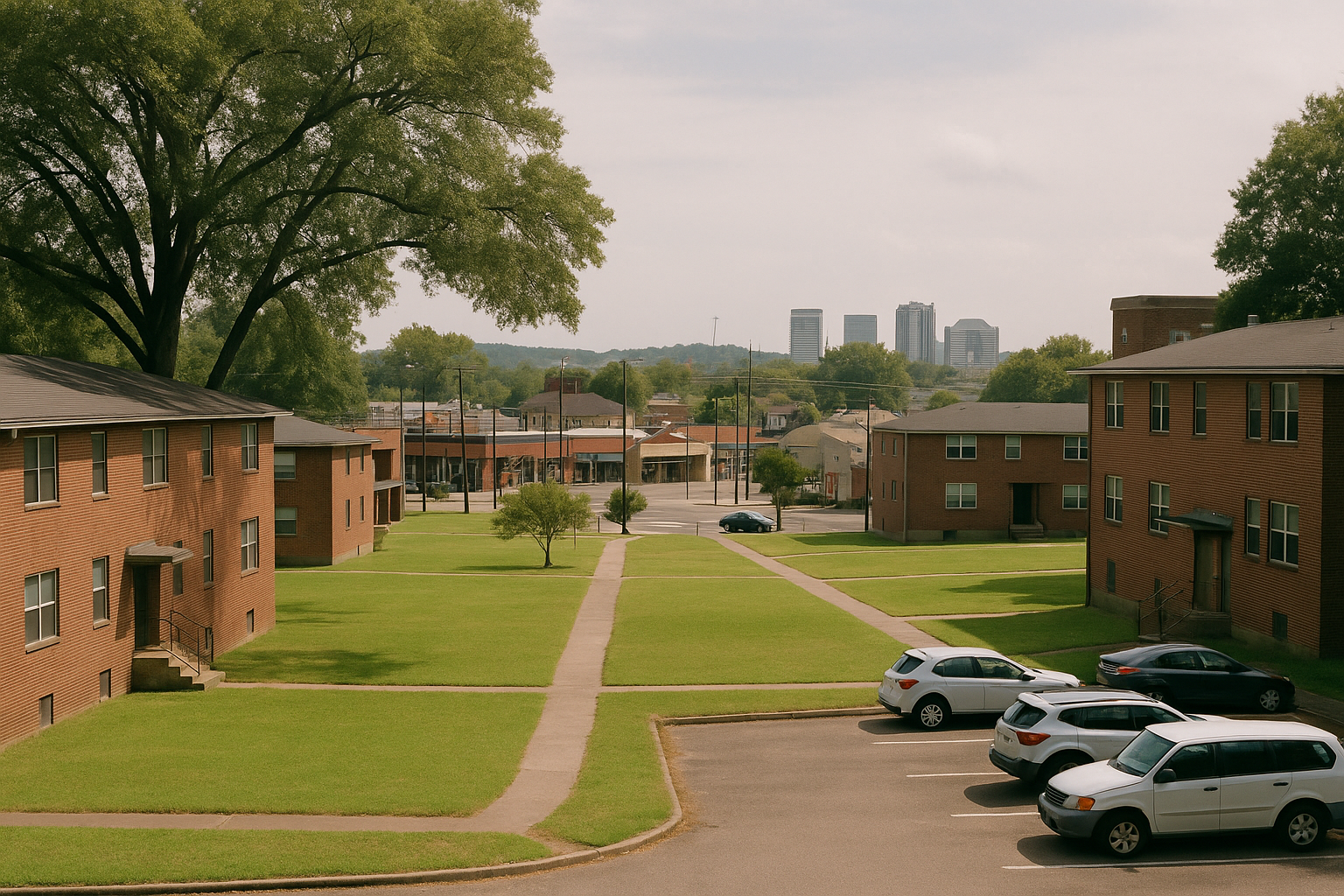
Two details there are worth pausing on, because most local coverage has compressed them. The award is not Woodlawn alone — HUD names the target neighborhood as Kingston-Woodlawn. And the target housing is not one property but two: Morrell Todd Homes, a roughly 456-unit community built in the 1950s, together with Anderson Court.1,2
Smithfield’s award is a different instrument entirely. In July 2023 HABD and the City of Birmingham received a $50 million Choice Neighborhoods Implementation Grant for Smithfield-College Hills-Graymont — the first in Alabama.3
The distinctionSmithfield holds an implementation grant and is building. Kingston-Woodlawn holds a planning grant and is writing a plan. Same program, different rung, hundredfold difference in money.
The ladder, and why the rung matters
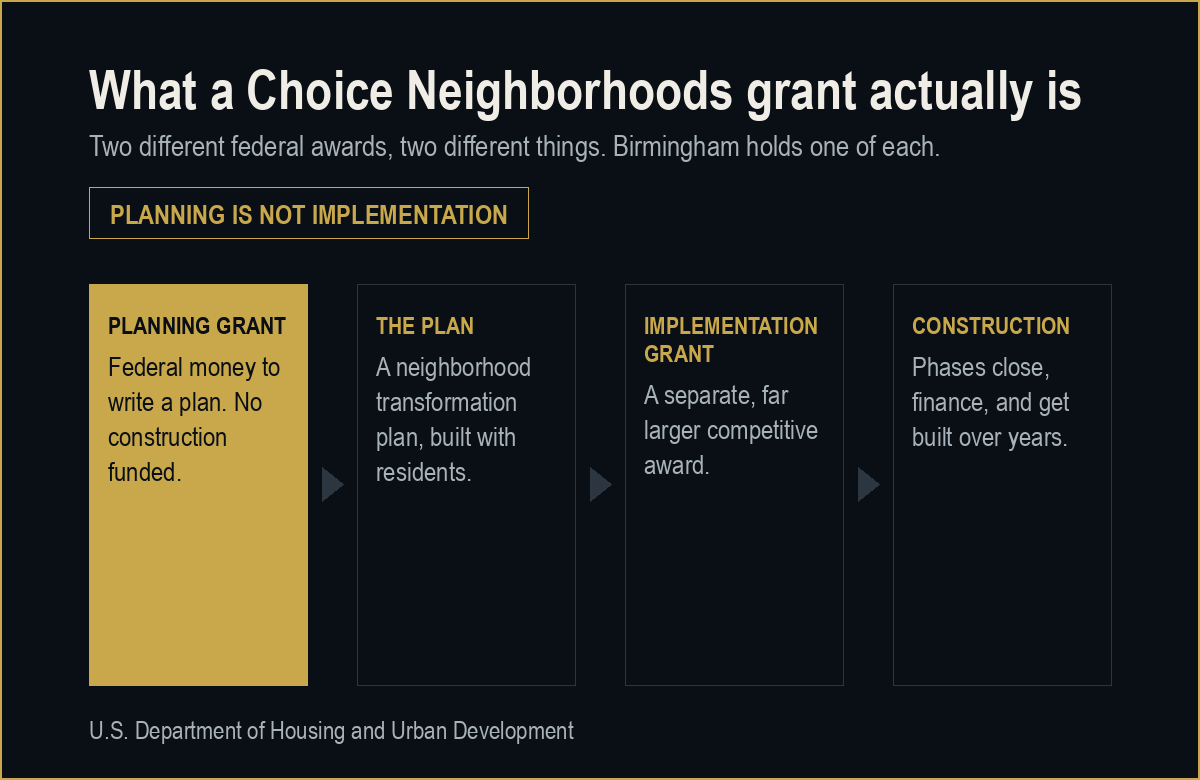
Choice Neighborhoods is a two-rung program by design. A planning grant funds the work of producing a neighborhood transformation plan with residents: the surveys, the design work, the partnership agreements, the housing strategy. It funds no construction. Its output is a document and a coalition.
An implementation grant is a separate, far larger, separately competitive award — and having a plan does not entitle you to one. It is the rung most planning grantees never reach.
HUD’s September 2024 list carries 123 planning grants stretching back more than a decade.1 Some became implementation neighborhoods. Many did not. Alabama’s own history is on that list: Huntsville, Mobile twice, Montgomery, Phenix City, Selma — and now Birmingham.1
Where each one actually stands
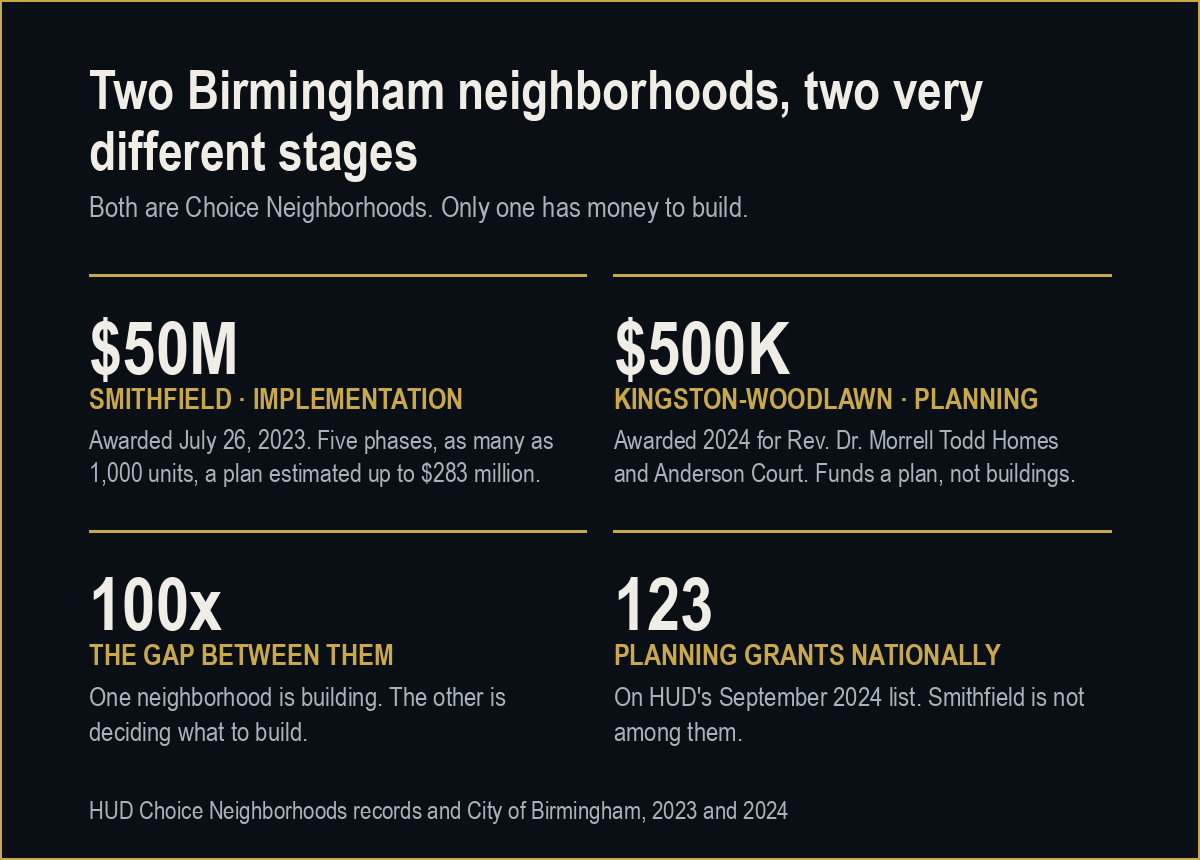
Smithfield has a five-phase build-out estimated at as much as $283 million, replacing Smithfield Court with as many as 1,000 mixed-income units. Phase 1 — the conversion of the former Graymont Elementary School into 101 senior units — is done. Phase 2, 151 units, was still working toward closing as of May 2026, when the City Council granted a six-month extension so the partnership could close on the property and start construction.3,4
Kingston-Woodlawn has a planning grant, a named target, and a partner: HABD is working with Woodlawn United on the planning process.2 There is no phase table, no unit count, no developer and no construction date, because producing those is what the $500,000 is for.
HUD's own planning-grant list naming the grantee, both target properties, the Kingston-Woodlawn target neighborhood and the $500,000 amount. Smithfield's $50 million implementation award, its phase structure, and the May 2026 extension on Phase 2.
Any Kingston-Woodlawn unit count, developer, phase plan, demolition or construction date. Whether the planning process will produce an implementation application at all, and whether it would win.
What each stage means if you have money in the ground
For residents of Morrell Todd Homes and Anderson Court, the near-term reality is meetings, not moving trucks. The value of being at the planning stage is that residents can still shape what gets proposed — which is precisely the leverage that disappears once a plan is fixed.
For property owners and developers around Kingston and Woodlawn, a planning grant is a signal about intent and about institutional capacity, not about capital. It says HABD intends to pursue transformation here and that HUD thought the case was strong enough to fund the work. It does not say when, how many units, or on which parcels.
For anyone underwriting Smithfield, the useful lesson runs the other way. Even with $50 million committed and a plan complete, a phase labeled 2024 needed a schedule extension in 2026. Implementation is slower than the award announcement suggests, and the gap between the two is where most misjudgements about these neighborhoods get made.
ELM Property Management manages rental property in Birmingham. We follow the difference between a planning grant and an implementation grant closely, because it is the difference between a neighborhood that will change on a known schedule and one that might change on an unknown one.
Sources
- U.S. Department of Housing and Urban Development. Choice Neighborhoods Planning Grant List, September 2024. 2024 View source
- WBRC. Housing Authority wins $500,000 planning grant for Dr. Morrell Todd Homes community. September 18, 2024 View source
- City of Birmingham. HUD Awards $370 Million in Choice Neighborhoods Implementation Grant Awards. 2023 View source
- BirminghamWatch. Smithfield Affordable Housing Project Gets Six-Month Extension From Birmingham City Council. May 26, 2026 View source