
Three years ago Birmingham won the largest federal neighborhood grant in the state’s history. The honest answer to what it has produced so far is: one converted school, a land transfer, and a deadline extension.
That is not a criticism. It is what a $283 million redevelopment looks like at year three, and it is a far more useful thing for a property owner or a resident to understand than a ribbon-cutting photo.
What the grant actually is
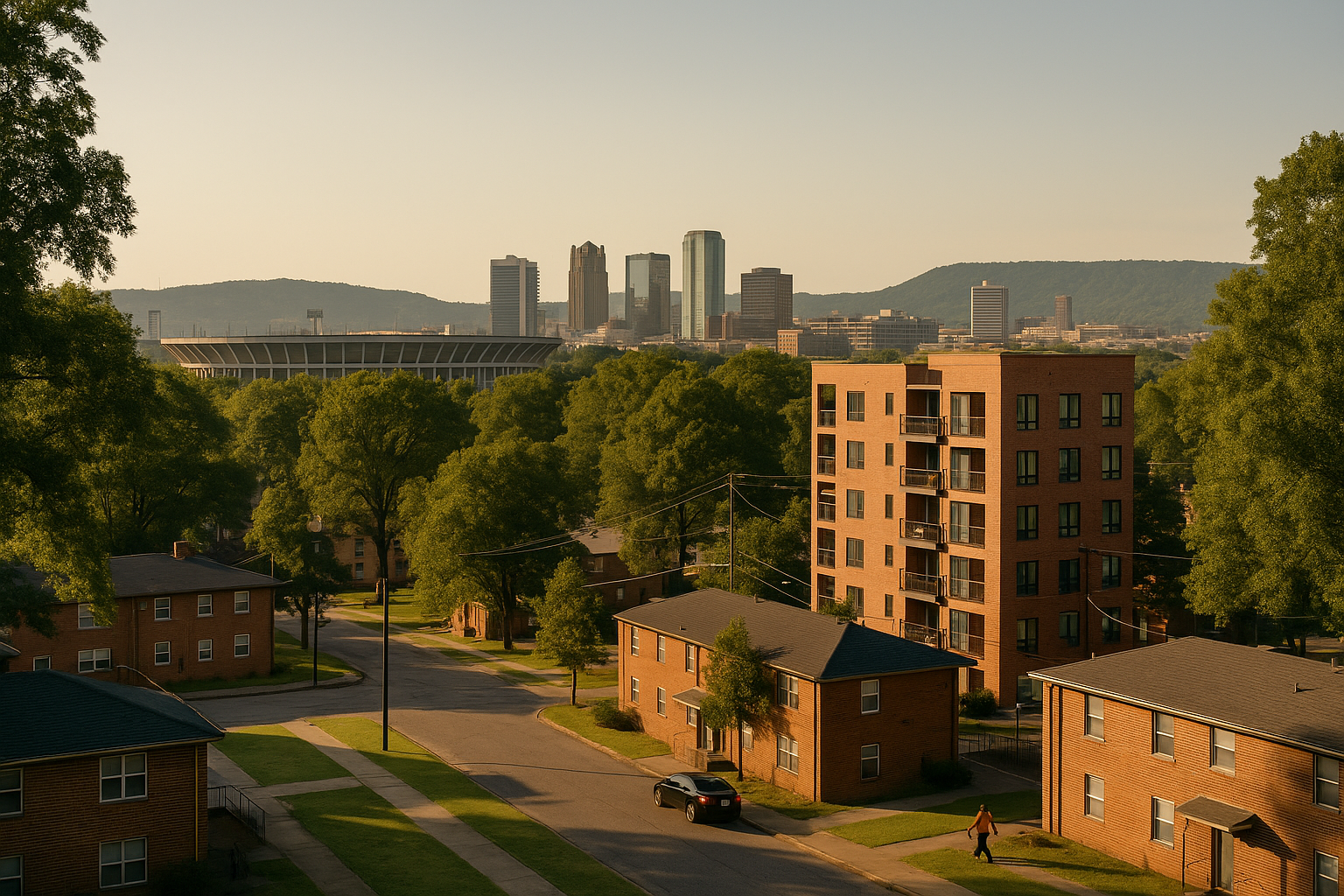
Choice Neighborhoods is HUD’s replacement program for severely distressed public housing, and it is deliberately not a housing grant alone. The award went jointly to the Housing Authority of the Birmingham District and the City of Birmingham on July 26, 2023, for the Smithfield-College Hills-Graymont community west of downtown.1 Birmingham was the first city in Alabama to receive one.
The target is Smithfield Court, a barracks-era public housing community, and the plan is to replace it with as many as 1,000 housing units ranging from fully subsidized to market rate.2 The full build-out is estimated at as much as $283 million. The federal grant is therefore about 18 cents on the dollar — an anchor, not the budget.
The five phases, and what is real in each
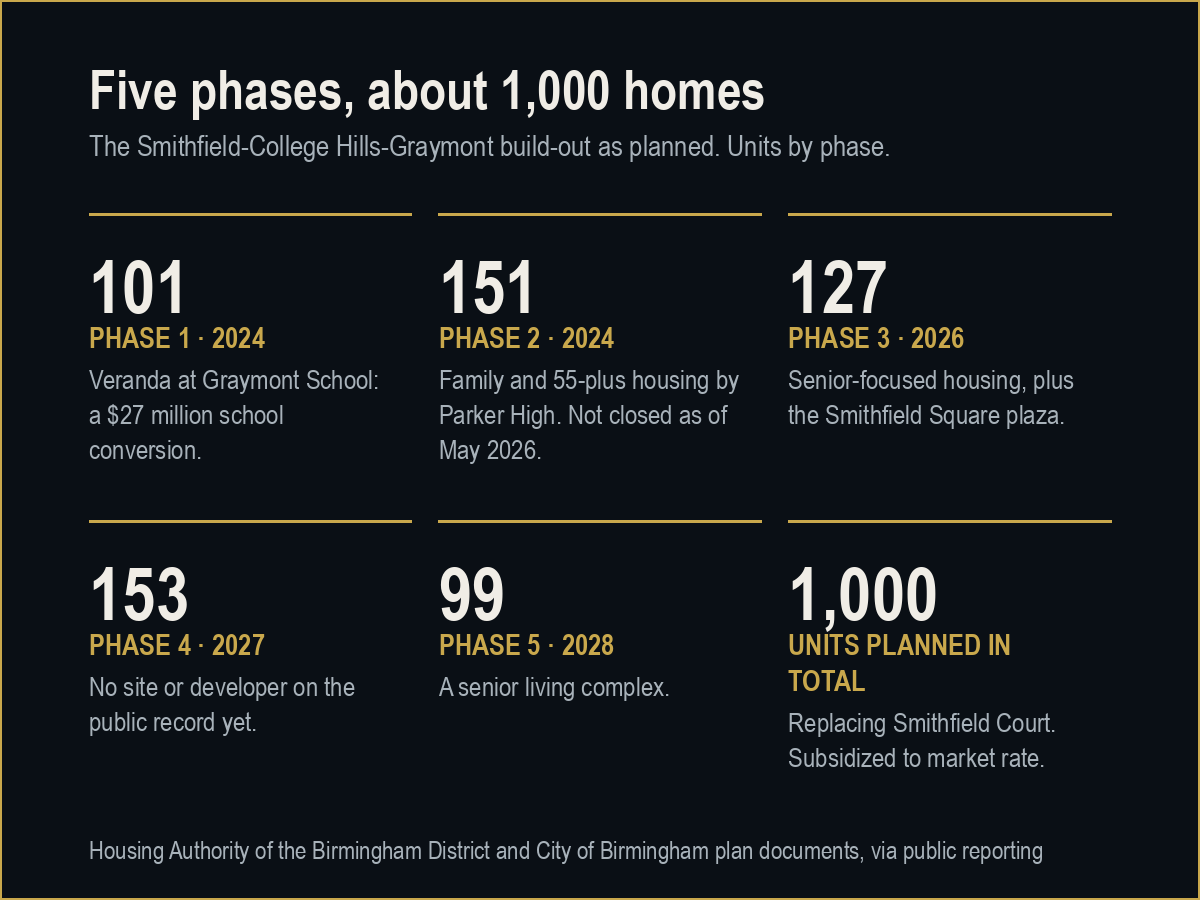
Phase 1 (2024) is the one you can actually visit. The former Graymont Elementary School was leased by a nonprofit and converted into 101 units of senior housing — a $27 million renovation the city supported with a $3.5 million forgivable loan. Reusing a closed school as senior housing is the least glamorous and most reliably deliverable move in the whole plan.2
Phase 2 (2024) is 151 units of family and 55-plus housing on the block north of Parker High School’s stadium — and it is where the timeline tells on itself. The developer entity is Smithfield Phase II LP, a tax-credit partnership of the Housing Authority with Atlanta-based Integral and Rural Enterprises. In May 2026 the Birmingham City Council approved a six-month extension of its agreement with that entity so the partners could close on the property and begin construction. The extension was requested by the agency financing the deal.3
Where it actually standsA phase labeled 2024 had not closed on its property as of May 2026. That is the single most useful fact in this article, and it is not in any press release.
Phase 3 (2026) is 127 units of senior-focused housing together with a public plaza called Smithfield Square. Phase 4 (2027) is 153 units, with no site or developer yet on the public record. Phase 5 (2028) is a 99-unit senior living complex.2
Read down that list and a pattern appears: this plan is heavily weighted toward senior housing. Three of five phases are senior or 55-plus. That is a specific bet about who the neighborhood is for, and it has consequences — senior units generate different demand for schools, transit and retail than family units do.
Where the other 82 cents come from
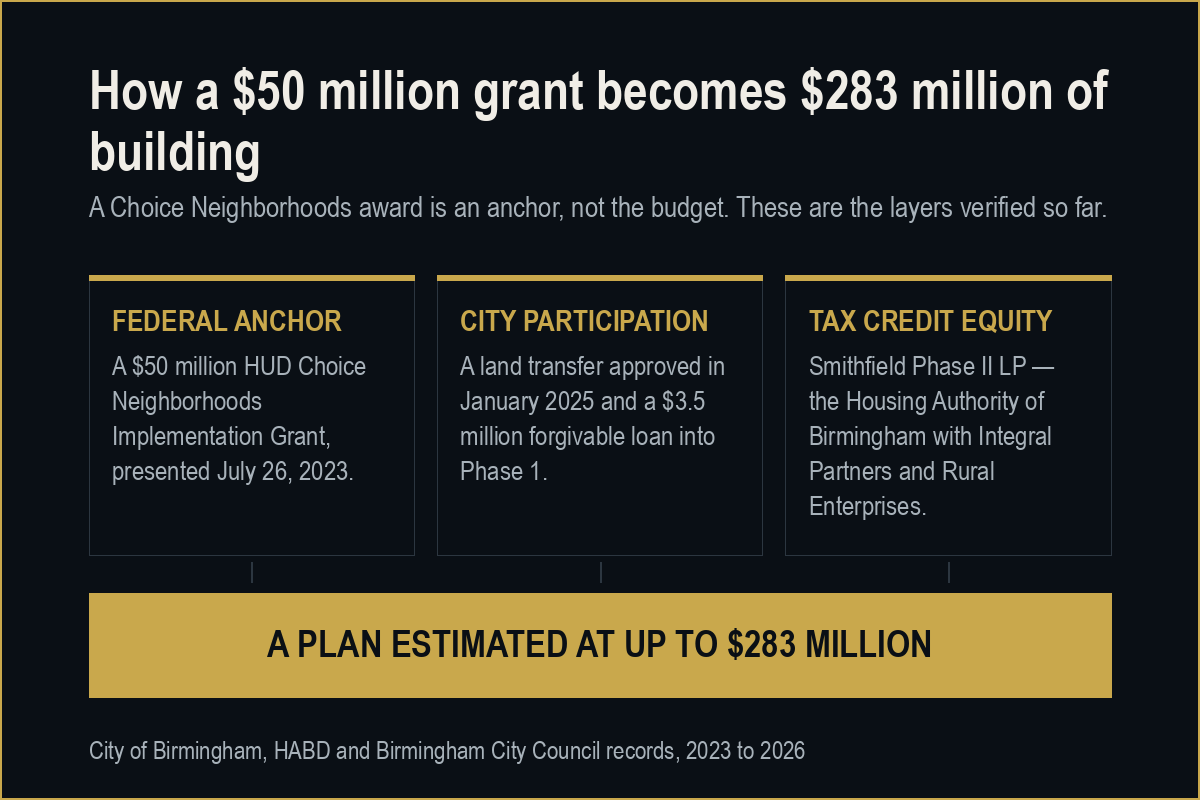
The federal money buys credibility more than square footage. Its real function is to make the rest of the stack financeable: the city contributed land — the council approved a transfer in January 2025 — plus the forgivable loan into Phase 1, and the phases themselves are being built through low-income housing tax-credit partnerships that bring private equity to the table.3
This is also why the schedule moves. A tax-credit deal has to align an allocation, an investor, a lender and a construction bid in the same window. Miss the window and you wait for the next one. The six-month extension is that process being visible in public for once.
The $50 million award and its date, the joint recipients, five phases with unit counts and target years, Phase 1's conversion and cost, Phase 2's developer entity and its May 2026 extension, the January 2025 land transfer, and the roughly $283 million total plan estimate.
Street addresses for Phases 2 through 5, the affordable-versus-market unit split, the number of replacement public-housing units, construction start dates, and the Smithfield Social Innovation Center — which appears in circulating descriptions of the plan but which we could not confirm in any primary record.
What it could mean if you own or rent nearby
For renters, the near-term issue is relocation rather than availability. Replacing occupied public housing means moving households first, and reporting in 2026 indicated seniors were being moved from Smithfield Court to the Graymont property.4 New supply arrives years after the disruption does.
For property owners, the mechanism worth watching is concentration. A thousand units delivered across five phases into a few blocks is a large change in a small area, and mixed-income redevelopment historically shifts both who lives on a block and what retail can survive there. Whether that reads as opportunity or as displacement pressure depends almost entirely on the affordable-to-market ratio — the number this plan has not yet published.
For investors, the discipline is to underwrite phases, not the headline. A $283 million plan with $50 million of federal anchor and a six-month extension on its second phase is a project with real momentum and real schedule risk at the same time. Both things are true.
ELM Property Management manages rental property in Birmingham. We track redevelopment at this scale because a thousand new homes concentrated in a few blocks changes a rental submarket more than almost anything else a city can do — and because the phase that slips is usually more informative than the one that opens.
Sources
- City of Birmingham. HUD Awards $370 Million in Choice Neighborhoods Implementation Grant Awards. 2023 View source
- Bhamwiki. Smithfield-College Hills-Graymont Choice Neighborhood Initiative — phase plan. 2026 View source
- BirminghamWatch. Smithfield Affordable Housing Project Gets Six-Month Extension From Birmingham City Council. May 26, 2026 View source
- CBS 42. Seniors to be moved from Smithfield Court to Graymont property in early 2026. 2026 View source
- Smithfield Choice / HABD. Smithfield — A Choice Neighborhood, project site. 2026 View source