
Birmingham’s next cycle of growth is not starting from scratch. The metro’s core counties already host a dense job base, higher average wages and a run of recent institutional and corporate commitments. The open question is how much of the next decade of jobs, housing and services remains in those cores versus spilling further into outlying counties.
Jefferson and Shelby: where the jobs and wages are
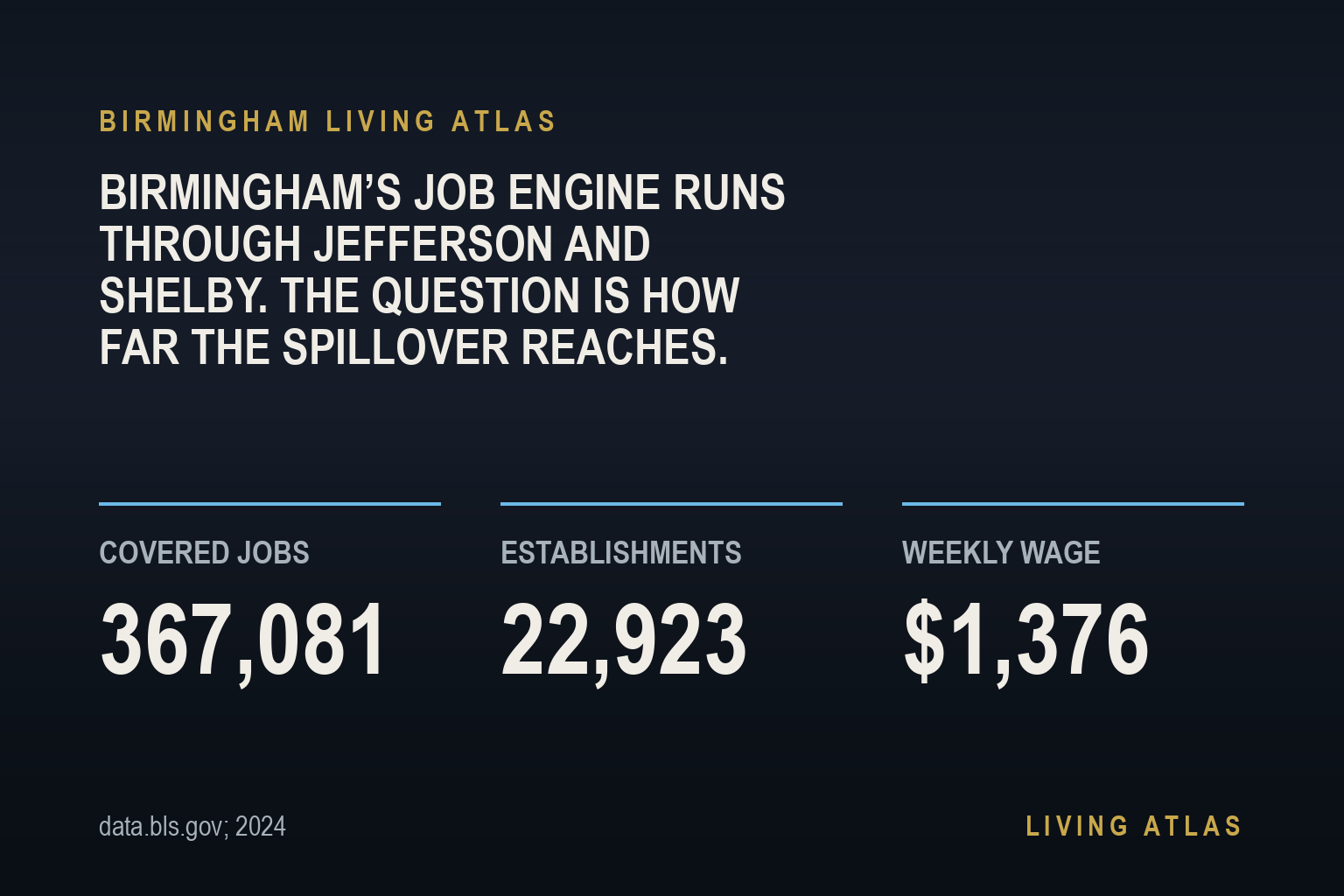
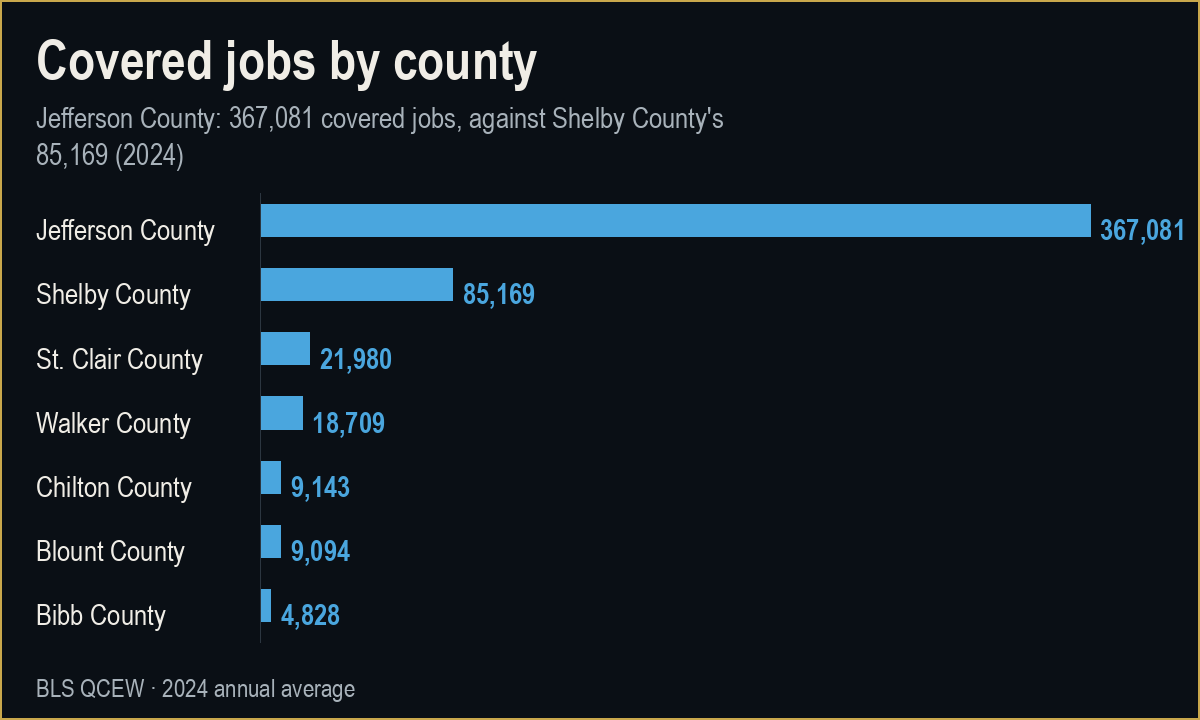
Jefferson County is the region’s anchor. It supports 367,081 covered jobs on a Quarterly Census of Employment and Wages (QCEW) basis and nearly 23,000 business establishments as of 2024, according to the U.S. Bureau of Labor Statistics 11. Average weekly wages there reach $1,376, the highest figure in the evidence set and well above surrounding counties 1.
Shelby County is the clear secondary job center. It holds 85,169 covered jobs and 7,251 establishments in 2024 22. Wages average $1,284 per week, second only to Jefferson in this group 2. That combination—substantial employment, a diversified establishment base and relatively high wages—positions Shelby as a suburban employment hub rather than a pure bedroom community.
St. Clair and Walker counties sit a tier below in scale but show steady growth. St. Clair’s covered employment rose from 19,970 in 2022 to 21,980 in 2024, and its establishment count increased from 1,769 to 1,943 over the same period 33. Average weekly wages reached $989 in 2024 3. Walker County’s covered jobs climbed from 17,790 in 2022 to 18,709 in 2024, with establishments fluctuating modestly to 1,536 and wages rising to $936 per week 444.
Smaller counties in the wider orbit are growing from much lower starting points. Blount County reached 9,094 covered jobs in 2024 and 956 establishments, with average weekly wages of $879 555. Chilton County’s covered employment is similar at 9,143 jobs and 922 establishments, with wages averaging $915 per week 666. Bibb County remains the smallest in this evidence set, with 4,828 covered jobs, 445 establishments and average weekly wages at $1,020 777.
The pattern is straightforward: Jefferson and Shelby hold the densest and highest-paying job bases the evidence shows, while nearby counties are adding jobs and establishments from smaller footprints and, generally, at lower wages.
Corporate and institutional bets are reinforcing the core
Several announced projects layer onto that existing concentration. In 2018, Alabama officials announced that Shipt would expand its Birmingham headquarters under the internal codename “Project Unicorn” 8. The state described a plan to add 881 full-time employees to its then-current Birmingham staff of 330 employees over three years, with an average salary of $48,231 8. Those figures are an announced plan, not a verified outcome, but the location—Birmingham—links the potential headcount growth directly to Jefferson County.
In 2021, The J. M. Smucker Co. announced a manufacturing plant in the Jefferson County community of McCalla with a total stated investment of $1.1 billion, to be built over three phases and described as creating up to 750 jobs 9. Construction was expected to begin no later than January 2022, with production commencing in calendar year 2025 9. Again, the timing and job numbers are plans; the verified evidence here is the announced investment amount, location and intended phasing 99. If built and staffed as described, that plant would add a meaningful block of industrial employment inside Jefferson County’s existing base.
Federal and research designations add another layer. The U.S. Economic Development Administration identifies the Birmingham Bio Innovation Corporation as lead agency for a “Birmingham Biotechnology Hub,” with Alabama as the state served and the applicant-defined region listed as the Birmingham–Hoover metro area with statewide partnerships 101010. The document names “AI-driven biotechnology” as the core technology area 10. That does not itself guarantee private-sector job creation, but it does establish that the region has secured a federal technology-hub designation in a specific domain.
Healthcare scale and expansion deepen Jefferson’s anchor role
Healthcare is another concentration point. UAB Hospital reports 1,400 hospital beds and notes that it is now the fifth-largest hospital in the nation by that metric, based on a 2026 article citing Becker’s Hospital Review 1111. That scale in a single institution helps explain why Jefferson County’s health-related employment and wages can support specialized roles that may not appear in smaller counties.
UAB is also actively expanding. In July 2023, UAB reported plans to create 59 new exam rooms and more than 66,000 square feet of clinical space in its hospital emergency department, citing support from the State of Alabama 12. The institution noted that UAB Hospital had already seen 20 percent emergency department patient volume growth in the prior five years and expected further volume increases in the next five years 12. A separate UAB careers page states that the emergency department expansion will increase the footprint to more than 115 treatment and triage spaces and will include a 30-bed inpatient observation unit 1313.
Beyond the emergency department, UAB describes a campus building cycle that includes the Altec/Styslinger Genomic Medicine and Data Sciences Building. In a November 2025 article, UAB’s president said that the official opening of that building on October 23 marked the seventh new or renovated facility opened in a span of only five months, as part of a broader set of 14 construction and renovation projects 141414. Those projects are physically concentrated in Birmingham, further reinforcing Jefferson County as the hub for high-intensity clinical and research activity.
What this employment pattern could mean for property and local business
If Jefferson and Shelby continue to capture the bulk of new institutional and corporate commitments, it would be reasonable to expect demand for nearby housing, services and commercial space to remain strongest there. That is an inference, not a verified outcome: no evidence here quantifies recent housing starts or rent changes. But a job base of more than 450,000 covered positions across Jefferson and Shelby combined, with wages in both counties above every surrounding county in this sample, is a starting condition that can support more intensive development 1212.
For smaller counties like Blount, Chilton and Bibb, the data shows modest but real covered employment and establishment bases 567. If large employers in Jefferson and Shelby draw workers from these areas, one plausible scenario is increased commuter patterns without proportional local job creation. In another scenario, secondary suppliers or services may follow, slowly building up local establishments over time. The evidence here does not distinguish between those paths; it only confirms that the current employment and wage levels outside the core are lower and more limited in scale.
Execution risk and what would test the growth case
Several dependencies stand between the current announcements and any broader regional transformation. First, announced projects such as Shipt’s headquarters expansion and the J. M. Smucker plant carry execution risk: the evidence documents the plans, investment amounts and intended job creation but does not confirm that all phases, hires or timelines have been met 899. Second, the biotech hub designation identifies a core technology area and region but does not specify the volume of future private investment or job counts 1010.
Third, while UAB’s hospital and campus expansions are verifiable institutional commitments, the downstream effects—on surrounding medical office, housing demand or neighborhood retail—are not quantified in the sources. UAB’s report of 20 percent five-year emergency department volume growth and expectations of additional growth illustrates rising clinical demand, but it does not itself measure changes in employment or nearby development 12.
What to watch next
- Project delivery at McCalla and Shipt’s headquarters. Evidence that all three phases of the J. M. Smucker facility are built and staffed near the “up to 750 jobs” plan, and data on Shipt’s actual Birmingham headcount relative to its announced 881-addition target, would sharpen how much new employment the Jefferson core truly captured 98.
- Follow-on activity from the biotech hub designation. Additional grants, lab buildouts, or private-company expansions tied explicitly to the “AI-driven biotechnology” hub would clarify whether the federal designation is catalyzing a broader cluster or remaining primarily institutional 1010.
- Measured employment and wage shifts by county. Subsequent QCEW releases will show whether Jefferson and Shelby continue to outpace surrounding counties in job and wage growth, or whether places like St. Clair, Walker, Blount, Chilton and Bibb begin to close some of the gap 34567.
- UAB’s buildout milestones. Completion of the emergency department expansion to the stated 59 exam rooms and 66,000 additional square feet, and confirmation of the more than 115 treatment and triage spaces and 30-bed observation unit, would test how far the hospital’s footprint is actually growing on the ground 121313.
- Local-government response capacity. The City of Birmingham’s Department of Innovation and Economic Opportunity, based at City Hall with weekday hours and published contact details, is positioned as a point of contact for business and expansion issues 15151515. Future public documents from that department could provide additional detail on incentives, site preparation and how the city is managing growth-related pressures.
At this stage, the evidence supports a clear conclusion: Birmingham’s core counties already house a substantial and relatively high-wage employment base, and recent institutional and corporate decisions are reinforcing that concentration. Whether that foundation translates into broader, multi-county transformation will depend on execution of announced projects and the pace at which spillover jobs and investment appear beyond Jefferson and Shelby.
Sources
- U.S. Bureau of Labor Statistics. Quarterly Census of Employment and Wages, annual averages — Jefferson County, Alabama. 2024 View source
- U.S. Bureau of Labor Statistics. Quarterly Census of Employment and Wages, annual averages — Shelby County, Alabama. 2024 View source
- U.S. Bureau of Labor Statistics. Quarterly Census of Employment and Wages, annual averages — St. Clair County, Alabama. 2024 View source
- U.S. Bureau of Labor Statistics. Quarterly Census of Employment and Wages, annual averages — Walker County, Alabama. 2024 View source
- U.S. Bureau of Labor Statistics. Quarterly Census of Employment and Wages, annual averages — Blount County, Alabama. 2024 View source
- U.S. Bureau of Labor Statistics. Quarterly Census of Employment and Wages, annual averages — Chilton County, Alabama. 2024 View source
- U.S. Bureau of Labor Statistics. Quarterly Census of Employment and Wages, annual averages — Bibb County, Alabama. 2024 View source
- Office of the Governor of Alabama. Governor ivey announces birminghams shipt to create 881 jobs in major expansion View source
- Office of the Governor of Alabama. Governor ivey announces the j m smucker co to build alabama manufacturing plant creating up to 750 jobs in birmingham View source
- U.S. Economic Development Administration. Birmingham Biotechnology Hub View source
- University of Alabama at Birmingham. Uab hospital now fifth largest in the nation View source
- University of Alabama at Birmingham. Uab hospital emergency department to expand with state support View source
- careers.uabmedicine.org. Uab hospital ED expansion View source
- University of Alabama at Birmingham. Uab continues to transform through 14 new construction and renovation projects View source
- City of Birmingham. Department innovation economic opportunity View source