
The job market around Birmingham is being built on three overlapping foundations: a large, mature employment core in Jefferson County, faster establishment growth in nearby counties, and a run of big public and institutional projects that could pull more private investment to key corridors.
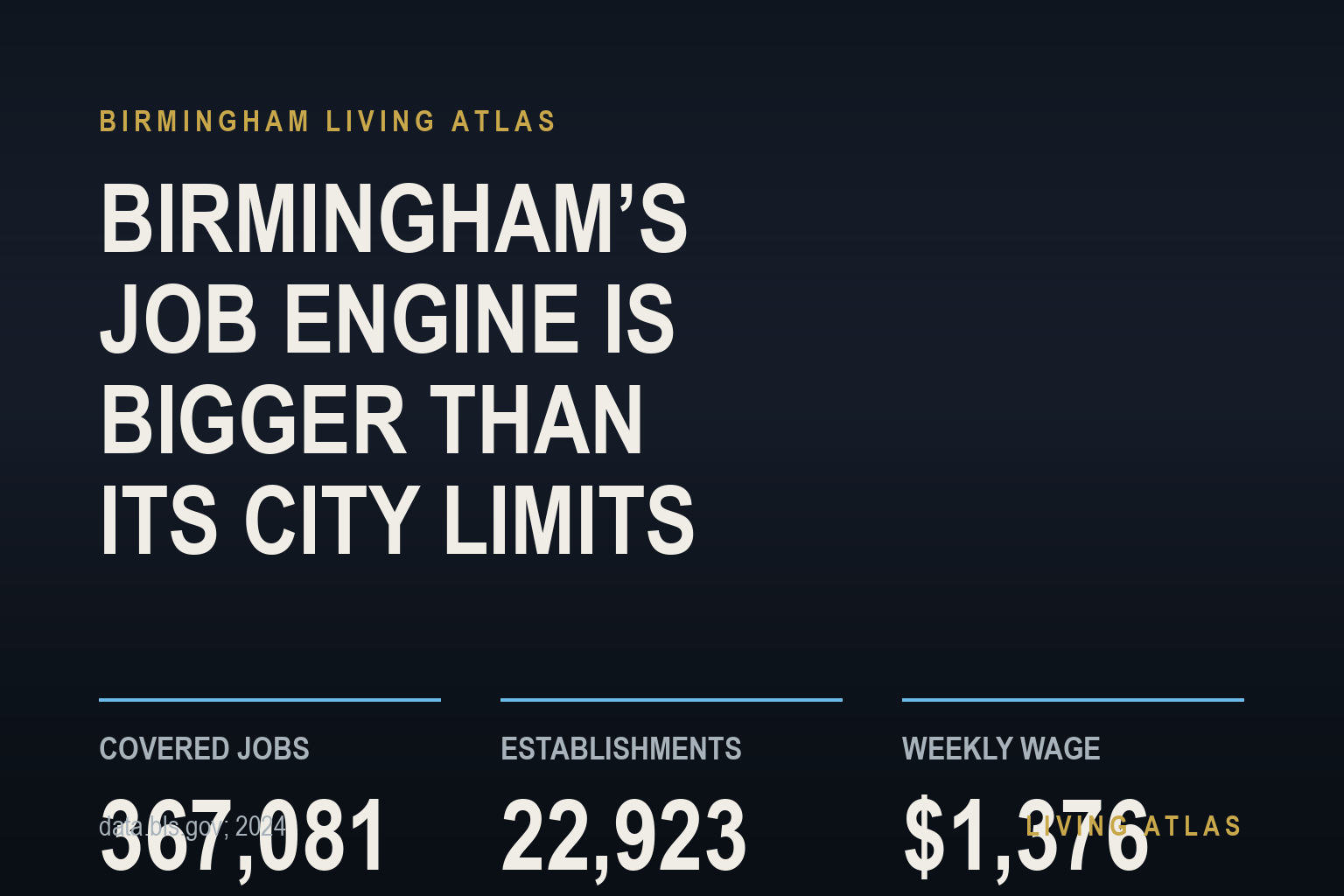
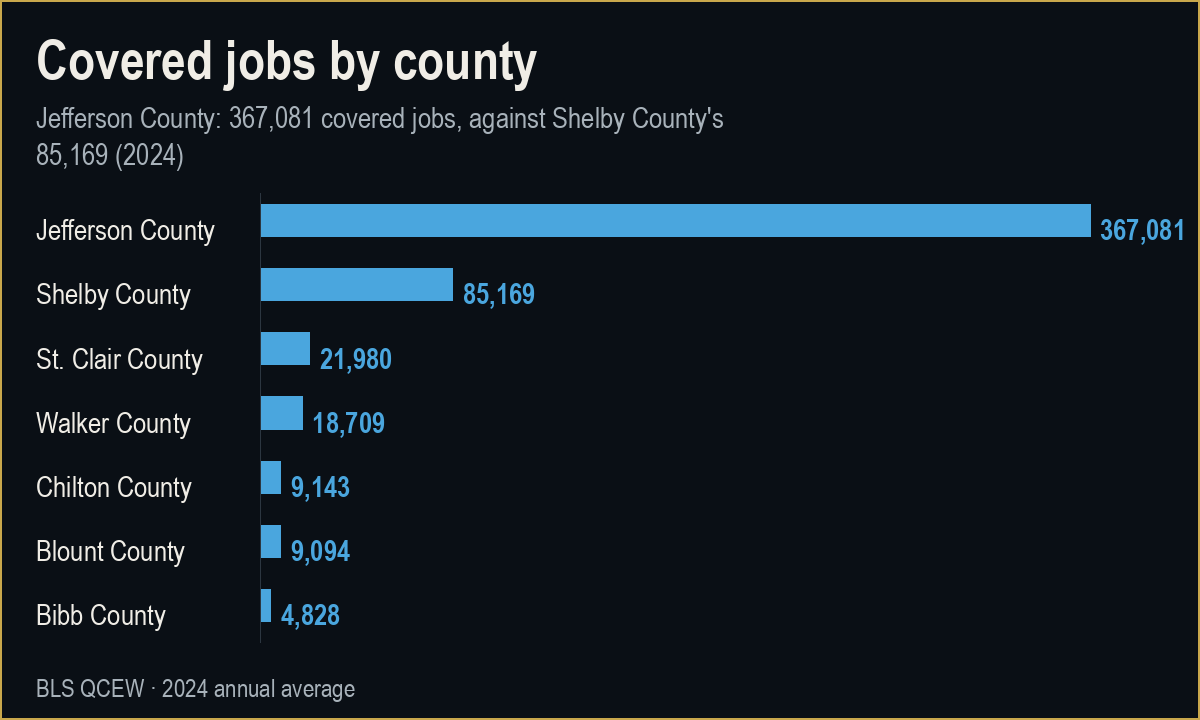
Jefferson County remains the center of gravity. In 2024 it supported 367,081 covered jobs and 22,923 business establishments, more than any neighboring county by a wide margin 11. Average weekly pay there reached $1,376, ahead of every adjacent county in this dataset 1. The Birmingham metro’s core still holds the densest stack of employers and the highest wages.
But growth in business locations is not confined to the core. Shelby County, immediately southeast, had 7,251 establishments in 2024, up from 6,809 in 2022 2. St. Clair County to the northeast rose from 1,769 to 1,943 establishments over the same period 3. Even smaller counties such as Blount, Chilton and Bibb all added establishments between 2022 and 2024, albeit from much smaller bases 456. That pattern suggests the economic footprint around Birmingham is slowly thickening along the I‑65 and I‑20/I‑59 corridors rather than concentrating ever more tightly in one county.
On the employment side, the gap between Jefferson and its neighbors is even more pronounced. Shelby County carried 85,169 covered jobs in 2024, essentially flat compared with 2022 but still the clear secondary employment center 2. St. Clair County supported 21,980 covered jobs, up notably from just under 20,000 in 2022 3. Walker County, northwest of Birmingham, reached 18,709 covered jobs in 2024, up from 17,790 in 2022 7. Blount and Chilton each supported a bit more than 9,000 covered jobs in 2024, while Bibb County held under 5,000 456.
Wages show a similar core‑and‑ring structure. Shelby’s average weekly wage in 2024 was $1,284, second only to Jefferson in this group 2. Bibb County’s average weekly wage was $1,020, ahead of St. Clair’s $989 and Walker’s $936 637. Blount and Chilton trailed with average weekly wages of $879 and $915, respectively 45. For investors and employers, that spread sketches where the higher‑pay anchors are today and where labor remains cheaper but less dense.
Against that backdrop, several capital projects and policy efforts are trying to shape where the next wave of jobs lands. In McCalla, in Jefferson County, The J.M. Smucker Co. has announced plans for a manufacturing facility involving a total financial investment of $1.1 billion, to be built over three phases and expected to create up to 750 jobs according to the company and state officials 8. Construction was expected to begin no later than January 2022, with production commencing in calendar year 2025 8. The company has stated that investment and job creation will align with those phases and are contingent on tax and business incentive approvals and on closing the property transaction for the site 8. Those contingencies mean the full jobs impact remains an announced plan rather than an observed outcome.
Inside the city, Birmingham’s Department of Innovation and Economic Opportunity is trying to coordinate the public side of that growth pattern. The department describes its role as connecting people, businesses, assets and opportunities to markets and investments that drive sustainable growth, including strengthening homegrown businesses, attracting and retaining high‑growth industries, cultivating a skilled workforce and positioning the city for new investment and development 9. It also sets out explicit commitments to residents, business leaders and philanthropic partners, emphasizing economic mobility, a predictable business environment, and a framework for collaborative investment 9.
The department says it targets its resources toward activities with the “highest multiplier effect,” specifically citing support for businesses ready to scale and industries ready to invest 9. If execution follows that stated approach, one reasonable inference is that more of the city’s direct effort and incentives may go toward firms and sectors that already have some traction rather than purely speculative projects.
One concrete example of this kind of structured initiative is the Reinvest BHM request for proposals for a Workforce Development Technical Assistance Contractor. The department lists an RFP issued by the City of Birmingham’s Department of Innovation and Economic Opportunity with an August 17, 2026 release date and a September 18, 2026 proposal deadline, naming a specific contact for submissions 9. A technical‑assistance contract of that type does not itself create jobs, but it is a mechanism to influence how effectively residents and employers connect to whatever jobs materialize.
Alongside industrial recruitment and local business support, the University of Alabama at Birmingham (UAB) is quietly reshaping a different but related piece of the economic base: the built environment of a major research and healthcare anchor. UAB reports that the development of its physical campus plays a role in recruiting and retaining students, faculty and staff, by offering state‑of‑the‑art spaces to live, study and work 10. The university also notes that new research buildings and renovations bring new technology, support retention and hiring of investigators to expand its research portfolio, and open up additional private and public funding opportunities 10.
Those statements are about institutional strategy rather than guaranteed economic outcomes, but the capital behind them is substantial. For the Altec/Styslinger Genomic Medicine and Data Sciences Building, UAB cites a funding package that includes philanthropy and $50 million from the State of Alabama via the Public School and College Authority plus another $5 million from Jefferson County 10. That is a concrete example of state and county dollars going into specialized research infrastructure inside the county that already carries the region’s highest wages and densest job base.
Healthcare infrastructure is seeing similar public support. UAB reports that, in recent state budget legislation, $50 million in funds was allocated from the State of Alabama to support the long‑term expansion of UAB Hospital’s Emergency Department (UED), a project that has received Stage 1 approval from the University of Alabama System Board of Trustees, with further approvals still needed 11. The long‑term expansion is described as a $73 million project that would renovate the first floor of UAB Hospital’s North Pavilion, convert the adjacent atrium into clinical care space and add a new three‑story structure in the pavilion’s drop‑off drive 11.
UAB anticipates roughly 66,030 square feet of new construction from this project, including 59 new exam rooms and added imaging capacity for emergency care 11. The university also reports that UAB Hospital has seen 20 percent UED patient‑volume growth over the last five years and expects further growth over the next five 11. Taken together, those numbers indicate that a nontrivial share of new public capital in Jefferson County is being channeled into healthcare capacity that responds to existing service demand and anticipated volume rather than speculative future use.
Looking across these pieces, a pattern emerges: Jefferson County still dominates employment and wages, but smaller surrounding counties are gradually adding establishments and covered jobs, while major public and institutional investments cluster heavily in and around Birmingham’s core. If projects like the McCalla plant, UAB’s research facilities and the emergency department expansion proceed as announced, one reasonable scenario is that supplier activity, service businesses and workforce programs could increasingly organize around these specific nodes.
That outcome is not guaranteed. The McCalla investment remains contingent on incentives and land transactions, UAB’s expansion plans still require additional governance approvals, and the city’s economic‑development department can state its priorities without fully controlling how private capital responds 8119. For now, the evidence establishes a sizable and modestly growing job base, a wage premium in Jefferson and Shelby counties, and a set of targeted public and institutional investments that could reinforce those advantages if they execute as planned.
What to watch next
- Whether all three phases of the McCalla manufacturing facility move forward on the announced schedule and at the stated $1.1 billion scale, and how many of the “up to 750” jobs ultimately materialize in Jefferson County 888.
- Board and state‑level approvals, construction milestones and eventual utilization of UAB’s emergency department expansion and the Altec/Styslinger Genomic Medicine and Data Sciences Building, given the significant state and county contributions 10111111.
- How the distribution of covered employment and establishments across Jefferson, Shelby, St. Clair and the smaller surrounding counties evolves in future QCEW releases, particularly whether the secondary counties begin to add higher‑wage jobs at a faster rate 123.
- Implementation of Birmingham’s workforce and business‑support initiatives, including the Reinvest BHM technical‑assistance RFP, and any measurable effects on business formation or hiring patterns within the city 999.
Sources
- U.S. Bureau of Labor Statistics. Quarterly Census of Employment and Wages, annual averages — Jefferson County, Alabama. 2024 View source
- U.S. Bureau of Labor Statistics. Quarterly Census of Employment and Wages, annual averages — Shelby County, Alabama. 2024 View source
- U.S. Bureau of Labor Statistics. Quarterly Census of Employment and Wages, annual averages — St. Clair County, Alabama. 2024 View source
- U.S. Bureau of Labor Statistics. Quarterly Census of Employment and Wages, annual averages — Blount County, Alabama. 2024 View source
- U.S. Bureau of Labor Statistics. Quarterly Census of Employment and Wages, annual averages — Chilton County, Alabama. 2024 View source
- U.S. Bureau of Labor Statistics. Quarterly Census of Employment and Wages, annual averages — Bibb County, Alabama. 2024 View source
- U.S. Bureau of Labor Statistics. Quarterly Census of Employment and Wages, annual averages — Walker County, Alabama. 2024 View source
- Office of the Governor of Alabama. Governor ivey announces the j m smucker co to build alabama manufacturing plant creating up to 750 jobs in birmingham View source
- City of Birmingham. Department innovation economic opportunity View source
- University of Alabama at Birmingham. Uab s 12 new construction and renovation projects transforming campus supporting strategic initiatives View source
- University of Alabama at Birmingham. Uab hospital emergency department to expand with state support View source