
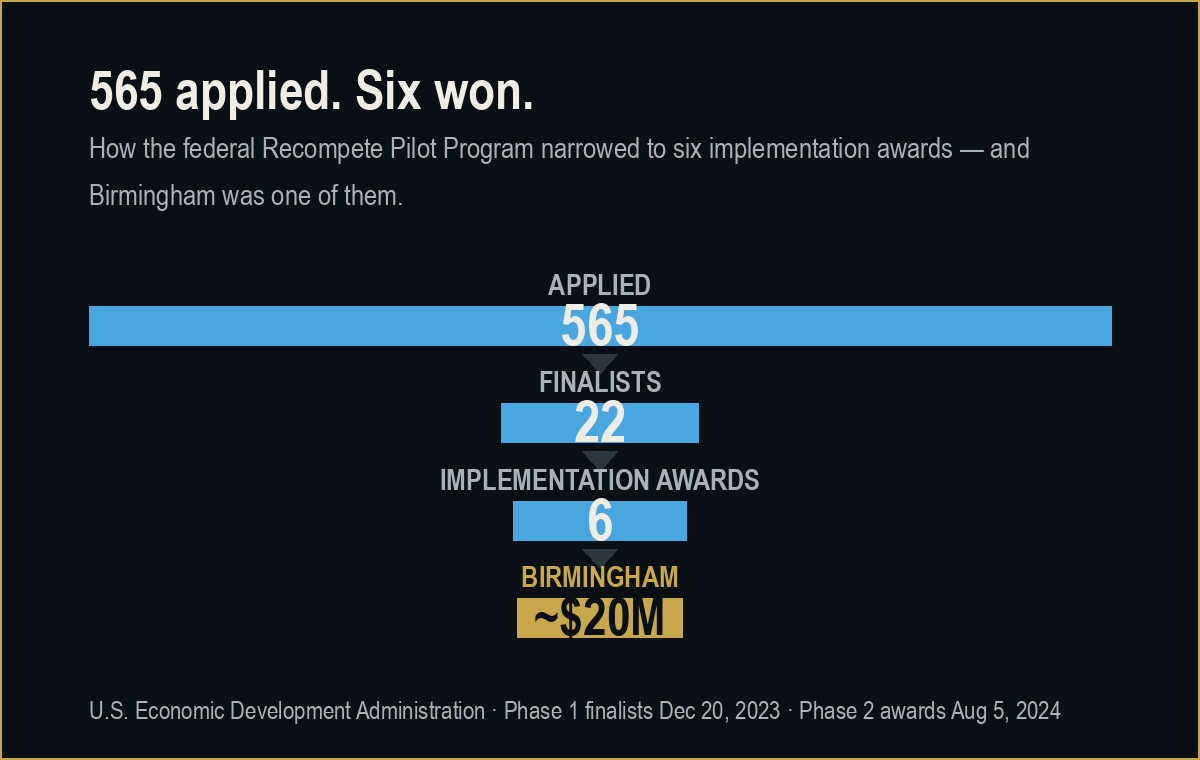
Five hundred and sixty-five communities asked the federal government for money to fix their labor markets. Six got it. Birmingham was one of the six.

The funnel is the story
The Distressed Area Recompete Pilot Program was created by the CHIPS and Science Act with an unusual premise for federal economic development: instead of chasing a company, chase the gap. Recompete targets places where prime-age employment — the share of 25-to-54-year-olds actually working — sits well below the national average.1
That premise attracted a stampede. The Economic Development Administration received 565 Phase 1 applications requesting more than $6 billion. On December 20, 2023 it named 22 finalists. On August 5, 2024 it announced six implementation awards totaling $184 million, ranging from $20 million to $40 million each and funding five to eight projects apiece.1
What the $20 million actually buys
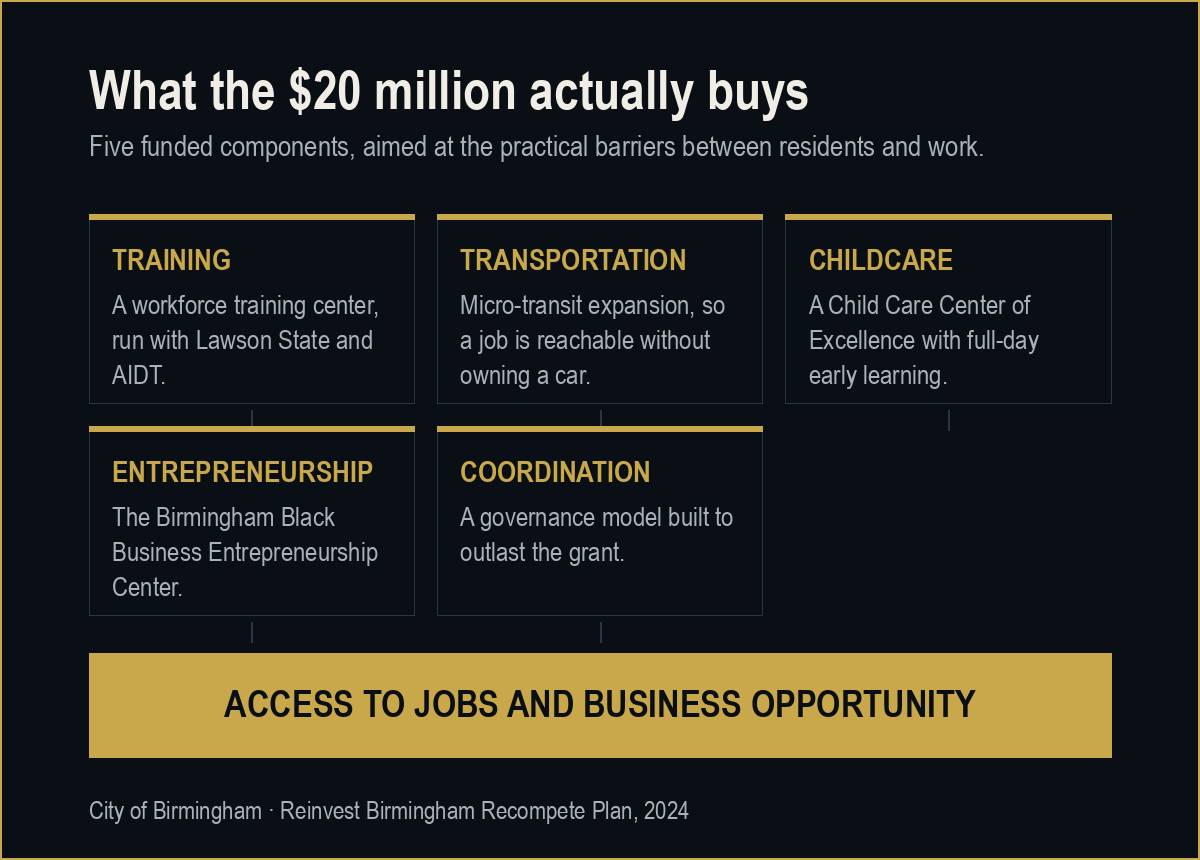
The City of Birmingham was awarded approximately $20 million on August 5, 2024, for four neighborhoods in the northwest quadrant: North Birmingham, Northside, Smithfield and Pratt.2 The plan is called Reinvest Birmingham, and it does not build a factory.
It funds five things: a centrally located workforce training center; micro-transit expansion for affordable transportation; a Child Care Center of Excellence offering full-day early learning; the Birmingham Black Business Entrepreneurship Center; and a governance model designed to keep the whole thing running after the grant ends.2
Why those five, and not something flashier
Read the list again and notice what is missing. There is no incentive package, no land assembly, no speculative building. That is deliberate, and it reflects a specific diagnosis: the jobs are already here. Jefferson County reported 367,081 covered jobs across 22,923 business establishments in 2024, and the region’s highest average weekly wage at $1,376.3 The problem Recompete is aimed at is not a shortage of employers. It is the distance — practical, not geographic — between certain neighborhoods and work that already exists.
Each component removes one link in a chain that fails as a whole. Training without transportation strands a certified worker at a bus stop that does not run to the job. Transportation without childcare does not help a parent whose shift starts before daycare opens. Childcare without training returns someone to the same wage they left. Entrepreneurship addresses the residents who would rather build the employer than commute to one. And coordination exists because the previous four have been funded separately in American cities for forty years, by different agencies on different timelines, which is roughly how you guarantee that none of them compounds.
The named partners suggest the same logic. Lawson State Community College and AIDT carry the training. The Birmingham Jefferson County Transit Authority carries the transportation. Childcare Resources and the YMCA of Greater Birmingham carry the childcare. Prosper, Regions Bank and the Black Business Initiative carry the business side, with Central Six AlabamaWorks! coordinating.2 It is an unusually operational list for a federal announcement — these are organizations that already run the thing they have been asked to expand.
Memphis made the final 22. It did not get the money.
The Memphis Chamber Foundation submitted the Prosper Memphis 2030 Recompete Plan, requesting approximately $20 million to build career pathways into advanced industries, expand childcare, and support entrepreneurship in underserved communities. It was named one of the 22 finalists on the same day Birmingham was.4
It was not among the six implementation awardees announced in August 2024.1 This matters for two reasons. The first is accuracy: coverage of competitive federal programs routinely blurs finalist into funded, and Memphis did not receive Recompete implementation money. The second is that it tells you how thin the margin was. Memphis is a larger metro with a comparable plan and a serious institutional coalition behind it, and it cleared every stage but the last one.
The same distinction applies down the road in Columbus, Georgia, where the United Way of the Chattahoochee Valley won a $500,000 Phase 1 Strategy Development Grant — a planning grant, and a real accomplishment. Local coverage has described the region as “both a finalist and a winner.” It was a finalist. It was not one of the six implementation awardees.
What this could mean if you own, rent or hire here
Here is where we have to be careful, because the honest answer is that nothing has been measured yet. What follows is mechanism, not forecast.
A funded, multi-year program aimed at four specific northwest Birmingham neighborhoods, with named operating partners and employer commitments attached, in a county that already holds 367,081 covered jobs and the region's highest average weekly wage.
Any completed facility, any enrolled trainee, any expanded transit route, any childcare seat, or any hire. The award was announced in August 2024; per-component budgets, addresses and opening dates are not yet public.
For employers, the interesting variable is not the training center itself but the transit and childcare running alongside it. Employers in and around Jefferson County have spent years describing the same two failure modes — candidates who cannot reliably get to a shift, and workers who leave within ninety days when a childcare arrangement collapses. A program that attacks both at once is worth watching for retention effects before it is worth watching for hiring effects.
For renters, the plausible near-term effect is employment stability rather than anything about rent. A household where one adult moves from intermittent to steady work is a household whose housing situation gets less fragile. That is a real outcome and it does not show up in any rent index.
For property owners and investors, the mechanism to watch is sequencing. Sustained improvements in labor-force participation, business formation and transit connectivity can precede changes in housing demand and neighborhood investment — but the operative word is precede, over years, and often unevenly. We would want to see movement in three things before drawing any conclusion: prime-age employment in the target tracts, new establishment counts in the four neighborhoods, and actual micro-transit service hours. All three are measurable. None has moved yet in published data.
ELM Property Management manages rental property in Birmingham and Memphis. We track development like this because employment, transportation and childcare are the three things that most reliably determine whether a tenant can stay housed — which makes them the three things a property owner should understand before they matter.
Sources
- U.S. Economic Development Administration. Recompete Pilot Program — Phase 1 finalists and Phase 2 implementation awardees. 2023-2024 View source
- City of Birmingham. City of Birmingham Awarded $20 Million Distressed Area Recompete Pilot Program Grant. 2024 View source
- U.S. Bureau of Labor Statistics. Quarterly Census of Employment and Wages, annual averages — Jefferson County, Alabama. 2024 View source
- U.S. Economic Development Administration. Prosper Memphis 2030 Recompete Plan — Phase 1 finalist. 2023 View source