Jefferson County and its neighbors form an economic core for central Alabama where wages, job growth and public investment are not evenly distributed. Verified labor market data and recent project announcements show a metro anchored by relatively high-paying jobs in Jefferson and Shelby counties, surrounded by lower-wage counties that remain tied into the same employment region.
Jefferson County: high wages and deep job base
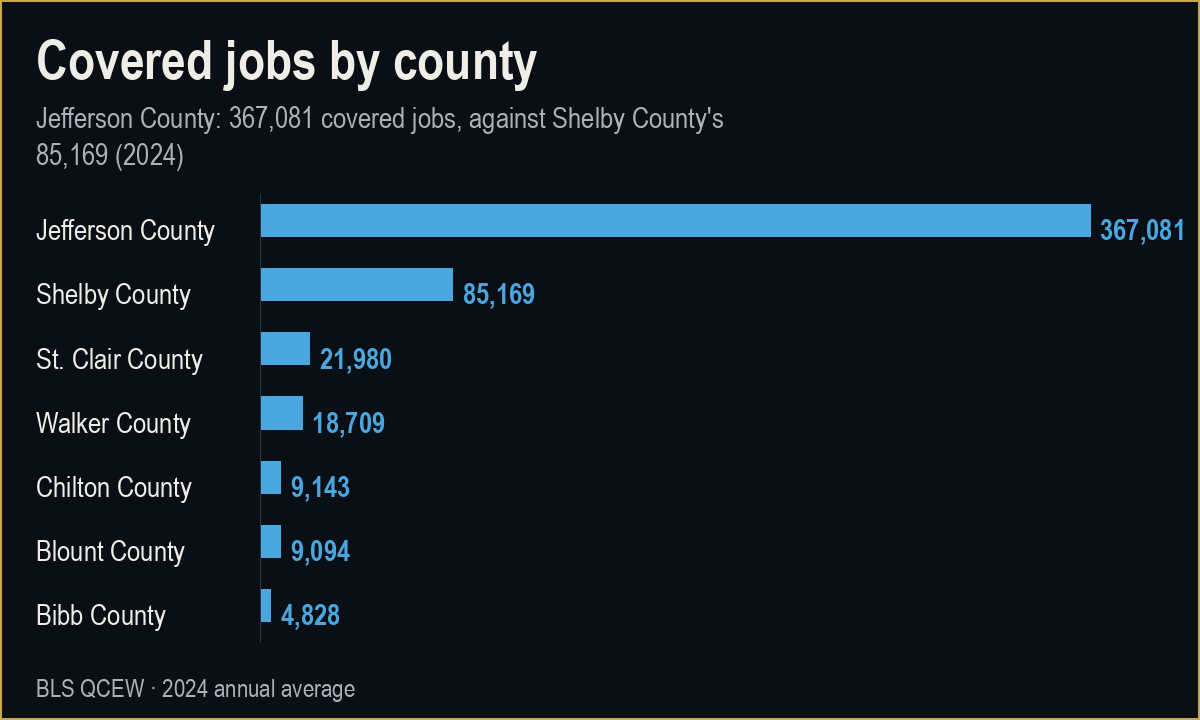
In 2024, Jefferson County recorded an average weekly wage of $1,376, based on the Bureau of Labor Statistics’ Quarterly Census of Employment and Wages (QCEW) annual averages.1 That wage level is the highest among the surrounding counties documented in the data set and sits on top of a large employment base: Jefferson County supported 367,081 covered jobs in 2024, up from 356,742 in 2022.2 The number of business establishments also expanded, from 21,422 in 2022 to 22,923 in 2024.3
City planning documents frame downtown as the core of this economic role. Birmingham’s City Center Master Plan states that the City Center is “Birmingham’s economic engine—a hub for innovation, business, and employment,” and that the plan was inspired by the 2013 Comprehensive Plan recognizing the City Center as the city’s economic and social core.45 Those are policy characterizations rather than measured outcomes, but they align with the concentration of jobs and establishments recorded in Jefferson County’s QCEW data.
Smucker’s McCalla project: large investment at the edge of the core
Some of the newest industrial investment is planned just outside Birmingham’s downtown but still within Jefferson County. According to the Alabama governor’s office, The J.M. Smucker Co. announced a facility in the Jefferson County community of McCalla with a total financial investment of $1.1 billion, to be constructed over three phases and projected to create up to 750 jobs.6 The same announcement said construction was expected to begin no later than January 2022, with production to start in calendar year 2025.7
The company indicated that financial investments and job creation would “align with each of the three phases” and that these were contingent on the approval of tax and business incentives and closing the property purchase.8 That contingency means the final timing and scale of jobs and capital spending depend on factors outside the construction schedule itself. The evidence here does not document whether those milestones were ultimately met, so any assessment of realized impact remains uncertain.
Wage and employment gaps across the Birmingham region
The counties surrounding Jefferson are strongly linked to the same labor market but operate at different wage levels.
- Shelby County, immediately southeast of Jefferson, had an average weekly wage of $1,284 in 2024, below Jefferson’s but well above the region’s more rural counties.9 Shelby’s covered employment stood at 85,169 jobs, declining modestly from 86,332 in 2022, while its business establishments increased from 6,809 in 2022 to 7,251 in 2024.1011
- St. Clair County, to the northeast, posted a 2024 average weekly wage of $989.12 Covered employment there grew from 19,970 jobs in 2022 to 21,980 in 2024, and establishments increased from 1,769 to 1,943 over the same period.1314
- Walker County, northwest of Jefferson, recorded a 2024 average weekly wage of $936, with covered employment rising from 17,790 to 18,709 jobs between 2022 and 2024.1516 Business establishments ticked up from 1,498 in 2022 to 1,549 in 2023, then edged down to 1,536 in 2024.17
- Chilton County, to the south, had an average weekly wage of $915 in 2024.18 Covered employment there was comparatively small at 9,143 jobs in 2024, essentially flat relative to 9,047 in 2022, and business establishments grew from 856 to 922 over those years.1920
- Blount County, north of Jefferson, reported an average weekly wage of $879 in 2024.21 Its covered employment increased from 8,726 jobs in 2022 to 9,094 in 2024, and establishments grew from 896 to 956 over the same period.2223
- Bibb County, southwest of the metro core, showed a 2024 average weekly wage of $1,020—higher than several neighboring counties but based on a small employment base.24 Covered employment there was 4,828 jobs in 2024, essentially unchanged from 4,836 in 2022, while establishments increased from 404 to 445.2526
This pattern points to a metro anchored by Jefferson County’s relatively high wages and deep job base, a comparatively high-wage but smaller Shelby County economy, and a ring of lower-wage counties with smaller employment totals. The available evidence does not show commuting patterns or household incomes, so any further inference about how much these workers depend on jobs in Jefferson County remains speculative.
Downtown planning and housing: adding residents to the job core
Birmingham’s City Center Master Plan pairs this job concentration with a stated goal to add more housing downtown. The plan cites “5,000 mixed-income homes planned over the next decade” and says the initiative will “redefine Birmingham’s downtown, attracting a dynamic workforce and reinvigorating underutilized spaces.”27 Those statements are forward-looking and do not yet constitute measured outcomes, but they specify a housing quantity target that, if built, would significantly increase residential capacity in the core.
The same plan asserts that concentrating development into high-density hubs “creates more opportunities for business, culture, and entertainment.”28 That is a policy claim about urban form rather than an empirically demonstrated effect in Birmingham; the evidence provided does not include evaluation data linking high-density hubs in the city to specific business or employment metrics.
University and medical projects: institutional investment near downtown
Major institutional projects at the University of Alabama at Birmingham (UAB) add another layer of investment close to the city’s economic core. UAB reports that the Altec/Styslinger Genomic Medicine and Data Sciences Building is funded by philanthropic gifts from university donors, $50 million from the State of Alabama via the Public School and College Authority, $5 million from Jefferson County, $1 million from City of Birmingham funds, and additional institutional funds.29 The document does not give a total project cost, so the overall budget and relative weight of each funding stream cannot be calculated from this evidence alone.
Another UAB project, a Biomedical Research and Psychology Building, is described as a $190 million project supported by $152 million in federal funding, along with funds from the Heersink School of Medicine and the College of Arts and Sciences.30 UAB reports that it broke ground on the facility in June 2024 and expected completion in summer 2026.30 The evidence does not state projected or actual job creation from these projects, but facilities of this type typically house research and clinical workforces that feed into the broader employment base documented in Jefferson County.
Economic development strategy and neighborhood-level interventions
Within city government, Birmingham’s Department of Innovation and Economic Opportunity explicitly positions itself as a connector between residents, businesses and capital. The department states that it is “shaping Birmingham’s future by connecting our people, businesses, assets, and opportunities to the markets and investments that drive sustainable growth,” and that it works to strengthen homegrown businesses, attract and retain high-growth industries, cultivate a skilled and competitive workforce, and position Birmingham for new investment and development.3132 These are statements of mission and scope rather than measurable outcomes.
The department further describes its goal as building “a resilient, opportunity-rich economy where businesses can grow, talent can thrive, and Birmingham can compete as a premier destination for innovation and economic opportunity,” and notes a commitment to residents: building pathways to economic mobility and seeking to ensure growth translates into tangible opportunities for every neighborhood.3334 These phrases are promotional and aspirational; they indicate policy intent, not verified performance. No quantitative indicators accompany these statements in the provided evidence.
One set of measurable commitments appears in the federal Reinvest Birmingham Recompete Plan, led by the City of Birmingham and supported by the U.S. Economic Development Administration. The plan is slated to receive approximately $20 million to support the persistently distressed neighborhoods of North Birmingham, Northside, Pratt and Smithfield.35 The federal description notes that Northwest Birmingham has experienced “significant challenges over the years” that have contributed to a lack of prime-age residents participating in the labor force.36
Recompete funding will provide in-demand workforce training to residents in the target neighborhoods through a partnership with Lawson State Community College, and also includes support for entrepreneurs facing disparities in training and capital access, as well as efforts to expand and improve transportation and accessible childcare in the target areas.3738 These program descriptions are concrete, but the evidence does not yet include data on participation levels, job placement, or wage gains resulting from the plan.
What this means for property and investment analysis
For investors and practitioners evaluating Birmingham and its surrounding counties, the evidence supports several grounded observations and leaves others unresolved:
- Jefferson County combines comparatively high average weekly wages with a large and growing base of covered employment and establishments, indicating a substantial job core for the region.123
- Neighboring counties participate in the same labor market at lower average wage levels and smaller employment scales, with Shelby County standing out as a higher-wage suburban complement and Bibb County showing a relatively high average wage on a small base of jobs.91215182124
- Large-scale projects—the Smucker’s McCalla facility and UAB’s research buildings—represent billions of dollars in capital commitments to Jefferson County and Birmingham’s institutional core, but the available evidence does not yet quantify their realized employment effects or secondary impacts on wages or property demand.62930
- City policy documents and federal program descriptions outline strategies to concentrate development downtown and to direct workforce and entrepreneurial support toward distressed neighborhoods. Those strategies are clearly stated; their long-term impact on labor force participation, incomes and property markets is not yet measured in the evidence provided.2735363738
In short, the data show a metro anchored by a relatively high-wage urban core with ongoing industrial and institutional investment, surrounded by lower-wage counties and neighborhoods that federal and local programs are explicitly targeting for workforce and business support. The trajectory of those interventions—and their eventual effect on property demand, rents and values—cannot be inferred from the current evidence alone and will require follow-up as program and project outcomes are reported.