Metro Birmingham’s labor market is telling a clear story in the wage data: the highest pay is concentrated in Jefferson County, even as surrounding counties add jobs and establishments of their own.
In 2024, workers covered by unemployment insurance in Jefferson County earned an average of $1,376 a week, based on annual averages from the federal Quarterly Census of Employment and Wages (QCEW). That is the highest verified wage level in the region’s core counties and underscores Jefferson County’s role as the metro’s earnings center.
The surrounding counties trail that benchmark by meaningful margins. Shelby County, directly south of Birmingham and a major suburban jobs market, posted an average weekly wage of $1,284 in 2024, about $92 below Jefferson’s level. St. Clair County workers earned $989 a week on average, while Walker County averaged $936, Chilton County $915, and Blount County $879. Bibb County, with a much smaller employment base, still came in above several of its peers at $1,020 a week.
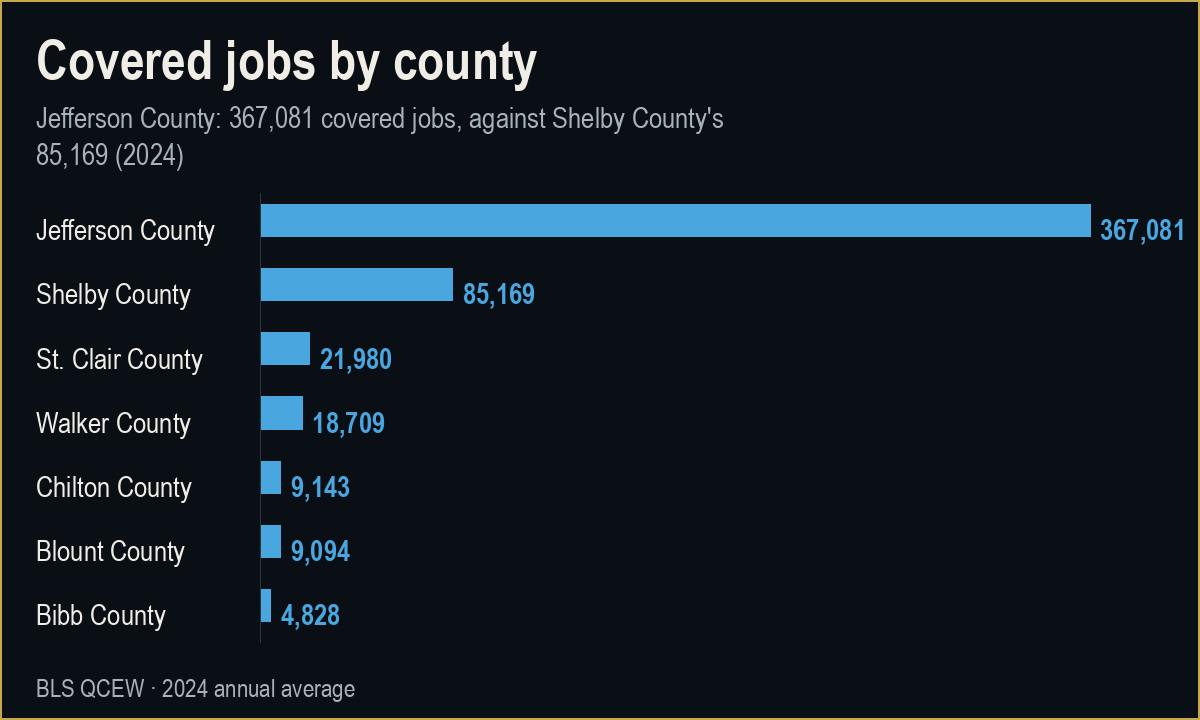
Those wage gaps sit on top of a large difference in the size of each county’s job base. Jefferson County carried 367,081 covered jobs on an annual-average basis in 2024, making it the clear employment anchor for the region. Shelby County’s employment base was roughly a quarter of that, at 85,169 jobs in 2024, and Walker County’s was 18,709. St. Clair County supported 21,980 covered jobs, Blount County 9,094, Chilton County 9,143, and Bibb County 4,828.
Business establishment counts reinforce that picture of concentration. Jefferson County was home to 22,923 establishments on a 2024 annual-average basis, while Shelby County had 7,251, St. Clair County 1,943, Walker County 1,536, Blount County 956, Chilton County 922, and Bibb County 445. These are not just counts of storefronts; they are a proxy for where business formation and employment relationships are actually showing up in the data.
City documents describe Birmingham itself as the economic center of the metropolitan area, with a diverse economy supported by multiple development projects and major employers. One example: the University of Alabama Medical Center is identified as the city’s largest employer with approximately 19,000 jobs in a past city report. That same report notes that banking is another pillar, highlighting Regions Bank’s acquisition of AmSouth Bancorp and stating that the merger was expected to add around 400 jobs across the metropolitan area, with a significant share in the city. These institutional anchors help explain why higher-wage employment is concentrated in Jefferson County.
City policy has also tried to shape how and where growth shows up. In a letter about federal Opportunity Zone designations, Birmingham officials described their model as built by identifying community and economic assets, and asked to substitute one Ensley census tract for another so that the chosen tract would include the neighborhood’s Commercial Business District. They also noted that only half of Eastlake’s commercial district fell inside a designated Opportunity Zone and argued for an adjustment. In that same document, city leaders expressed confidence that these zones would “contain projects that would yield a return for investors, produce value for Birmingham residents and deliver on the promise of creating opportunity for the small businesses, entrepreneurs and institutions” that underpin a strong local economy; that is the city’s stated expectation rather than a verified outcome.
Beyond federal incentives, Birmingham has used its own funding tools to target neighborhood-level development. The city’s BOLD program is described as having been created to advance economic mobility and equitable development across Birmingham’s 99 neighborhoods, and as a request-for-proposals process implemented in 2018 to make community and economic development funding more competitive and transparent. According to the city’s five-year impact report, BOLD has channeled money toward priorities including small businesses, minority- and women-led organizations, workforce development, barrier reduction and data-driven innovation. In 2022 the program added geographic priority areas, explicitly tying grants to place-based development and economic mobility goals.
Not every economic development line item is large on its face. A 2025 non-departmental expense report, for instance, lists an “Economic Development” service (Service 99002) with zero dollars across all budget and transaction columns and “+++” under the percentage-used column, indicating that particular service code did not carry active spending in that period. By contrast, a 2023 capital projects fund report shows an “Opus Project” categorized under “2020 CIP Economic Development,” with an appropriation of $67,999.99 and a status of “Active” tied to a February 25, 2020 start date. These entries illustrate how specific capital projects and operating lines are used—sometimes lightly, sometimes with discrete allocations—to pursue economic development within the broader budget.
For regional investors and employers, the verified data points set some boundaries on what is actually happening. Jefferson County combines the metro’s largest job base with its highest average weekly wages and the densest concentration of business establishments. The neighboring counties show smaller, but real, employment and establishment bases at lower wage levels. City documents add context about how Birmingham is trying to steer that growth through incentive zones, neighborhood grant programs and targeted capital projects.
What the evidence does not show, at least in this set of documents, is whether these interventions are changing long-run wage or employment trajectories in specific neighborhoods. The BLS data are reported at the county level, and the city program documents describe goals and structures rather than measured outcomes. Any claim that the region is on the verge of a dramatic shift in economic standing would go beyond what the current evidence supports. What is established is a metro anchored by a high-wage, high-density core, with surrounding counties building out their own employment and business bases alongside city-led efforts to direct where the next projects land.