
One plant, one tech expansion or one federal award does not remake a metro economy. Around Birmingham, though, several of these moves are stacking on top of an already substantial job base – and they are landing in different parts of the region rather than a single downtown block.
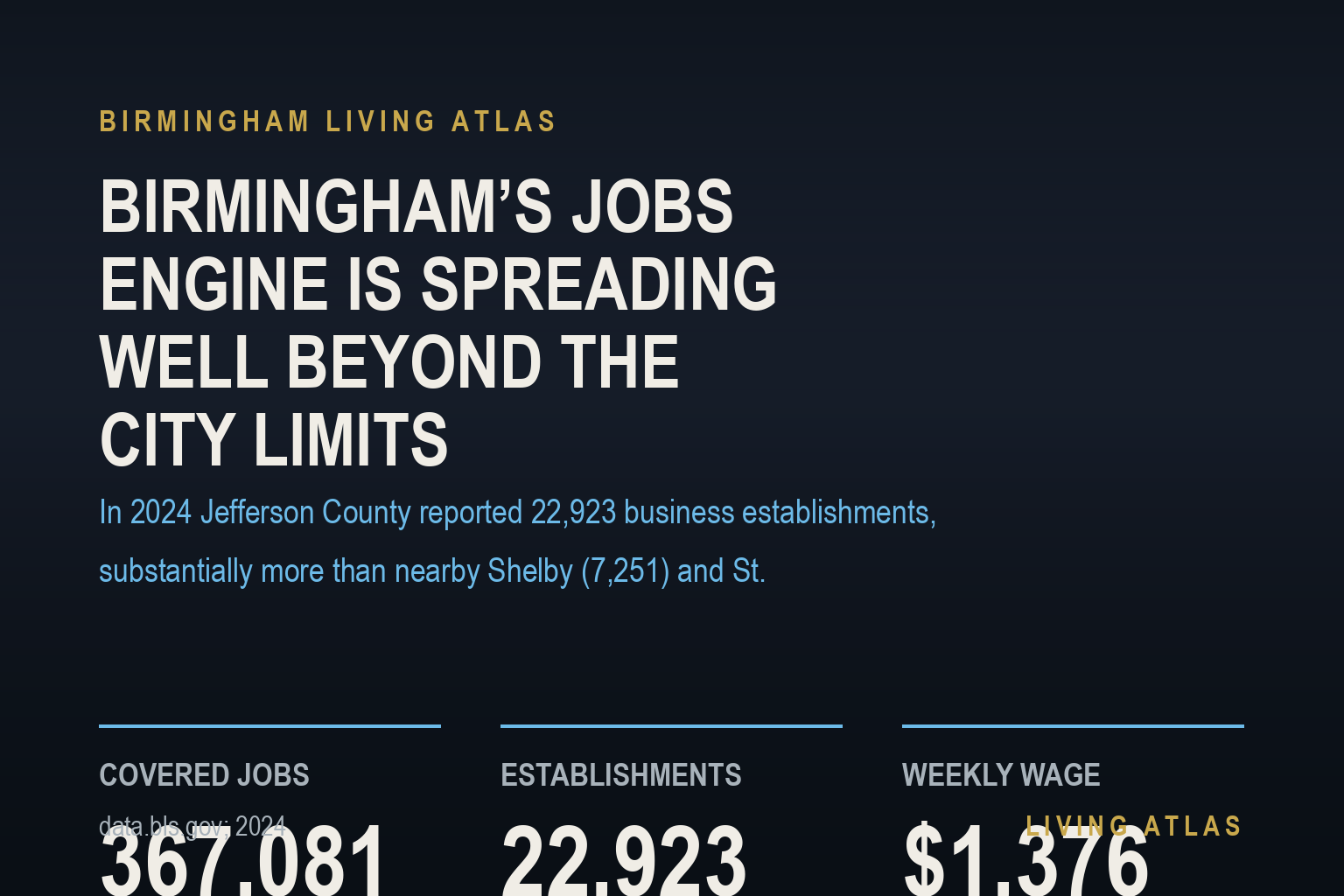
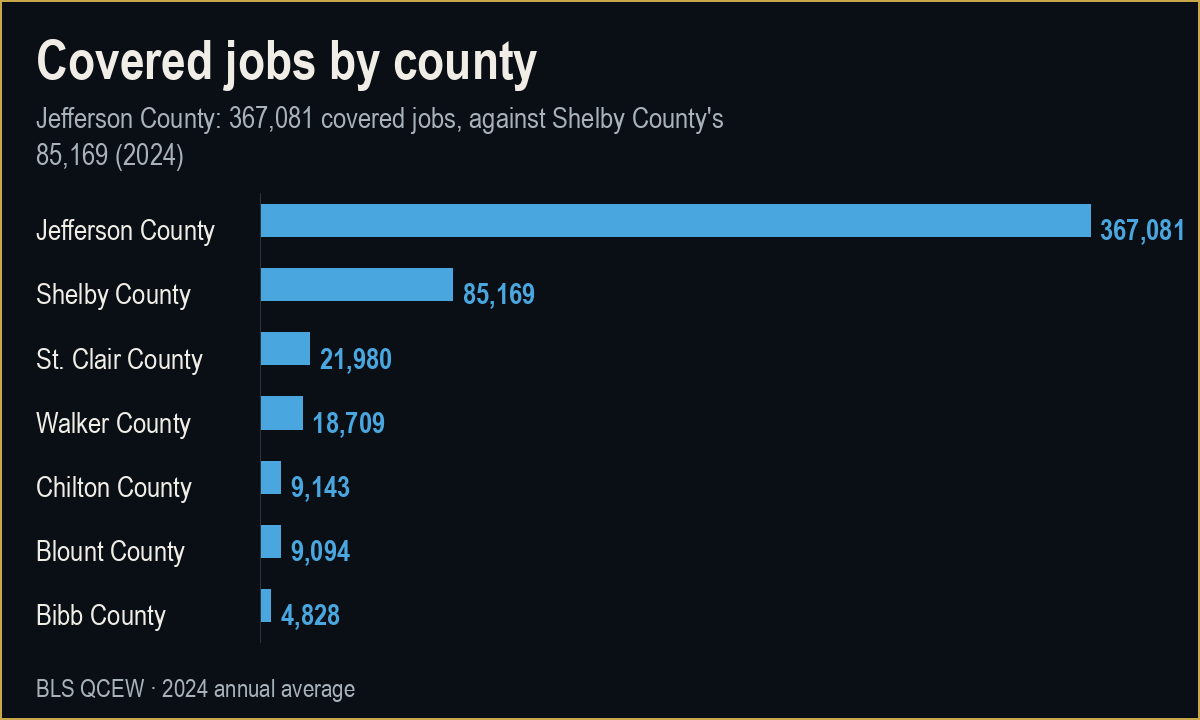
Jefferson County still carries most of the Birmingham-area economy. It averaged 367,081 covered jobs in 2024, with employers paying an average weekly wage of $1,376. 1 1 Those jobs are spread across 22,923 business establishments, up from 21,422 in 2022. 1 But capital and hiring commitments are no longer confined to Jefferson’s core.
Committed projects: logistics, tech and food manufacturing
On the logistics and manufacturing side, The J.M. Smucker Co. is building a facility in the Jefferson County community of McCalla. The project carries a total financial investment of $1.1 billion and is planned in three phases, with up to 750 jobs tied to the buildout. 2 2 The announced site sits inside Jefferson County, but its hiring pool will inevitably extend into neighboring counties that already show smaller, commuting-scale employment bases.
In Birmingham’s tech sector, Shipt has laid out a separate expansion path. The company’s project calls for adding 881 full-time employees to its existing Birmingham staff of 330 over three years, with an average salary of $48,231. 3 State officials describe this as a plan to “create more than 800 new jobs” to grow Alabama’s technology industry. 3 The City of Birmingham, for its part, has committed up to $1.7 million as part of an economic development package, targeted at professional skill development, hiring local talent and attracting software engineers and data scientists. 3
If those announced jobs materialize on schedule, they would represent a meaningful increment to Jefferson County’s covered employment base and to the region’s tech-and-services wage pool. Whether that hiring ultimately drives additional office demand or new residential development will depend on where workers choose to live and how many of those positions are filled locally versus through in-migration.
Federal research money as an economic catalyst
Alongside private-sector projects, the University of Alabama at Birmingham is expanding its research footprint with a new Biomedical Research and Psychology Building. UAB reports a project budget of $190 million, backed by $152 million in federal funding – 80 percent of the total – from the Health Resources and Services Administration, with the remaining $38 million coming from non-federal sources. 4 5 A separate UAB account notes the project has “now received $152 million in federal funding,” following an earlier $76 million appropriation. 5
UAB ties that building directly to its research and economic role. The university points to $780 million in annual research expenditures and says the new facility will help “build on” that figure. 4 In a different document, UAB reports that its research funding exceeded $715 million in 2022, a $67.8 million year‑over‑year increase and a five‑year gain of $237 million, which it characterizes as 50 percent growth over that period. 5 UAB leadership explicitly names economic development as one of the institution’s mission pillars, alongside education, research innovation, community service and patient care. 6 They also argue that new and renovated research buildings allow UAB to retain and hire investigators, expand its research portfolio and open up additional public and private funding opportunities. 6
UAB’s vice president for research goes a step further, saying the Biomedical Research and Psychology Building will allow the university to “aggressively expand its research portfolio and related funding and economic impact.” 5 That language is a statement of intent rather than a measured outcome; it does, however, show how UAB is framing research infrastructure as part of the region’s economic story, not just its academic one.
Biotechnology and AI as a distinct lane
Beyond UAB itself, the Birmingham Biotechnology Hub has secured federal recognition under the U.S. Economic Development Administration’s Regional Technology and Innovation Hubs program. The EDA describes the hub as “building a stronger U.S. foundation for drug discovery and next‑generation medicines by combining biotechnology with advanced data and AI tools.” 7 According to the same documentation, the hub – led by the Birmingham Bio Innovation Corporation – draws on “regional strengths in clinicogenomic data, human‑relevant testing systems, and applied machine learning” to improve how potential treatments are identified, evaluated and prepared for development. 7
The stated goals extend beyond lab work. The hub’s mandate includes strengthening the domestic infrastructure needed to advance new medicines, supporting biotechnology entrepreneurs and expanding the technical workforce. 7 The EDA writes that, through this effort, the hub seeks to enhance U.S. competitiveness in biomedical innovation and contribute to “more resilient and effective pathways” for developing future therapeutics. 7 As with other announced initiatives, those are aims rather than outcomes, but they give a sense of the lane Birmingham is trying to occupy within life sciences and data‑driven medicine.
How the region’s job base is distributed
The Birmingham economy is not just Jefferson County and UAB. Surrounding counties already support their own employment and business bases, at much smaller scale, which positions them as potential spillover markets if job growth continues to cluster around logistics, research and advanced services.
To the south, Shelby County recorded 85,169 covered jobs in 2024, with an average weekly wage of $1,284 and 7,251 business establishments. 8 8 8 Its employment total is roughly one quarter of Jefferson’s but at a wage level not far behind, suggesting a substantial professional and industrial base.
St. Clair County, to the northeast, averaged 21,980 covered jobs in 2024, across 1,943 establishments, with an average weekly wage of $989. 9 9 9 Blount County supported 9,094 covered jobs and 956 establishments, with workers earning an average weekly wage of $879. 10 10 10 Southwest of Birmingham, Bibb County recorded 4,828 covered jobs in 2024, spread over 445 establishments, with an average weekly wage of $1,020. 11 11 11
Chilton County to the south had 9,143 covered jobs and 922 establishments in 2024, with an average weekly wage of $915. 12 12 12 Walker County to the northwest recorded 18,709 covered jobs, 1,536 establishments and an average weekly wage of $936. 13 13 13 Individually, these are modest economies; taken together, they form a ring of employment that interacts with Jefferson’s core through commuting, supply chains and shared infrastructure.
City hall’s role: where Birmingham says it is aiming its efforts
Birmingham’s Department of Innovation and Economic Opportunity presents itself as the city’s economic development arm. On its own site, the department says it is “shaping Birmingham’s future by connecting our people, businesses, assets, and opportunities to the markets and investments that drive sustainable growth.” 14 It lists specific functions: strengthening homegrown businesses, attracting and retaining high‑growth industries, cultivating a skilled and competitive workforce and positioning Birmingham for new investment and development. 14
The department also says it “aligns local strengths with regional and global opportunities” to build what it calls a “resilient, opportunity‑rich economy where businesses can grow” and talent can thrive. 14 It describes its resource strategy as focusing on areas with the “highest multiplier effect” by supporting businesses ready to scale and industries ready to invest. 14 Those are stated priorities, not audited outcomes, but they help explain why the city has been willing to put dollars behind projects like the Shipt expansion. 3
If these bets compound, what changes next?
None of these projects, taken alone, guarantees a step‑change for Birmingham. The Smucker’s plant in McCalla is planned to create up to 750 jobs over three phases. 2 Shipt’s expansion calls for 881 additional full‑time roles. 3 UAB’s new building represents $190 million of bricks‑and‑mortar research infrastructure with $152 million in federal backing. 4 5 The biotechnology hub is described as an effort to strengthen the region’s role in drug discovery and AI‑enabled medicine. 7 7
If execution matches these announcements, one reasonable scenario is that Jefferson County’s already large employment base becomes more weighted toward higher‑wage sectors – technology, research, advanced manufacturing – with some of the housing and service‑sector response landing in adjacent counties that currently have far smaller job counts and business establishment numbers. In that case, counties like Shelby and St. Clair, which already show meaningful employment and establishment bases at lower wages than Jefferson, could see incremental demand for both labor and space.
The downside risk is straightforward: announced jobs can arrive later than projected, at lower headcounts, or not at all; research facilities can take longer to translate into private spin‑outs and new employers than their advocates hope. The evidence here captures committed capital and stated intentions – not a guarantee of how much private investment, population growth or real‑estate pressure will follow.
What to watch from here
- Smucker’s hiring and construction pacing: whether the McCalla facility advances through all three planned phases, and how quickly it approaches the “up to 750 jobs” figure. 2 2
- Shipt’s actual headcount in Birmingham: progress toward adding 881 full‑time employees and the mix of local versus imported talent, given the city’s $1.7 million commitment. 3 3
- UAB research growth after the new building opens: whether the university’s research funding and expenditure totals continue to rise from the $715–$780 million baseline it reports today. 4 5
- Biotech hub activity: concrete signs that the Birmingham Biotechnology Hub is supporting new companies, workforce programs or infrastructure tied to drug discovery and AI‑enabled medicine, beyond the federal designation itself. 7 7
- Spillover into surrounding counties: changes in covered employment, average wages and business establishments in Shelby, St. Clair, Walker, Chilton, Blount and Bibb that would indicate regional, not just Jefferson‑centric, growth. 8 9 13 12 10 11
The through‑line in the evidence is that Birmingham is adding committed capital and announced hiring on top of a large existing job base, anchored by UAB and logistics‑driven manufacturing. The scale of the next chapter will be determined less by any single ribbon‑cutting than by whether these pieces begin to reinforce one another across the metro’s counties.
Sources
- U.S. Bureau of Labor Statistics. Quarterly Census of Employment and Wages, annual averages — Jefferson County, Alabama. 2024 View source
- Office of the Governor of Alabama. Governor ivey announces the j m smucker co to build alabama manufacturing plant creating up to 750 jobs in birmingham View source
- Office of the Governor of Alabama. Governor ivey announces birminghams shipt to create 881 jobs in major expansion View source
- University of Alabama at Birmingham. Biomedical research and psychology building groundbreaking View source
- University of Alabama at Birmingham. Federal funding to bring new biomedical research and psychology building to uab View source
- University of Alabama at Birmingham. Uab s 12 new construction and renovation projects transforming campus supporting strategic initiatives View source
- U.S. Economic Development Administration. Birmingham Biotechnology Hub View source
- U.S. Bureau of Labor Statistics. Quarterly Census of Employment and Wages, annual averages — Shelby County, Alabama. 2024 View source
- U.S. Bureau of Labor Statistics. Quarterly Census of Employment and Wages, annual averages — St. Clair County, Alabama. 2024 View source
- U.S. Bureau of Labor Statistics. Quarterly Census of Employment and Wages, annual averages — Blount County, Alabama. 2024 View source
- U.S. Bureau of Labor Statistics. Quarterly Census of Employment and Wages, annual averages — Bibb County, Alabama. 2024 View source
- U.S. Bureau of Labor Statistics. Quarterly Census of Employment and Wages, annual averages — Chilton County, Alabama. 2024 View source
- U.S. Bureau of Labor Statistics. Quarterly Census of Employment and Wages, annual averages — Walker County, Alabama. 2024 View source
- City of Birmingham. Department innovation economic opportunity View source