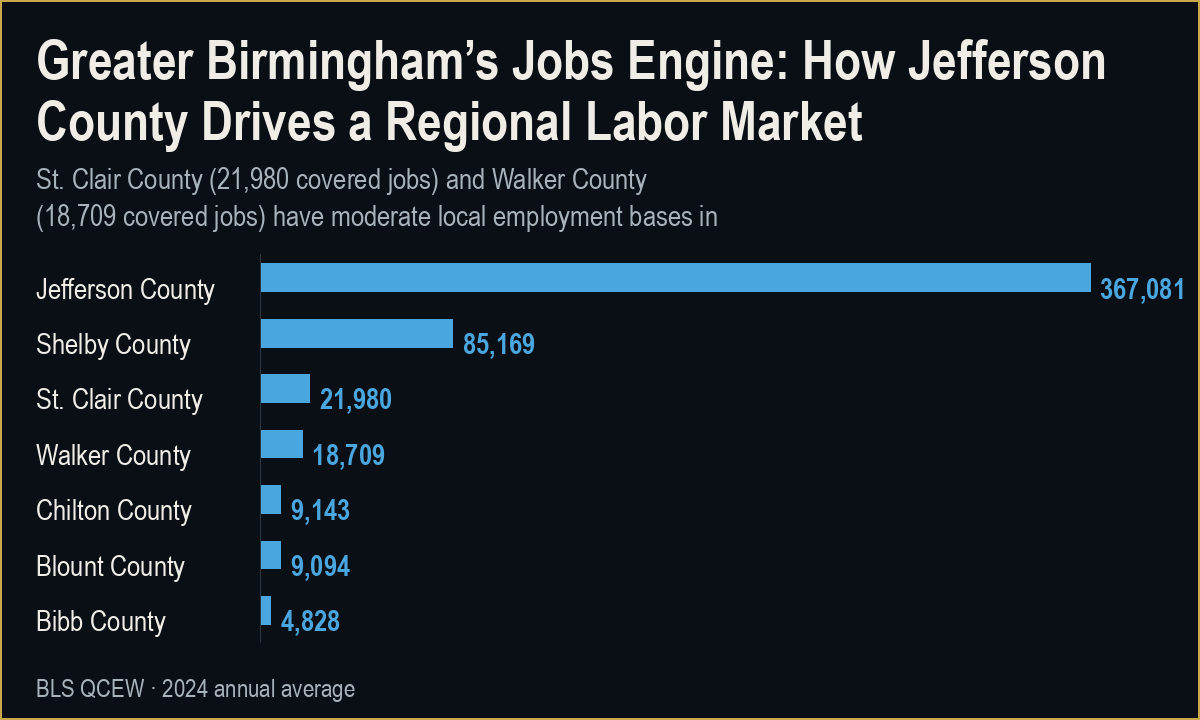
Employment and investment data indicate that Jefferson County functions as the core of a larger, integrated labor market spanning multiple central Alabama counties. Those cross‑county ties shape the operating environment for employers, workers, and ultimately for real estate and infrastructure decisions across the region.
Jefferson County as the regional employment center
On standard labor‑market measures, Jefferson County is the clear jobs hub. The U.S. Bureau of Labor Statistics’ Quarterly Census of Employment and Wages (QCEW) shows that Jefferson County had 367,081 covered jobs on an annual‑average basis in 2024, up from 356,742 in 2022 and 362,788 in 20231. The county also supported 22,923 business establishments in 2024, rising from 21,422 in 2022 and 22,427 in 20232. Average weekly wages reached $1,376 in 2024, after $1,276 in 2022 and $1,331 in 20233.
Regional organizations describe this scale as part of a broader, shared economy. The Birmingham Business Alliance states that “Greater Birmingham operates as one connected economy. Talent, jobs, and investment move across city and county lines every day”4. In that framing, Jefferson County’s dense employment base and higher wage levels provide jobs and income opportunities that reach well beyond its borders.
Surrounding counties: smaller bases, linked to the core
Counties surrounding Jefferson have much smaller job bases and establishment counts, but they participate in the same commuting and business network.
- Shelby County recorded 85,169 covered jobs in 2024, slightly down from 86,332 in 2022 and 85,595 in 20235. It hosted 7,251 establishments in 2024, up from 6,809 in 2022 and 6,982 in 20236. Average weekly wages stood at $1,284 in 2024, after $1,223 in 2022 and $1,246 in 20237.
- St. Clair County had 21,980 covered jobs in 2024, up from 19,970 in 2022 and 21,121 in 20238. Establishments increased to 1,943 in 2024 from 1,769 in 2022 and 1,827 in 20239. The average weekly wage reached $989 in 2024, compared with $920 in 2022 and $957 in 202310.
- Blount County reported 9,094 covered jobs in 2024, up from 8,726 in 2022 and 8,857 in 202311. It had 956 establishments in 2024, after 896 in 2022 and 932 in 202312. Average weekly wages were $879 in 2024, compared with $825 in 2022 and $840 in 202313.
- Chilton County had 9,143 covered jobs in 2024, similar to 9,047 in 2022 and 9,227 in 202314. Establishments totaled 922 in 2024, up from 856 in 2022 and 913 in 202315. The county’s average weekly wage reached $915 in 2024, following $854 in 2022 and $897 in 202316.
- Walker County recorded 18,709 covered jobs in 2024, up from 17,790 in 2022 and 18,468 in 202317. It had 1,536 establishments in 2024, compared with 1,498 in 2022 and 1,549 in 202318. Average weekly wages were $936 in 2024, after $867 in 2022 and $903 in 202319.
- Bibb County had 4,828 covered jobs in 2024, effectively level with 4,836 in 2022 and 4,815 in 202320. It counted 445 establishments in 2024, rising from 404 in 2022 and 433 in 202321. Average weekly wages reached $1,020 in 2024, up from $932 in 2022 and $986 in 202322.
The Birmingham Business Alliance describes these jurisdictions collectively as “a unified network of organizations across seven central Alabama counties, working together to strengthen economic development, talent recruitment and tourism”23. It further notes that every day “thousands of people cross city and county lines to work in Greater Birmingham,” highlighting a daily commuting workforce that ties the counties together24. While the evidence does not provide county‑to‑county commuter flows or specific property impacts, it does support the conclusion that employers in one county draw on labor and supporting services from others.
Infrastructure, location, and industrial strategy
Transportation access is one of the region’s main structural advantages as presented by local organizations. The Birmingham Business Alliance points out that five major interstate corridors intersect in Birmingham, including I‑20/59, I‑65, and I‑22, connecting the region to key Southeast markets and placing 78% of the U.S. population within a two‑day drive25. The same organization also emphasizes Birmingham’s “central location” and combined interstate, rail, and air access as giving companies the ability to operate efficiently at regional and national scales26. Those claims describe connectivity conditions that are relevant to site‑selection, logistics, and industrial land demand, but the material here does not quantify how that connectivity has translated into specific project counts or absorbed square footage.
On the industry side, the Birmingham Business Alliance reports that its economic development efforts focus on advanced manufacturing, automotive, business services, food and beverage, life sciences, logistics, metals, and technology27. It also notes that the region is home to more than 100 foreign‑based companies representing over 20 countries28. These details establish an explicit sectoral focus and a base of international investors, though the available material does not break those presences down by county or corridor.
Local and federal initiatives shaping the labor market
Within the City of Birmingham, municipal economic development activity is organized around the Department of Innovation and Economic Opportunity. The department describes its purpose as “connecting our people, businesses, assets, and opportunities to the markets and investments that drive sustainable growth”29. It reports that it works to “strengthen homegrown businesses, attract and retain high‑growth industries, cultivate a skilled and competitive workforce, and position Birmingham for new investment and development”30. The department also states that, by “aligning local strengths with regional and global opportunities,” it is working to build “a resilient, opportunity-rich economy”31, and that for residents it is “dedicated to building pathways toward economic mobility” so that growth translates into “tangible opportunities for every neighborhood”32. These are mission statements rather than measured outcomes; the evidence here does not quantify program results.
Federal resources are also flowing into specific Birmingham neighborhoods. The U.S. Economic Development Administration reports that the Reinvest Birmingham Recompete Plan, led by the City of Birmingham, will receive approximately $20 million “to support the persistently distressed neighborhoods of North Birmingham, Northside, Pratt, and Smithfield”33. According to EDA, Northwest Birmingham has faced “significant challenges over the years that contributed to a lack of prime-age residents participating in the labor force”34. Recompete funding is expected to provide “in-demand workforce training to residents in the target neighborhoods through a partnership with Lawson State Community College”35, and also to include “support for entrepreneurs facing disparities in training and capital access” as well as expanded “transportation and accessible childcare in the target neighborhoods”36. These initiatives speak directly to labor‑force participation and small‑business conditions in specific neighborhoods; what they mean for commercial vacancy, rent levels, or residential turnover is not quantified in the material provided.
Large‑scale projects and capital investment
At the project level, state officials have highlighted individual industrial investments that rely on the region’s workforce and infrastructure. In 2021, the Alabama governor’s office announced that The J.M. Smucker Co. would build a manufacturing facility in the Jefferson County community of McCalla with “a total financial investment of $1.1 billion”37. The facility is planned to be “constructed over three phases creating up to 750 jobs”38. Those figures document the scale of the capital commitment and projected employment for that specific plant and confirm that at least some large industrial users are choosing Jefferson County locations tied into the interstate network. However, the evidence set here does not include follow‑up data on build‑out timing, hiring progress, wage levels at the facility, or secondary effects on nearby industrial or residential property.
How regional dynamics affect local decisions
The regional organizations’ descriptions emphasize that employers draw from a broad, multi‑county labor market and that “talent, jobs, and investment move across city and county lines every day”424. They also state that employers benefit from “a broad labor market supported by leading universities, technical colleges, and workforce development programs” that provide “the skilled workers they need to meet the demands of evolving industries”41. While those points are qualitative, they align with the quantitative pattern in which Jefferson County’s job and establishment totals far exceed those of its neighbors, and wage levels in Jefferson and Shelby counties sit above those reported for surrounding counties371013161922. For property stakeholders, the documented facts establish a few clear anchors:
- Jefferson County is the dominant employment and establishment center by a wide margin, which is likely to concentrate office, industrial, and supporting service demand.
- Surrounding counties are smaller but growing on most measures of establishments and wages, and they are explicitly described by regional organizations as part of the same functional economy.
- Public initiatives—from the J.M. Smucker investment to the Recompete Plan—are channeling capital and workforce resources into both suburban industrial sites and historically distressed urban neighborhoods.
What the evidence does not show are parcel‑level outcomes, detailed sector employment by submarket, or any forecasted performance. Those gaps matter: readers should not infer guaranteed project delivery, automatic neighborhood uplift, or specific rent trajectories from the data presented here. The information available supports a grounded picture of a multi‑county labor market with a strong Jefferson County core, but it does not by itself resolve how that structure will translate into future property‑market results.
- Jefferson County covered employment 2022–2024: 356,742; 362,788; 367,081 jobs (QCEW annual averages).↩︎
- Jefferson County business establishments 2022–2024: 21,422; 22,427; 22,923 (QCEW annual averages).↩︎
- Jefferson County average weekly wage 2022–2024: $1,276; $1,331; $1,376 (QCEW annual averages).↩︎
- Greater Birmingham described as “one connected economy” with talent, jobs, and investment moving across city and county lines daily (Birmingham Business Alliance).↩︎
- Shelby County covered employment 2022–2024: 86,332; 85,595; 85,169 jobs (QCEW annual averages).↩︎
- Shelby County business establishments 2022–2024: 6,809; 6,982; 7,251 (QCEW annual averages).↩︎
- Shelby County average weekly wage 2022–2024: $1,223; $1,246; $1,284 (QCEW annual averages).↩︎
- St. Clair County covered employment 2022–2024: 19,970; 21,121; 21,980 jobs (QCEW annual averages).↩︎
- St. Clair County business establishments 2022–2024: 1,769; 1,827; 1,943 (QCEW annual averages).↩︎
- St. Clair County average weekly wage 2022–2024: $920; $957; $989 (QCEW annual averages).↩︎
- Blount County covered employment 2022–2024: 8,726; 8,857; 9,094 jobs (QCEW annual averages).↩︎
- Blount County business establishments 2022–2024: 896; 932; 956 (QCEW annual averages).↩︎
- Blount County average weekly wage 2022–2024: $825; $840; $879 (QCEW annual averages).↩︎
- Chilton County covered employment 2022–2024: 9,047; 9,227; 9,143 jobs (QCEW annual averages).↩︎
- Chilton County business establishments 2022–2024: 856; 913; 922 (QCEW annual averages).↩︎
- Chilton County average weekly wage 2022–2024: $854; $897; $915 (QCEW annual averages).↩︎
- Walker County covered employment 2022–2024: 17,790; 18,468; 18,709 jobs (QCEW annual averages).↩︎
- Walker County business establishments 2022–2024: 1,498; 1,549; 1,536 (QCEW annual averages).↩︎
- Walker County average weekly wage 2022–2024: $867; $903; $936 (QCEW annual averages).↩︎
- Bibb County covered employment 2022–2024: 4,836; 4,815; 4,828 jobs (QCEW annual averages).↩︎
- Bibb County business establishments 2022–2024: 404; 433; 445 (QCEW annual averages).↩︎
- Bibb County average weekly wage 2022–2024: $932; $986; $1,020 (QCEW annual averages).↩︎
- Description of Greater Birmingham Region as a unified network of organizations across seven central Alabama counties (Birmingham Business Alliance).↩︎
- Statement that “thousands of people” cross city and county lines daily to work in Greater Birmingham (Birmingham Business Alliance).↩︎
- Five major interstate corridors intersecting in Birmingham, connecting to key Southeast markets and 78% of the U.S. population within a two‑day drive, including I‑20/59, I‑65, and I‑22 (Birmingham Business Alliance).↩︎
- Birmingham’s central location and multimodal transportation access enabling regional and national operations (Birmingham Business Alliance).↩︎
- Target industries listed by the Birmingham Business Alliance: advanced manufacturing, automotive, business services, food & beverage, life sciences, logistics, metals, technology (Birmingham Business Alliance).↩︎
- Greater Birmingham region reported as home to 100+ foreign‑based companies from 20+ countries (Birmingham Business Alliance).↩︎
- Department of Innovation and Economic Opportunity purpose statement: connecting people, businesses, assets, and opportunities to markets and investments that drive sustainable growth (City of Birmingham).↩︎
- Department activities: strengthening homegrown businesses, attracting and retaining high‑growth industries, cultivating a skilled and competitive workforce, and positioning Birmingham for new investment and development (City of Birmingham).↩︎
- Economic‑development framing around aligning local strengths with regional and global opportunities to build a resilient, opportunity‑rich economy (City of Birmingham).↩︎
- Commitment to residents: building pathways toward economic mobility and aiming for tangible opportunities for every neighborhood (City of Birmingham).↩︎
- Reinvest Birmingham Recompete Plan award of approximately $20 million for North Birmingham, Northside, Pratt, and Smithfield neighborhoods (U.S. Economic Development Administration).↩︎
- EDA description of Northwest Birmingham’s challenges and low prime‑age labor‑force participation (U.S. Economic Development Administration).↩︎
- Planned provision of in‑demand workforce training through a partnership with Lawson State Community College (U.S. Economic Development Administration).↩︎
- Support for entrepreneurs facing training and capital‑access disparities, and for transportation and childcare in target neighborhoods (U.S. Economic Development Administration).↩︎
- J.M. Smucker facility in McCalla announced with a total financial investment of $1.1 billion (Office of the Governor of Alabama).↩︎
- J.M. Smucker facility to be constructed over three phases creating up to 750 jobs (Office of the Governor of Alabama).↩︎
- Employers reported to benefit from a broad labor market supported by universities, technical colleges, and workforce development programs (Birmingham Business Alliance).↩︎