Jefferson County’s economy is adding jobs and paychecks from a higher starting point than any county around it, and new capital projects could reinforce that position if they come together as planned.
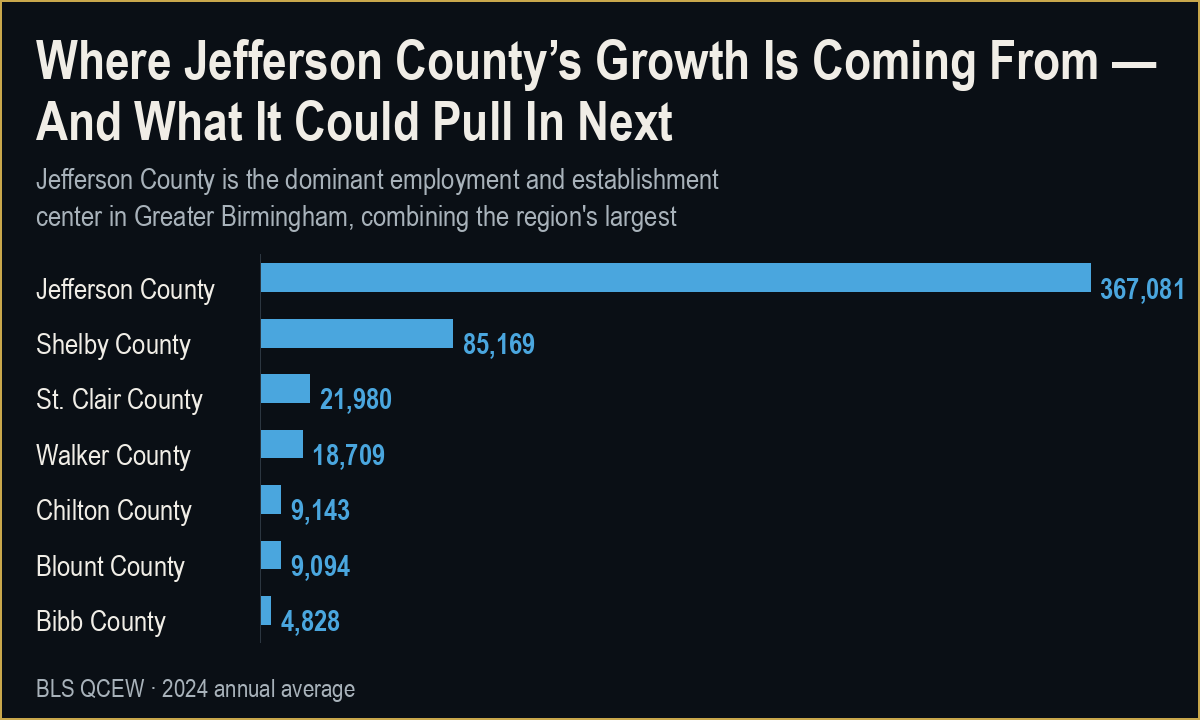
On the jobs side, covered employment in Jefferson County averaged 367,081 positions in 2024, up from 356,742 in 2022 and 362,788 in 2023, according to the U.S. Bureau of Labor Statistics’ Quarterly Census of Employment and Wages (QCEW).[1] Over the same period, the number of business establishments grew from 21,422 in 2022 to 22,923 in 2024.[2] Average weekly wages rose from $1,276 in 2022 to $1,376 in 2024.[3]
Those numbers give Jefferson County a substantially larger and better‑paid employment base than the counties around it. Shelby County, for example, had 85,169 covered jobs in 2024 — about one quarter of Jefferson’s level — with an average weekly wage of $1,284.[4][5] Walker County had 18,709 covered jobs and a $936 average weekly wage,[6][7] St. Clair 21,980 jobs at $989 a week,[8][9] Chilton 9,143 jobs at $915 a week,[10][11] Blount 9,094 jobs at $879 a week,[12][13] and Bibb 4,828 jobs at $1,020 a week.[14][15]
In business-formation terms, Jefferson’s 22,923 establishments in 2024 compare with 7,251 in Shelby County,[16] 1,943 in St. Clair,[17] 1,536 in Walker,[18] 956 in Blount,[19] 922 in Chilton,[20] and 445 in Bibb.[21] The surrounding counties are clearly participating in the region’s employment story, but the bulk of jobs and firms remain concentrated in Jefferson.
What is actually being built and committed?
Two sets of projects show how more capital could layer onto that base if plans execute: a large manufacturing investment on the edge of the county and a steady build‑out of UAB’s campus in the urban core.
In 2021, the State of Alabama announced that The J.M. Smucker Co. would build a manufacturing plant in the Jefferson County community of McCalla. The governor’s office described the project as involving a total financial investment of $1.1 billion, to be constructed over three phases and creating up to 750 jobs.[22] The company said construction and production would occur in three phases over multiple years, with investments and job creation aligned to each phase.[23] It also stated that those investments and jobs were contingent on approval of tax and business incentives and on closing the property purchase.[23]
Construction of the facility was expected to begin no later than January 2022, with production commencing in calendar year 2025, according to the same announcement.[24] The evidence here is about the plan and timeline as described at the time. Whether the project has stayed on schedule, fully secured its incentives, or reached each employment phase is not documented in the material provided, so any current status beyond those statements would be speculative.
In downtown Birmingham, the University of Alabama at Birmingham (UAB) is using construction and renovation as a tool for its broader mission, which explicitly includes economic development. A UAB campus article says a slate of 12 new construction and renovation projects is intended to enhance opportunities across the university’s pillars of education, research innovation and economic development, community service, and patient care.[25] The same document notes that the development of UAB’s physical campus affects recruitment and retention of students, faculty and staff by providing state‑of‑the‑art places to live, study and work.[26]
On the research side, UAB says new and renovated research buildings bring updated technology, support retention and hiring of investigators to expand the university’s research portfolio and impact, and enable additional private and public funding opportunities.[27] The piece does not quantify those funding flows or employment impacts, but it establishes that campus capital projects are being pursued partly for their economic effects.
How local agencies say they are trying to shape that growth
Within this landscape, Birmingham’s Department of Innovation and Economic Opportunity describes its role as connecting people, businesses, assets and opportunities to markets and investments that drive sustainable growth.[28] The department says it works to strengthen homegrown businesses, attract and retain high‑growth industries, cultivate a skilled and competitive workforce, and position Birmingham for new investment and development.[29]
The department also states that it focuses resources where they have the highest multiplier effect, by supporting businesses ready to scale and industries ready to invest.[30] These are the department’s own characterizations of its strategy; the evidence set here does not include independent evaluation of outcomes.
Why this matters for the region’s next cycle
The combination of a large existing employment base in Jefferson County, wage levels that exceed those in neighboring counties, and a concentration of establishments suggests that the county is the primary economic engine in this part of Alabama.[1][2][3][4][5][6][7][8][9][10][11][12][13][14][15][16][17][18][19][20][21] If announced projects like the McCalla manufacturing facility are completed roughly as described, they could add several hundred additional jobs tied to a $1.1 billion capital investment.[22][23] That would be meaningful relative to Jefferson’s recent net gain of about 10,000 covered jobs from 2022 to 2024.[1]
Similarly, if UAB’s campus build‑out continues to support the recruitment and retention of students, faculty and researchers and attracts additional private and public funding, it could deepen Birmingham’s role as a research and healthcare employer.[25][26][27] That, in turn, could support more professional‑services and real‑estate demand in the neighborhoods around campus. Those are reasonable inferences based on how university‑anchored districts often evolve, but the documents cited do not quantify the scale or timing of such effects, so they should be read as conditional rather than as established outcomes.
What to watch next
- Execution of the McCalla plant phases. The key questions are whether all three phases proceed, whether the facility reaches “up to 750 jobs” as stated, and how quickly capital is deployed relative to the 2025 production target.[22][23][24]
- Trajectory of Jefferson County’s wage and employment growth. Covered employment and wages have risen from 2022 to 2024; whether that trend continues, accelerates or stalls will shape how much additional demand the county can support.[1][3]
- Spillovers into surrounding counties. Neighboring counties like Shelby, St. Clair, Walker, Blount, Chilton and Bibb all show smaller employment and wage bases but are part of the same labor market.[4][5][6][7][8][9][10][11][12][13][14][15][16][17][18][19][20][21] If Jefferson‑based jobs continue to grow, some of the housing and small‑business response may appear across county lines.
- UAB’s ability to translate campus projects into funding and hiring. The university has stated its goals for new and renovated facilities in terms of investigators, impact and funding.[25][26][27] Tracking actual research awards, staffing and related development over time would show how much of that potential is realized.
- Alignment with city economic‑development strategy. Birmingham’s economic‑development department describes an emphasis on scaling businesses and high‑growth industries.[29][30] Observing which sectors actually expand — advanced manufacturing, healthcare, research, or others — will indicate where the strategy is gaining traction.
None of these developments, on their own, guarantee a step‑change in growth. But the evidence does show a county with the region’s largest employment and business base, incremental gains in jobs and wages, a sizable manufacturing project announced in its orbit, and a research university explicitly tying construction and renovation to economic development. How strongly those pieces reinforce one another will determine how much further the Birmingham area’s next cycle can run.
Evidence
- Jefferson County, AL covered employment 2022–2024 (356,742; 362,788; 367,081).QCEW, BLS
- Jefferson County, AL business establishments 2022–2024 (21,422; 22,427; 22,923).QCEW, BLS
- Jefferson County, AL average weekly wage 2022–2024 ($1,276; $1,331; $1,376).QCEW, BLS
- Shelby County, AL covered employment 2022–2024 (86,332; 85,595; 85,169).QCEW, BLS
- Shelby County, AL average weekly wage 2022–2024 ($1,223; $1,246; $1,284).QCEW, BLS
- Walker County, AL covered employment 2022–2024 (17,790; 18,468; 18,709).QCEW, BLS
- Walker County, AL average weekly wage 2022–2024 ($867; $903; $936).QCEW, BLS
- St. Clair County, AL covered employment 2022–2024 (19,970; 21,121; 21,980).QCEW, BLS
- St. Clair County, AL average weekly wage 2022–2024 ($920; $957; $989).QCEW, BLS
- Chilton County, AL covered employment 2022–2024 (9,047; 9,227; 9,143).QCEW, BLS
- Chilton County, AL average weekly wage 2022–2024 ($854; $897; $915).QCEW, BLS
- Blount County, AL covered employment 2022–2024 (8,726; 8,857; 9,094).QCEW, BLS
- Blount County, AL average weekly wage 2022–2024 ($825; $840; $879).QCEW, BLS
- Bibb County, AL covered employment 2022–2024 (4,836; 4,815; 4,828).QCEW, BLS
- Bibb County, AL average weekly wage 2022–2024 ($932; $986; $1,020).QCEW, BLS
- Shelby County, AL business establishments 2022–2024 (6,809; 6,982; 7,251).QCEW, BLS
- St. Clair County, AL business establishments 2022–2024 (1,769; 1,827; 1,943).QCEW, BLS
- Walker County, AL business establishments 2022–2024 (1,498; 1,549; 1,536).QCEW, BLS
- Blount County, AL business establishments 2022–2024 (896; 932; 956).QCEW, BLS
- Chilton County, AL business establishments 2022–2024 (856; 913; 922).QCEW, BLS
- Bibb County, AL business establishments 2022–2024 (404; 433; 445).QCEW, BLS
- Smucker McCalla facility: total investment $1.1 billion; three phases; up to 750 jobs.Office of the Governor of Alabama
- Smucker statement that construction and production will occur in three phases over multiple years; investments and job creation contingent on incentives and property closing.Office of the Governor of Alabama
- Expected Smucker construction start by January 2022; production commencing in calendar year 2025.Office of the Governor of Alabama
- UAB statement that new construction and renovations support mission pillars including economic development.UAB
- UAB statement that campus development affects recruitment and retention of students, faculty and staff.UAB
- UAB statement that new/renovated research buildings support retention and hiring of investigators and create additional funding opportunities.UAB
- City description that the Department of Innovation and Economic Opportunity connects people, businesses, assets and opportunities to markets and investments driving sustainable growth.City of Birmingham
- Department statement that it strengthens homegrown businesses, attracts and retains high‑growth industries, cultivates a skilled competitive workforce, and positions Birmingham for new investment and development.City of Birmingham
- Department statement that it focuses resources where they have the highest multiplier effect by supporting businesses ready to scale and industries ready to invest.City of Birmingham