Birmingham is in an investment moment. Headquarters relocations, institutional construction and federal grant applications are stacking up. What is less clear is how far that wave will reach into the neighborhoods and nearby counties where most people actually live.
Three sets of facts frame the stakes.
- The state backed the relocation of flexible-apartment firm Landing’s headquarters from San Francisco to Birmingham, with the company stating that it plans to create 816 new full-time jobs in the city as it scales . The Alabama Department of Commerce estimates that, if this expansion plays out over 20 years, it would generate $1.3 billion in new payroll and $112 million in new state revenue, for a projected 356% return on the state’s incentive investment . Those are projections, but they show the magnitude state officials expect from one white-collar employer.
- Inside the city, Birmingham’s own Department of Innovation and Economic Opportunity says its role is to connect local people, businesses, assets and opportunities to the markets and investments that drive sustainable growth . The department specifically cites work to strengthen homegrown businesses, attract and retain high-growth industries, cultivate a skilled workforce and position Birmingham for new investment and development . It also states that it targets its resources where they have what it calls the “highest multiplier effect,” backing businesses ready to scale and industries ready to invest .
- The University of Alabama at Birmingham describes growth in 2024 across education, research, innovation, economic development, community engagement and patient care , and it ties its ongoing construction and renovation program directly to those pillars, including economic development .
Taken together, these establish that a set of anchors — state-backed employers, a major research university and the city’s own economic-development arm — are investing in and around central Birmingham. The question for residents is how much of that growth will reach their own block, commute and rent bill.
Downtown vs. neighborhoods: a gap the city itself flags
The city’s transportation department states bluntly that “much of downtown Birmingham has started to revitalize,” while “many low-income and underserved neighborhoods surrounding downtown have not experienced the same level of investment in transportation or public spaces” . That is an on-the-record admission that recent gains have been uneven.
One example of how the city says it wants to close that gap is the Birmingham Civil Rights Crossroads project. In 2023, Birmingham applied for a federal RAISE grant to support plans to reconnect the Graymont and Smithfield neighborhoods to downtown . The city describes a “reimagined route” that it says would create new connections to public transit, employment opportunities, green spaces and public health resources .
If that project is funded and built as described, a reasonable inference is that residents of Graymont and Smithfield would have better physical access to jobs and services in the urban core. For housing and neighborhood investment, that could cut both ways: improved connectivity often makes an area more attractive for new residential and retail projects, but it can also raise concerns about displacement if incomes in place do not keep pace. There is not enough evidence here to say which way those corridors will tip, only that the city is explicitly trying to link underserved neighborhoods back into the employment center.
Where the jobs are now: a regional snapshot
Looking at the broader Birmingham labor shed shows where employment and business activity are already concentrated and where there is room to grow.
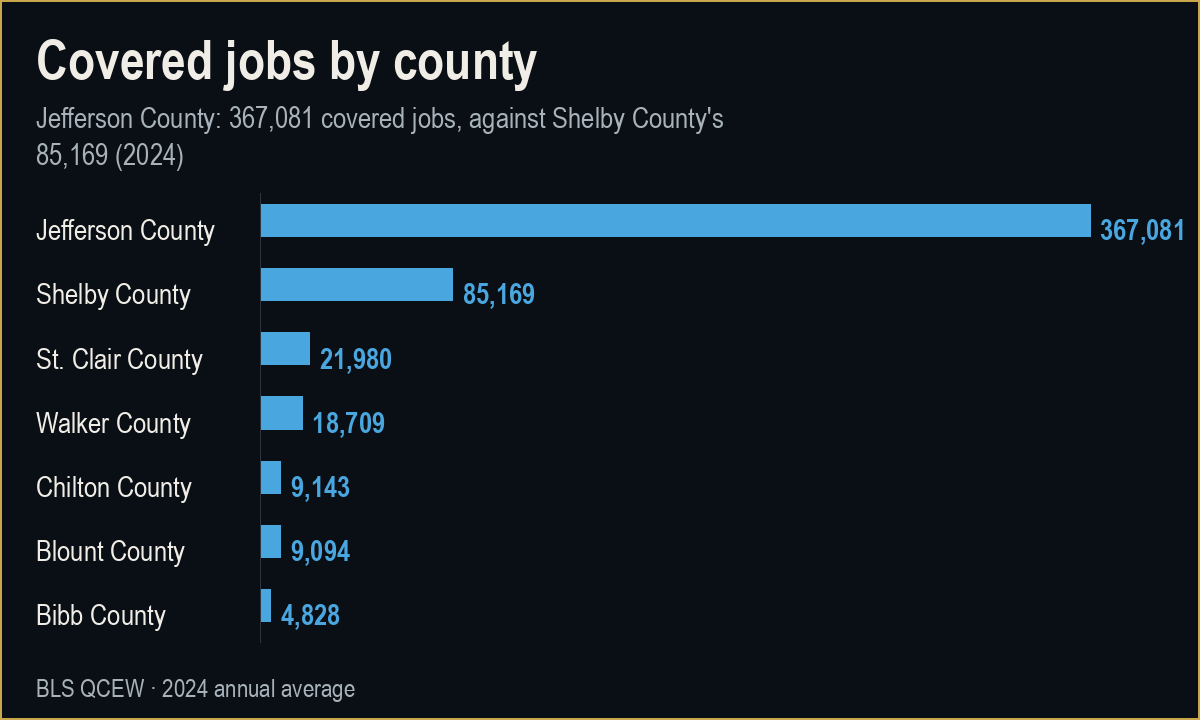
- Jefferson County, which includes Birmingham, had 367,081 covered jobs on average in 2024 , with an average weekly wage of $1,376 . The county also recorded 22,923 business establishments in 2024, up from 21,422 in 2022 . That combination — a large job base, relatively high average wages for the region and growing business counts — underscores Jefferson County’s role as the economic core.
- Shelby County, part of the same metro area, recorded 85,169 covered jobs in 2024 , with 7,251 business establishments and an average weekly wage of $1,284 . Those figures point to a substantial employment and business base, though smaller than Jefferson’s.
- Counties like St. Clair (21,980 jobs; 1,943 establishments; $989 average weekly wage) , Blount (9,094 jobs; 956 establishments; $879 average weekly wage) , Chilton (9,143 jobs; 922 establishments; $915 average weekly wage) , Bibb (4,828 jobs; 445 establishments; $1,020 average weekly wage) and Walker (18,709 jobs; 1,536 establishments; $936 average weekly wage) form a ring of smaller labor markets around the core urban counties.
These numbers are not a growth forecast; they are a baseline. They show that Jefferson and Shelby counties currently concentrate both jobs and higher average weekly wages, while surrounding counties have smaller employment bases and, in several cases, lower average wages.
For residents in those outer counties, the practical question is how easily they can tap into the higher-wage opportunities and services clustered closer to Birmingham’s core. That depends on transportation links, employer hiring patterns and whether new investment chooses central locations, suburban corridors or exurban sites. The evidence here does not specify those choices; it only establishes the starting geography.
Health care, research and HQ moves: what they could mean for the next housing and talent cycle
On the institutional side, UAB’s own descriptions connect its expansion to both neighborhood conditions and economic development. The university reports that in 2024 it reached new levels of growth and impact under its strategic plan, which it says is aimed at transforming lives across Alabama through education, research, innovation and economic development, community engagement and patient care . UAB also states that ongoing construction and renovation projects are being used to advance those mission pillars, explicitly including economic development .
Separately, the state’s incentive package for Landing illustrates how Alabama is trying to use high-growth employers as catalysts. The state committed funds through the Alabama Jobs Act and training services through AIDT, its primary workforce development agency, which provides recruitment, talent development and on-the-job training assistance . State materials say Landing’s hiring would increase its Alabama workforce to 900 and total employment to more than 1,000 nationwide over several years .
Those are announced plans and internal projections, not outcomes. But if they materialize, one reasonable scenario is that:
- Higher-wage, office-based jobs cluster in or near central Birmingham, reinforcing demand for nearby housing, food, retail and services.
- UAB’s construction and research expansion continue to draw students, medical professionals and research staff who need places to live within commuting distance of campus and the medical district.
- Outer counties with lower average weekly wages than Jefferson and Shelby — such as St. Clair, Blount, Chilton and Walker — become potential bedroom communities for residents who work in the urban core but seek lower housing costs or different neighborhoods.
Under that scenario, corridors with strong commuting access into Birmingham and UAB — for example, routes that benefit from projects like the Civil Rights Crossroads reconnection — could see more housing demand and small-business formation. The evidence here does not identify specific property projects or price points, so any discussion of particular developments would be speculative. The more grounded takeaway is that the combination of central-city job growth and uneven neighborhood investment sets up a classic question of whether adjacent areas become beneficiaries of spillover or remain disconnected.
Can Birmingham offer better value than bigger Southern metros?
The assignment asks how Birmingham stacks up on value versus larger Southern metros. The evidence here does not include comparative housing-cost data, cost-of-living indices or wage figures for those peer cities, so it is not possible to make a quantified comparison.
What the data does show is that:
- Jefferson and Shelby counties support large employment bases and higher average weekly wages than their neighboring counties .
- Several surrounding counties combine smaller job bases with lower average weekly wages, which implies lower regional earning power but could also correlate with lower housing costs. The current record does not include housing data to confirm that link.
- The state is willing to deploy incentives and training support to recruit and expand employers like Landing , and UAB is actively investing in facilities tied to economic development and neighborhood conditions .
From an investor or resident’s perspective, a reasonable inference is that Birmingham offers a growing set of employment anchors and institutional investments on top of an existing regional employment base. Whether that translates into “better value” than larger metros depends on relative housing costs, wage trajectories and migration patterns that are not documented in this evidence set.
What has to go right — and what to watch
For Birmingham’s current investment wave to translate into a new, more inclusive housing and talent cycle, several execution points matter:
- Follow-through on announced projects. Landing’s job creation figures and the Alabama Department of Commerce’s 20-year payroll and revenue estimates are projections . A key test is how many of those jobs are actually created, at what pace, and where those employees choose to live.
- Neighborhood connectivity. The Civil Rights Crossroads project is currently at the grant-application stage . Whether it is funded, and how it is implemented, will show how seriously the city can close the investment gap it has identified between downtown and nearby underserved neighborhoods .
- Alignment of economic development with local capacity. The city’s economic-development department says it focuses resources on activities with the highest multiplier effect and on businesses ready to scale . Over time, observers can test this claim by looking at where incentives, technical assistance and city-backed infrastructure are actually deployed — and whether those align with places residents can afford to live and start businesses.
- UAB’s neighborhood impact. UAB explicitly links its research and patient-care expansion to neighborhood revitalization and economic development . The concrete question is how far that impact extends off campus: do nearby blocks see new services and housing options accessible to current residents, or mostly new institutional buildings?
In other words, the wave of investment around central Birmingham is real in terms of commitments and institutional activity. Whether it reshapes everyday life in surrounding neighborhoods — in commute times, access to jobs and services, and the kind of housing that gets built — will be determined less by headline announcements and more by how transportation, employer hiring and neighborhood-scale projects evolve over the next several years.