
It took Irondale more than 1,956 days to land a Costco. It will take about a million tons of rock to build one.
What actually closed, and when
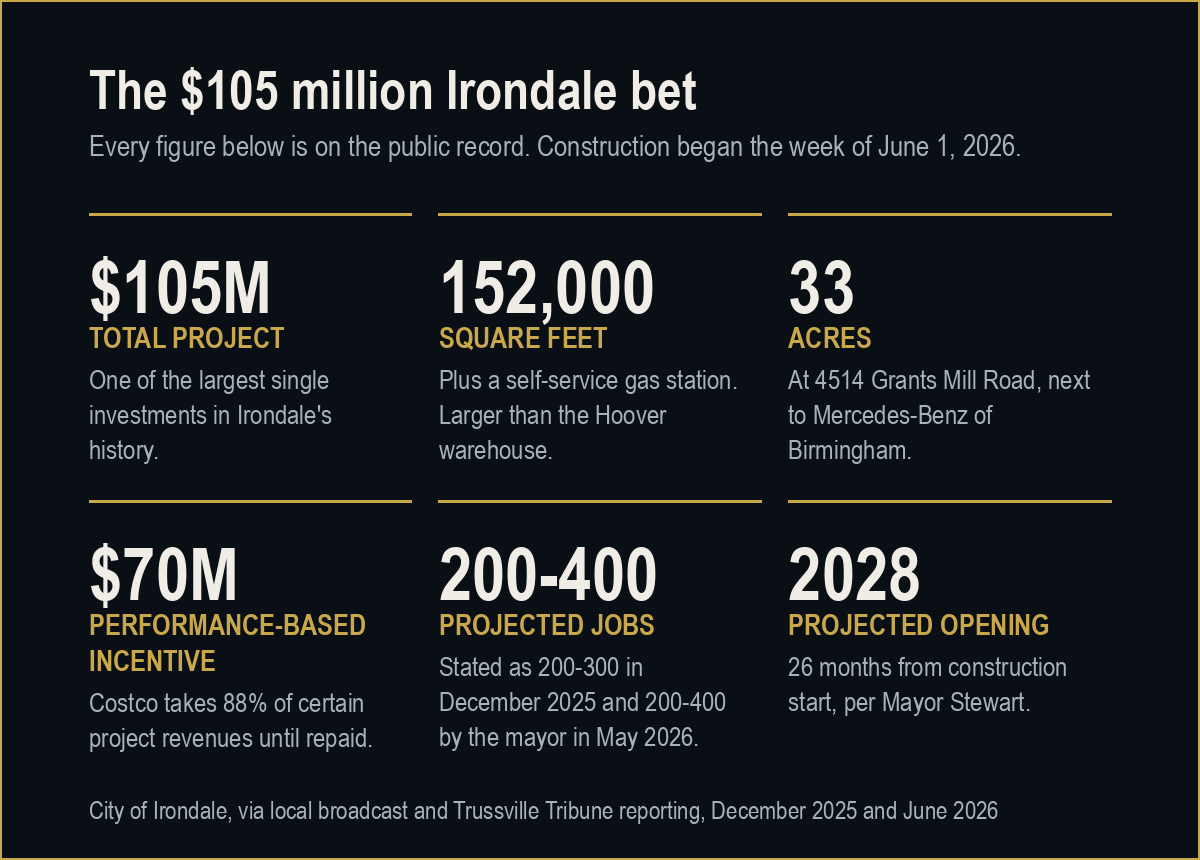
This is the part that matters, because a retail announcement and a retail project are different objects. Costco has been discussed at Grants Mill Road for years. The development agreement closed on May 29, 2026, and construction began the week of June 1.1 Mayor James D. Stewart Jr. told residents to count 26 months from that week for a projected opening, which puts it in 2028 — consistent with the “spring 2028” target the city was using in December 2025.1,2
The store itself is 152,000 square feet with a self-service gas station, next to Mercedes-Benz of Birmingham just off Interstate 459. It will be Alabama’s sixth Costco and larger than the Hoover warehouse. Irondale, population around 13,000, is the smallest city in the state to land one.2,3
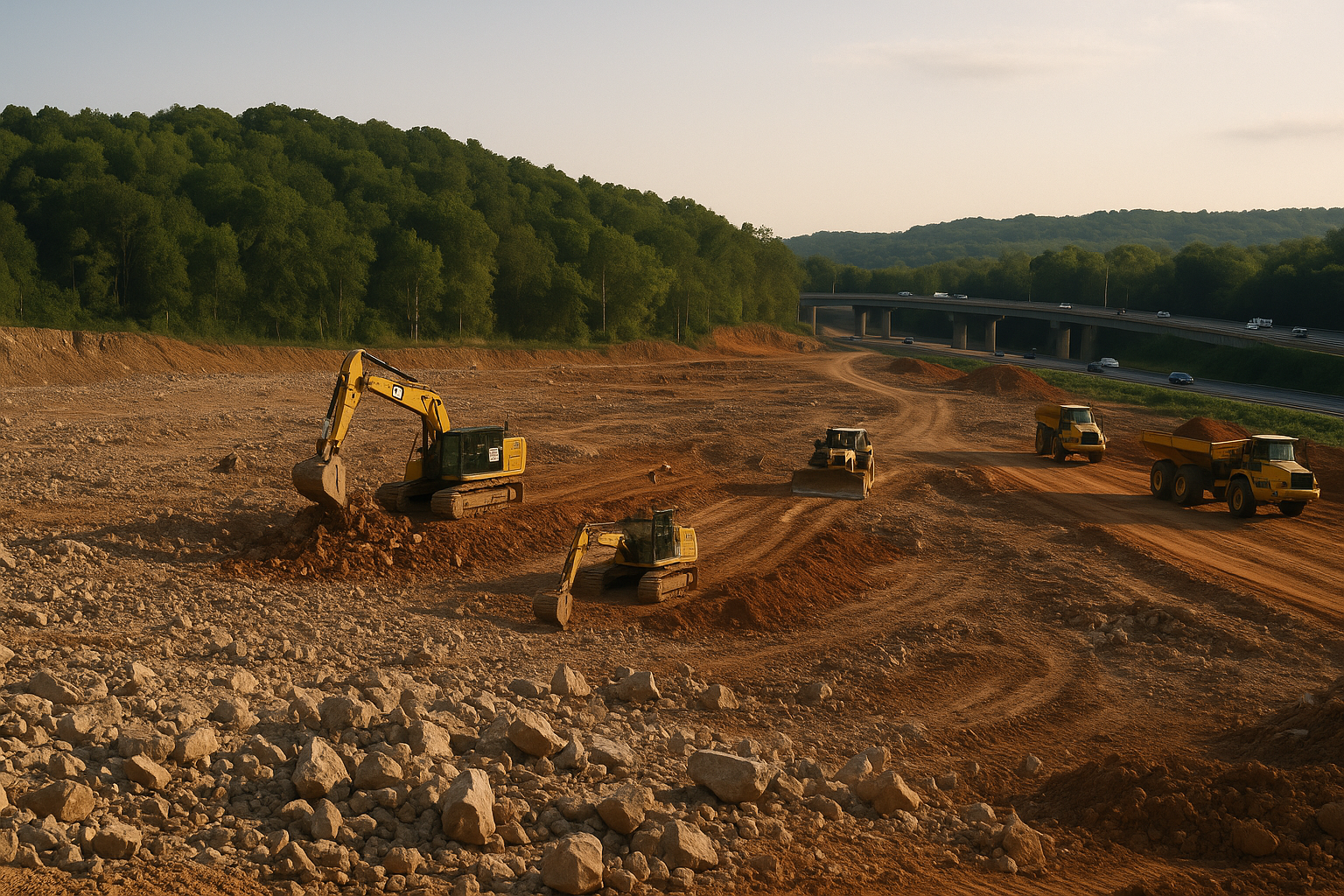
Where it stands todayConstruction is real and underway. The site is being cut out of rock — roughly one million tons of it — with pre-blast inspections offered to 300 to 310 properties inside a 1,500-foot radius.
The incentive is the interesting part
Most coverage stops at $105 million. The number worth reading twice is the $70 million performance-based incentive, and specifically how it is structured: Costco receives 88% of certain project revenues and the city 12%, until the incentive is repaid. The city projects repayment in seven to eight years, after which it takes 100% — an estimated $8 to $10 million a year.1
In December 2025 the city was projecting up to $1 million in first-year revenue and $6 to $8 million annually long term.2 The later figure is higher. Both are projections, and neither is a guarantee — performance-based means the city pays out of revenue that the store has to actually generate. That is a genuinely more conservative structure than an up-front cash incentive, and it is also why the first several years look thin on paper.
Why Irondale, and why it took 1,956 days
Irondale is not the obvious place for this. It is a city of roughly 13,000 people wedged between Birmingham and the eastern suburbs, and it is now the smallest municipality in Alabama to land a Costco.2 Retailers of this format underwrite on drive-time population rather than city limits, and the Grants Mill interchange is the relevant fact: it puts the site inside a short drive of Mountain Brook, Vestavia Hills, Trussville and the eastern half of Birmingham without asking any of those drivers to enter a city center.
That also explains the timeline. More than five years of negotiation is not unusual for a project that requires assembling a large flat site in terrain that is mostly not flat, agreeing an incentive structure a small city can carry, and getting a national retailer’s real-estate committee to commit capital. The 1,956 days Mayor Stewart cited is the story of a small city with one good interchange spending years converting that asset into a transaction.
Two years of rock
The construction phase deserves its own paragraph because residents will experience it long before anyone shops there. Roughly a million tons of rock and soil have to come off the site. That means blasting, and the city has offered pre-blast property inspections to the 300 to 310 properties inside a 1,500-foot radius — the standard mechanism for documenting a structure’s condition before shockwaves start, so that later damage claims have a baseline.1
The city also moved to buy an 18-acre buffer, which it said would leave about 700 feet between the property line and the nearest home.2 For a corridor where commercial and residential parcels sit close together, that buffer is arguably a more consequential land-use decision than the store itself: it permanently changes what can be built between the warehouse and the neighborhood behind it.
What a corridor anchor can pull in — and what it hasn’t yet
Here is where retail stories usually go wrong. A big-box anchor does have a well-documented gravitational effect on the parcels around it: it manufactures traffic, and traffic is the input service businesses shop for. That sequence is real enough that developers underwrite against it.
It is also not evidence about Grants Mill Road, because nothing has happened there yet.
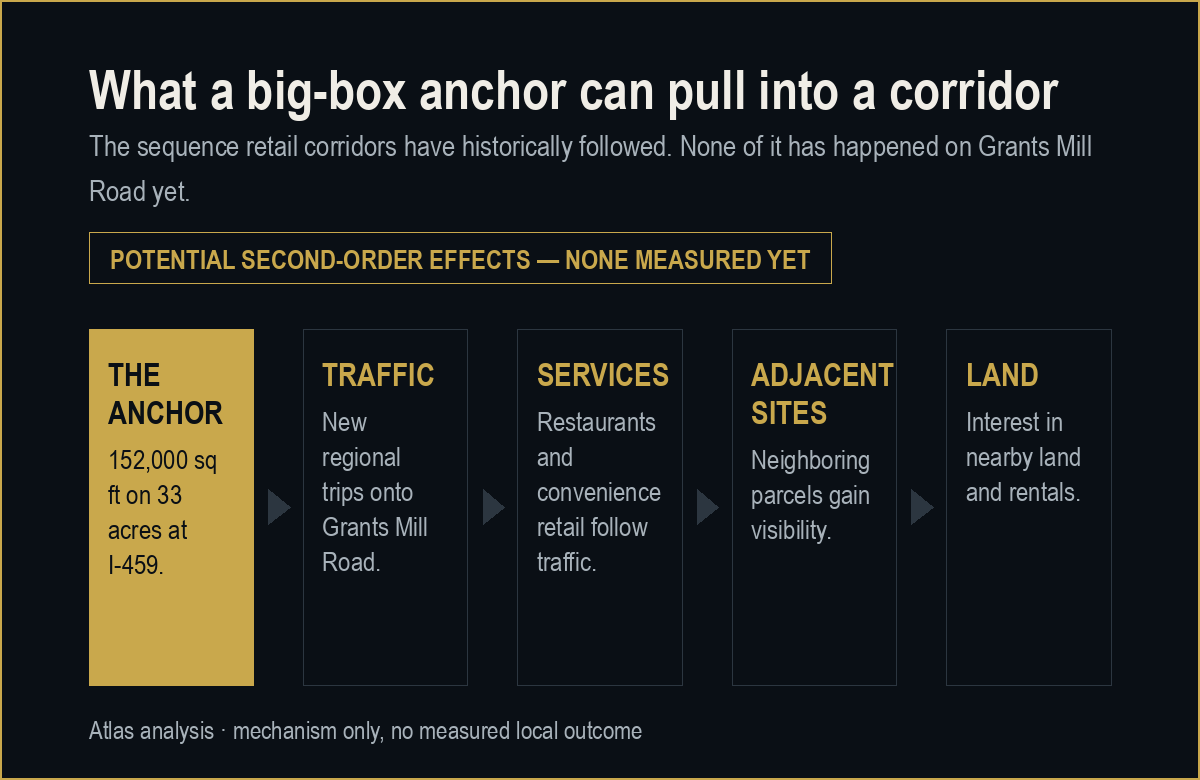
A closed development agreement, an active construction site, a 33-acre parcel, a $70 million incentive with a disclosed revenue split, and a 2028 opening target from the mayor.
Any restaurant, hotel, medical office, apartment or subdivision announced because of the Costco. Road and intersection improvements beyond a planned community meeting near the Mercedes dealership. Any land transaction on adjacent parcels.
What it could mean if you rent, own or invest here
For residents, the near-term reality is inconvenience before benefit: two years of hauling and blasting on a corridor people already commute through. The pre-blast inspection program for 300-plus properties is the city acknowledging as much.
For renters, 200 to 400 retail jobs is a real but modest addition to a metro with 367,081 covered jobs.4 The likelier effect is convenience — a category of shopping that currently requires a drive to Hoover — rather than anything that moves a rent roll.
For property owners and investors, the honest framing is that this is a catalyst worth monitoring, not a thesis. If the corridor is going to change, it shows up first in three places: commercial land transactions within about a mile of the site, new business licenses filed in Irondale, and any ALDOT or city action on the Grants Mill Road and I-459 interchange. Those are observable, and none of them has moved on the public record yet.
The sharper version of the investor question is not whether the corridor changes but who captures it. Big-box anchors tend to lift the parcels with direct visibility and a shared curb cut, and to do considerably less for land a quarter-mile back with no frontage. Anyone underwriting Grants Mill on the strength of this announcement should be able to say, specifically, which access point their parcel shares and what the interchange geometry does to turning movements. If that question has no answer yet, neither does the investment.
ELM Property Management manages rental property across the Birmingham metro. We follow corridor-scale investment because retail anchors, road work and employment shifts are the things that change how a neighborhood is used — usually years before they change what it costs.
Sources
- City of Irondale, via local broadcast reporting. Costco project officially moves forward in Irondale; construction set to begin this week. June 1, 2026 View source
- City of Irondale, via local broadcast reporting. Irondale's new Costco set to transform local economy; site prep starts in early 2026. December 16, 2025 View source
- The Trussville Tribune. Irondale, Costco finalize agreement for Grants Mill development. 2026 View source
- U.S. Bureau of Labor Statistics. Quarterly Census of Employment and Wages, annual averages — Jefferson County, Alabama. 2024 View source