
Walk a few blocks around the University of Alabama at Birmingham and you can see three different kinds of projects colliding: a hospital that has grown into one of the country’s largest, a campus adding new research and teaching space, and a wave of outpatient clinics spreading out into nearby neighborhoods.
The pattern raises a straightforward question for anyone watching Birmingham’s next cycle: if the medical core keeps growing at this pace, where will the spillover show up first in housing, retail and small-business demand?
A 1,400‑bed anchor that just climbed into the national top five
UAB Hospital has quietly become one of the largest single economic anchors in the region. As of a March 2026 institutional report, it is now the fifth‑largest hospital in the United States, up three spots from its 2025 ranking, according to Becker’s Hospital Review. The same report puts its bed count at 1,400.111
Scale matters because it signals both patient draw and the density of jobs and vendors that follow. In 2025, UAB Hospital cared for 929,021 unique patients, a record for the institution.1 That is not just a measure of throughput. It also suggests a large catchment area and a steady stream of visitors who need somewhere to park, eat, stay, and in some cases recover nearby.
If that volume continues, the demand for surrounding medical office space, short‑stay housing and service businesses could be significant. The evidence we have does not yet break out where those patients are coming from or how many nights they stay, which would be critical to sizing the impact on nearby real estate.
Clinics are pushing UAB Medicine’s footprint deeper into the metro
The hospital’s growth is being matched by a broader outpatient strategy. A July 2026 UAB Medicine update describes the system as continuing to expand its footprint across the Birmingham area, with “several new and enhanced specialty clinic locations opening in 2026.”222
That language is high level: the document does not list specific addresses or square footage, and it does not spell out how many jobs these clinics will carry. What it does establish is direction of travel. Care that might once have been concentrated entirely on the main campus is now being delivered in a more distributed way across the metro.
If these clinics land in neighborhood and suburban commercial corridors, they could become small but durable anchors for nearby retail and services — particularly in places that have not seen much new medical investment. Without site‑level details, though, it is too early to say which corridors will actually see that effect.
Gorrie Hall and the library edge: an engineering hub takes shape
On the academic side of campus, UAB has broken ground on a major new facility that could change the feel of the blocks around the Mervyn H. Sterne Library.
In July 2023, the university broke ground on Gorrie Hall, which is planned as a home for the School of Engineering.3 Earlier coverage notes that contractor Brasfield & Gorrie broke ground on this facility in 2023 and describes it as being strategically positioned on 13th Street South, beside Sterne Library.4
The building itself is large by campus standards. UAB describes Gorrie Hall as a nearly 116,000‑square‑foot facility with advanced labs, research suites and common areas.3 That type of space tends to concentrate faculty, graduate students, research staff and visitors in a tight footprint — all of whom need day‑to‑day services within a short walk.
Just across the way, Sterne Library is not static either. An institutional facilities document lists a “Sterne Library Exterior and Interior Refurbishment” project with a date notation of November 2026, under a section labeled Upcoming Projects with bid dates to be determined.55 The listing does not specify scope, budget or construction timing, so it should be read as an internal planning marker rather than a confirmed build schedule.
Taken together, a new 116,000‑square‑foot engineering building and planned library refurbishment indicate that this part of campus is being treated as a core academic and student‑life zone. If execution follows, the blocks around 13th Street South could see more foot traffic and demand for food, study and gathering spaces over the next several years, though the evidence does not yet show which private projects, if any, are lining up to respond.
Demolition and site prep: hints of the next wave
Campus construction is not limited to new builds. The same UAB facilities document that lists the Sterne Library refurbishment also includes a “Community Care Demolition” tagged to September 2026 and a “1701 Demolition” tagged to October 2026, again under a heading that makes clear bid dates are still to be determined.555
Demolition entries like these generally signal that UAB is clearing or reconfiguring existing structures to make room for future uses. The evidence supplied does not state what will replace these buildings or where exactly they are located within the campus and medical footprint, so any discussion of their eventual use would be speculative. What is clear is that the institution is actively managing its physical plant, which is a prerequisite for larger‑scale redevelopment.
The regional employment base around Birmingham’s core
All of this sits inside a labor market that already punches above its population weight in covered employment.
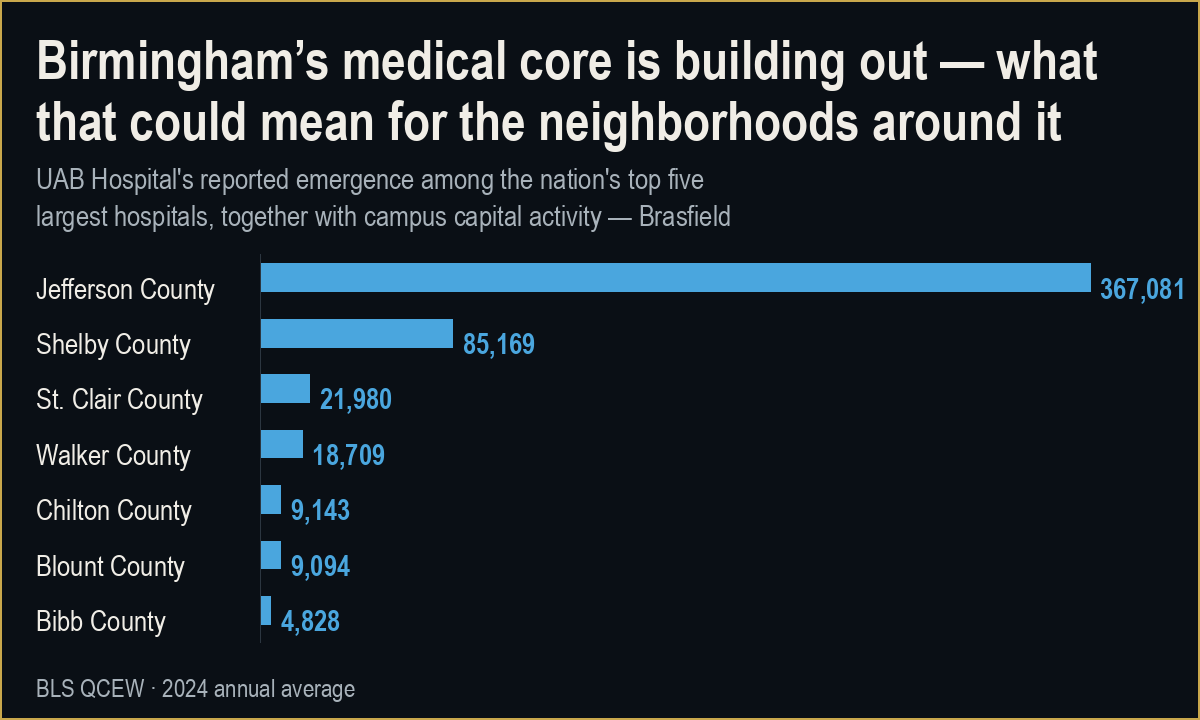
In 2024, Jefferson County — which contains Birmingham, UAB and much of the region’s hospital and clinic activity — averaged 367,081 covered jobs and 22,923 business establishments, with an average weekly wage of $1,376.666 The surrounding counties form a second ring of employment that is smaller but still material:
- Shelby County carried 85,169 covered jobs, 7,251 establishments and an average weekly wage of $1,284 in 2024.777
- St. Clair County recorded 21,980 covered jobs, 1,943 establishments and a $989 average weekly wage.888
- Blount County had 9,094 covered jobs, 956 establishments and an $879 average weekly wage.999
- Bibb County saw 4,828 covered jobs, 445 establishments and a $1,020 average weekly wage.101010
- Chilton County reported 9,143 covered jobs, 922 establishments and a $915 average weekly wage.111111
- Walker County had 18,709 covered jobs, 1,536 establishments and a $936 average weekly wage.121212
The pattern is straightforward: Jefferson County dominates the job base and wage pool, while a ring of smaller counties provides additional employment and lower average wages. For real‑estate investors and operators, that implies a commuting shed feeding into Birmingham’s core — including the UAB medical and campus district — from multiple directions.
What we do not yet have is a breakdown of how many of those jobs are directly tied to healthcare and higher education, or how quickly those specific sectors have been growing relative to the rest of the economy. That limits how precisely we can tie regional wage trends to the hospital and campus expansions described above.
Parks, city life and neighborhood context
While most of the hard evidence here sits with UAB and the labor market, there are smaller civic details that round out the picture of daily life near these anchors.
The City of Birmingham’s Parks & Recreation department, based at 400 Graymont Avenue West in Birmingham, lists office hours of Monday through Friday, 8:00 a.m. to 5:00 p.m., and provides a main phone line at (205) 254‑2391 and an email contact at parkreservations@birminghamal.gov.13131313 These are administrative facts, but they matter because park programming and facility upgrades often respond to where people are actually spending their time — and a growing medical and campus core is one of those pulls.
Separately, a January 2021 news story describes Birmingham’s plans for $11.25 million in parks and recreation improvements and notes that city officials were focused on construction at a facility at 2300 E. Lincoln St. starting in spring.141414 That article predates the UAB developments detailed here and does not explicitly tie those park investments to the medical district, but it does show that the city has been active in upgrading recreational assets during roughly the same period.
Cultural perception has been evolving as well. A March 2026 city piece cites Southern Living Magazine declaring Birmingham as a notable food city and mentions that the article released a list of “60 Places to Eat and Drink Right Now,” though the excerpt we have is limited and does not reproduce the full quote or list.1515 Even with partial text, the direction is clear: more outside attention on the city’s restaurant scene, which tends to cluster in and around walkable districts — including areas influenced by university and hospital traffic.
What this could mean if the pieces start reinforcing one another
If UAB’s 1,400‑bed hospital, its expanding clinic footprint, Gorrie Hall’s 116,000 square feet of engineering activity and the planned library refurbishment all continue on their current trajectories, the area around the medical and academic core could see several second‑order effects over the next decade. These are not outcomes the evidence proves today; they are conditional possibilities if execution follows through:
- Stronger demand for nearby housing, especially rentals that serve medical staff, graduate students and visiting faculty who want to live within a short commute of the hospital and engineering complex.
- More pressure on ground‑floor retail near campus, as daily foot traffic from hospital workers, patients and engineering students supports new food and service businesses.
- Incremental office and flex space demand from vendors, research partners and professional services that want to be physically close to UAB’s labs and clinics.
Each of these hinges on information we do not yet have: the specific locations of the 2026 clinics, the eventual tenants and research programs inside Gorrie Hall, the scope and timing of the library refurbishment, and any new zoning or infrastructure moves the city might make around the district.
What to watch next
For readers trying to track whether Birmingham’s medical and campus core is turning into a broader development engine, several concrete indicators would be telling:
- Site‑specific details on UAB Medicine’s new clinics: addresses, square footage, specialties and announced staffing levels for the 2026 openings.2
- Updated campus plans around Gorrie Hall: confirmed program mix inside the 116,000‑square‑foot facility, any adjacent projects that build on its presence, and clearer mapping of its interface with Sterne Library.34
- Follow‑through on the listed demolition and refurbishment projects: whether the Community Care and 1701 demolitions proceed on the indicated timeline and what replacement projects are proposed for those sites, along with detailed plans for the Sterne Library refurbishment.5555
- Changes in healthcare and education employment within Jefferson County: more granular BLS or local data showing whether jobs tied to UAB and related sectors are growing faster than the county’s overall employment base.6
- Private‑sector responses: new housing, retail or mixed‑use proposals explicitly citing proximity to UAB Hospital, the School of Engineering or the expanding clinic network as a core part of their pitch.
Those are the markers that would show whether Birmingham’s concentration of medical and academic investment is simply getting larger on its own footprint, or beginning to pull in the kind of private development that reshapes the surrounding neighborhoods.
Sources
- University of Alabama at Birmingham. Uab hospital now fifth largest in the nation View source
- University of Alabama at Birmingham. Uab medicine expands care with new clinics in second quarter of 2026 View source
- University of Alabama at Birmingham. Uab s 12 new construction and renovation projects transforming campus supporting strategic initiatives View source
- University of Alabama at Birmingham. Uab continues to transform through 14 new construction and renovation projects View source
- University of Alabama at Birmingham. Upcoming projects View source
- U.S. Bureau of Labor Statistics. Quarterly Census of Employment and Wages, annual averages — Jefferson County, Alabama. 2024 View source
- U.S. Bureau of Labor Statistics. Quarterly Census of Employment and Wages, annual averages — Shelby County, Alabama. 2024 View source
- U.S. Bureau of Labor Statistics. Quarterly Census of Employment and Wages, annual averages — St. Clair County, Alabama. 2024 View source
- U.S. Bureau of Labor Statistics. Quarterly Census of Employment and Wages, annual averages — Blount County, Alabama. 2024 View source
- U.S. Bureau of Labor Statistics. Quarterly Census of Employment and Wages, annual averages — Bibb County, Alabama. 2024 View source
- U.S. Bureau of Labor Statistics. Quarterly Census of Employment and Wages, annual averages — Chilton County, Alabama. 2024 View source
- U.S. Bureau of Labor Statistics. Quarterly Census of Employment and Wages, annual averages — Walker County, Alabama. 2024 View source
- City of Birmingham. Parks recreation View source
- www.hometownlife.com. 6701528002 View source
- City of Birmingham. Southern living declared birmingham next great food city discover 10 eateries featured magazine View source