
Memphis Isn’t Just Getting More AI. It’s Getting an Energy System Built for the AI Age.
The newest number in Memphis’s extraordinary AI story isn’t a GPU count. It’s 3.3 gigawatts—and it may tell us far more about where Elon Musk intends to take the region next.
For most of the past two years, the Memphis xAI story has been measured in computers.
First came Colossus. Then more GPUs. Then another facility. Then expansion into Mississippi. Each announcement made the cluster larger, but the basic story remained easy to understand: Elon Musk was building an enormous AI supercomputer in Memphis.
That description is becoming inadequate.
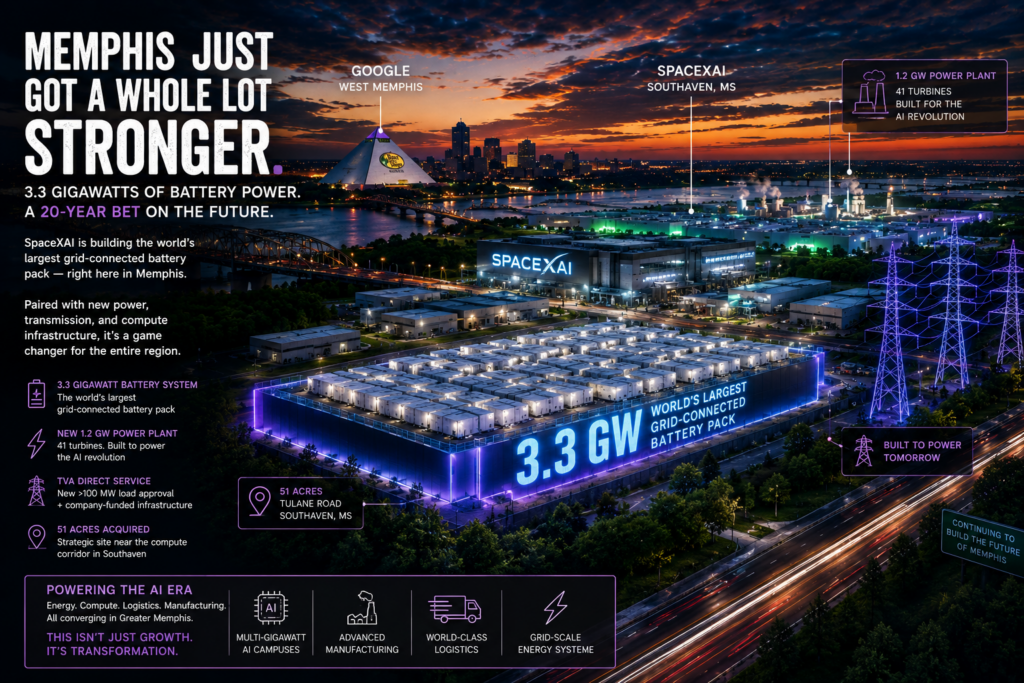
SpaceXAI has now publicly discussed plans for approximately 3.3 gigawatts of battery storage across its Memphis and Southaven operations, describing the project as what would become the world’s largest grid-connected battery system. At roughly the same time, TVA approved another large power agreement for SpaceXAI affiliate MZX Tech, while Southaven agreed to transfer another strategically located 51-acre property to the company.
Put those developments beside SpaceXAI’s planned 1.2-gigawatt permanent power plant in Southaven, new transmission infrastructure and specialized power-engineering workforce, and the picture changes.
Memphis isn’t simply hosting computers anymore. It is becoming the site of an enormous purpose-built energy system designed around computing.
That could be much more consequential.
3.3 Gigawatts Is Not a Normal Data-Center Number
It is difficult to appreciate what 3.3 GW means because battery projects are usually discussed in technical units that don’t translate easily into everyday experience.
The useful comparison is scale.
MLGW’s own planned battery-storage system for Shelby County is approximately 100 megawatts. SpaceXAI’s stated battery project would have a power rating roughly 33 times larger.
That doesn’t mean the batteries generate 3.3 GW of new electricity. Batteries store electricity and release it when needed, and the project’s total energy-storage duration has not yet been publicly established.
But that distinction actually helps explain why Musk wants them.
Giant AI clusters create extraordinary electrical demands. Hundreds of thousands of GPUs can rapidly change their power consumption as computing workloads fluctuate. A battery system can absorb electricity when it is available, discharge rapidly when necessary and help stabilize the enormous loads created by AI training.
In other words, SpaceXAI isn’t simply buying electricity.
It is increasingly engineering the system that delivers electricity to the computers.
Then TVA Made the Relationship More Permanent
Another development arrived almost simultaneously.
TVA approved a new service agreement for MZX Tech involving a load exceeding 100 MW. The SpaceXAI affiliate is expected to become a direct TVA customer and fund infrastructure, including transmission lines and transformers, required to serve the additional load.
This is an important evolution.
The early Colossus story was defined partly by improvisation. Musk needed computing capacity immediately, and SpaceXAI assembled temporary generation and other solutions at remarkable speed while larger utility connections were developed.
The emerging system looks different.
Permanent generation in Mississippi. Direct TVA service. Transmission. Transformers. Substations. Battery storage. Dedicated engineers responsible for operating and expanding all of it.
Those aren’t temporary fixes.
They are infrastructure.
SpaceXAI Is Also Quietly Accumulating More Land
Then there is the 51-acre clue.
Southaven recently agreed to transfer its existing police and fire training property on Tulane Road to MZX Tech. In return, the city receives a larger replacement property elsewhere, while SpaceXAI is contributing $40 million toward new public-safety training facilities.
The property SpaceXAI gains sits roughly 1.5 miles south of the Colossus 2 campus.
SpaceXAI has not said what it intends to build there, so it would be premature to call this another data center or battery site.
But strategically located land near a rapidly expanding multi-gigawatt compute-and-energy corridor is difficult to dismiss as incidental.
The pattern is becoming familiar.
SpaceXAI builds. Then it acquires more land. Then it adds power. Then it adds energy infrastructure. Then it builds again.
At some point, repetition becomes strategy.
Musk’s Memphis Bet Is Becoming Harder to Move
This may be the most important long-term implication.
AI software is extraordinarily portable. A model can be copied to another server. GPUs can eventually be removed and replaced.
The infrastructure underneath them is very different.
A power plant cannot be moved to Texas next Tuesday. Neither can a substation, transmission line, pipeline or hundreds of acres of developed industrial property.
Every time SpaceXAI adds another layer of fixed infrastructure, the Memphis cluster develops more economic gravity.
The original reason Musk chose Memphis appears to have involved speed: an enormous former industrial building was available, local institutions moved quickly, and Colossus could be brought online at a pace that shocked much of the technology industry.
What has happened since is more revealing.
After Memphis worked, Musk didn’t leave for a more fashionable technology market.
He kept investing here.
The original advantage was speed.
The emerging advantage is scale.
And now SpaceXAI is beginning to construct a physical moat around both.
This Could Create an Industry Around the Industry
The direct employment created by data centers is often criticized for being relatively modest compared with the enormous capital invested. That criticism is legitimate.
But it may also be looking at the wrong boundary.
Consider what an energy-and-compute complex of this scale requires over decades: high-voltage engineers, electricians, battery technicians, turbine specialists, cooling experts, power electronics, controls engineers, commissioning teams and specialized construction firms.
Then consider the equipment.
Transformers, switchgear, batteries, generators, turbines, cooling systems and control equipment all have to be installed, maintained, repaired and eventually replaced.
Companies such as Eaton, Schneider Electric, Vertiv, Siemens, ABB and GE Vernova suddenly become interesting—not because they have all announced Memphis factories, because they haven’t—but because their customers are concentrating an extraordinary amount of infrastructure in one region.
First comes service.
Then distribution.
Then regional operations.
Eventually, manufacturing or assembly can become economically rational.
That is the difference between landing a giant project and developing an industrial cluster.
And Musk Isn’t the Only Giant Electricity Customer Arriving
Across the Mississippi River, Google is simultaneously developing its own hyperscale campus in West Memphis.
That makes the regional story much more significant.
SpaceXAI and Google are radically different companies with different leadership and different site-selection processes, yet both have chosen essentially the same metropolitan geography for enormous computing investments.
Now add the other pieces.
FedEx is investing another roughly $400 million in Project Hercules at its Memphis World Hub.
Arkansas is pursuing a mystery advanced manufacturer for a 1,300-acre West Memphis megasite.
BlueOval City and its manufacturing ecosystem sit northeast of Memphis.
The region is accumulating computing, electricity, manufacturing and logistics infrastructure simultaneously.
That is why Greater Memphis increasingly needs to be viewed as one economic geography rather than three states competing with one another.
The Most Important Thing Musk Builds in Memphis May Not Be Colossus
AI changes incredibly quickly.
Today’s leading GPU will eventually be obsolete. Today’s most powerful model may eventually be surpassed. Even today’s dominant AI companies are not guaranteed to remain dominant forever.
Infrastructure moves much more slowly.
Transmission lines can operate for generations. Substations can serve different customers. Specialized electrical workers can move between employers. Industrial sites can be reused. Supplier networks can outlive the company that originally attracted them.
That leads to a fascinating possibility.
The most durable thing the AI boom leaves Memphis may not be the AI.
It may be the enormous energy and industrial system constructed to make the AI possible.
SpaceXAI’s proposed 3.3-GW battery system is therefore much more than another Musk-sized number.
It is evidence that the Memphis experiment is changing categories.
What began as a race to build one giant computer is becoming an attempt to construct the power infrastructure required to keep building giant computers.
And if that infrastructure continues accumulating, Memphis could eventually possess something far more valuable than one famous tenant:
a place already engineered for the next one.