
FedEx Just Made a $400 Million Bet on the Memphis of 2031
While everyone watches Elon Musk, Google and the next mystery megaproject, Memphis’s original global giant is quietly building something enormous of its own.
There is a wonderfully appropriate name for the next major addition to the FedEx World Hub: Hercules.
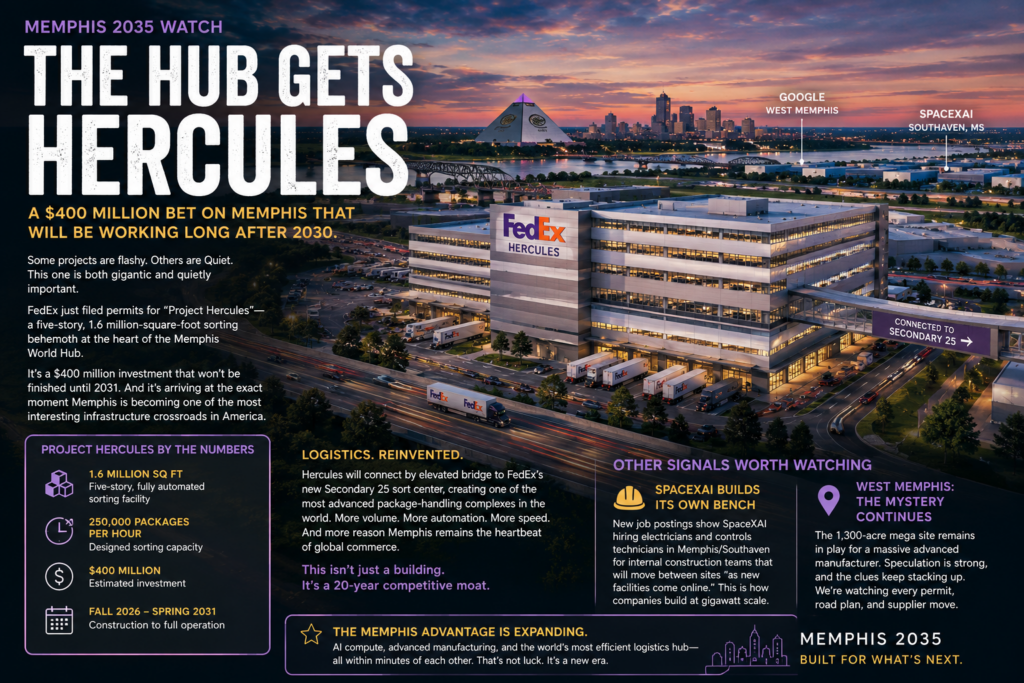
FedEx is moving forward with an approximately $400 million investment in a new automated sorting facility at Memphis International Airport. The planned building is enormous—five stories and nearly 1.6 million square feet—and is designed to process as many as 250,000 packages per hour. Construction is expected to begin this fall, with the facility targeted to become fully operational in spring 2031.
That alone makes Hercules a major Memphis project.
But the timing makes it much more interesting.
FedEx isn’t making this investment in the Memphis of yesterday. It is building it for the Memphis that is beginning to emerge around it.
The Old Memphis Story Is Colliding With the New One
For decades, the easiest explanation for Memphis’s economic importance was FedEx.
The company transformed the city’s central geography into a global advantage. Memphis became the place where packages could arrive from around the world in the middle of the night, be sorted at extraordinary speed and leave again before morning.
That system helped create one of America’s great logistics economies.
Now something unexpected is happening around it.
SpaceXAI is building enormous AI computing and energy infrastructure south of downtown and across the Mississippi state line. Google is developing its hyperscale campus across the river in West Memphis. Arkansas is pursuing a mystery advanced manufacturer for a 1,300-acre megasite. BlueOval City is developing another advanced-manufacturing ecosystem northeast of Memphis.
And right in the middle of this emerging three-state industrial corridor, FedEx is spending another $400 million to make its global machine faster.
That is where Hercules becomes more than a warehouse story.
Hercules Is Enormous
The scale is difficult to appreciate from a permit application.
Hercules would rise just south of FedEx’s recently completed Secondary 25 sorting facility, which itself spans approximately 1.3 million square feet and can handle roughly 56,000 packages per hour. FedEx says the existing Memphis World Hub can process approximately 484,000 packages per hour.
Hercules is being designed for as many as 250,000 packages per hour on its own.
The two facilities are expected to be connected by an elevated bridge, effectively creating an enormous integrated automated sorting complex at the heart of the World Hub.
This isn’t simply adding floor space.
It is another step in FedEx’s long-running effort to automate and modernize the infrastructure that makes Memphis indispensable to its network.
And the timeline may be the most revealing detail of all.
2031.
FedEx is making a capital decision today whose usefulness is being measured well into the next decade.
Why Build Something This Big Now?
The obvious answer is e-commerce.
Packages are getting smaller, more numerous and increasingly time-sensitive. FedEx needs infrastructure capable of processing enormous volumes with fewer manual touches and greater precision.
But there is another way to look at the investment.
Memphis itself is becoming more logistics-intensive.
AI sounds digital, but AI infrastructure is surprisingly physical. A giant computing campus needs servers, GPUs, networking equipment, transformers, switchgear, cooling equipment, batteries and replacement parts.
Advanced manufacturing creates another enormous supply chain.
If West Memphis lands its mystery manufacturer, thousands of workers and potentially an entire supplier ecosystem could appear immediately across the river.
BlueOval City creates similar demand to the northeast.
The more sophisticated the region’s physical economy becomes, the more valuable its ability to move high-value equipment quickly can become.
Memphis’s oldest competitive advantage may therefore become more valuable because of its newest industries.
FedEx Is Reinventing the Asset Everyone Else Is Trying to Copy
Cities around America spend fortunes trying to create logistics hubs.
Memphis already has one.
FedEx’s World Hub covers roughly 940 acres, employs approximately 13,000 people directly at the complex and remains the largest air hub in the company’s global network. FedEx employs more than 33,000 people across Shelby County.
Infrastructure on that scale cannot simply be recreated because another city offers a tax incentive.
That is what makes continued investment important.
Legacy infrastructure can become a liability if the company operating it stops modernizing it.
FedEx is doing the opposite.
Secondary 25 represented a major automation investment. Hercules would extend that modernization through the beginning of the 2030s.
The Memphis advantage isn’t simply that FedEx came here decades ago.
It’s that FedEx is still rebuilding Memphis for what comes next.
Memphis Is Becoming a Machine Made of Other Machines
There is a fascinating way to look at the emerging regional economy.
SpaceXAI is building a machine for processing enormous amounts of information.
Google is building another.
FedEx operates a machine for processing enormous amounts of physical commerce.
Ford and potentially another major manufacturer are building machines that turn components into finished products.
Railroads, interstates, the river and the airport connect them.
Each system does something different, but they increasingly benefit from the same underlying geography.
That is what makes the Greater Memphis story increasingly unusual.
The region isn’t developing one fashionable industry.
It is accumulating systems.
Computing.
Energy.
Manufacturing.
Logistics.
And those systems can reinforce one another.
The Most Important Memphis Investments May Be the Ones That Don’t Move
There is another reason Hercules matters.
Companies can change strategies.
AI models can become obsolete.
Factories can eventually close.
But major infrastructure creates economic gravity.
A 1.6-million-square-foot automated sorting complex connected directly into the world’s largest FedEx air hub is not easily relocated.
Neither is a high-voltage substation.
Neither is a rail terminal.
Neither is a gigawatt-scale power plant.
Neither is an interstate.
Every major piece of permanent infrastructure makes the next investment easier to justify.
That is how cities develop competitive moats.
Memphis Is Building for a City That Doesn’t Fully Exist Yet
This has become the recurring theme of the Memphis 2035 story.
The population hasn’t exploded.
The wages haven’t completely caught up.
The supplier ecosystem is still developing.
But the infrastructure keeps arriving.
SpaceXAI is building.
Google is building.
Industrial land is being prepared.
Power infrastructure is expanding.
And now FedEx is preparing to spend approximately $400 million on a facility that isn’t expected to reach full operation until 2031.
That is not a company making a short-term decision.
It is a company betting that Memphis will remain essential to its network well into the next decade.
For a city suddenly attracting some of the largest AI, energy and industrial investments in America, the timing could hardly be better.
Everyone is asking what Memphis’s new economy will look like.
FedEx just gave us part of the answer.
Whatever gets built here next, Memphis intends to remain very, very good at moving it.