
Birmingham’s core counties already hold a disproportionate share of central Alabama’s jobs and payroll. What is changing now is the mix: billion‑dollar food manufacturing, hospital expansions and research facilities are adding higher‑wage roles on top of that base, with the risk that surrounding counties stay locked into lower pay unless they can plug into the same growth lanes.
Jefferson and Shelby carry the job base — and the wage ceiling
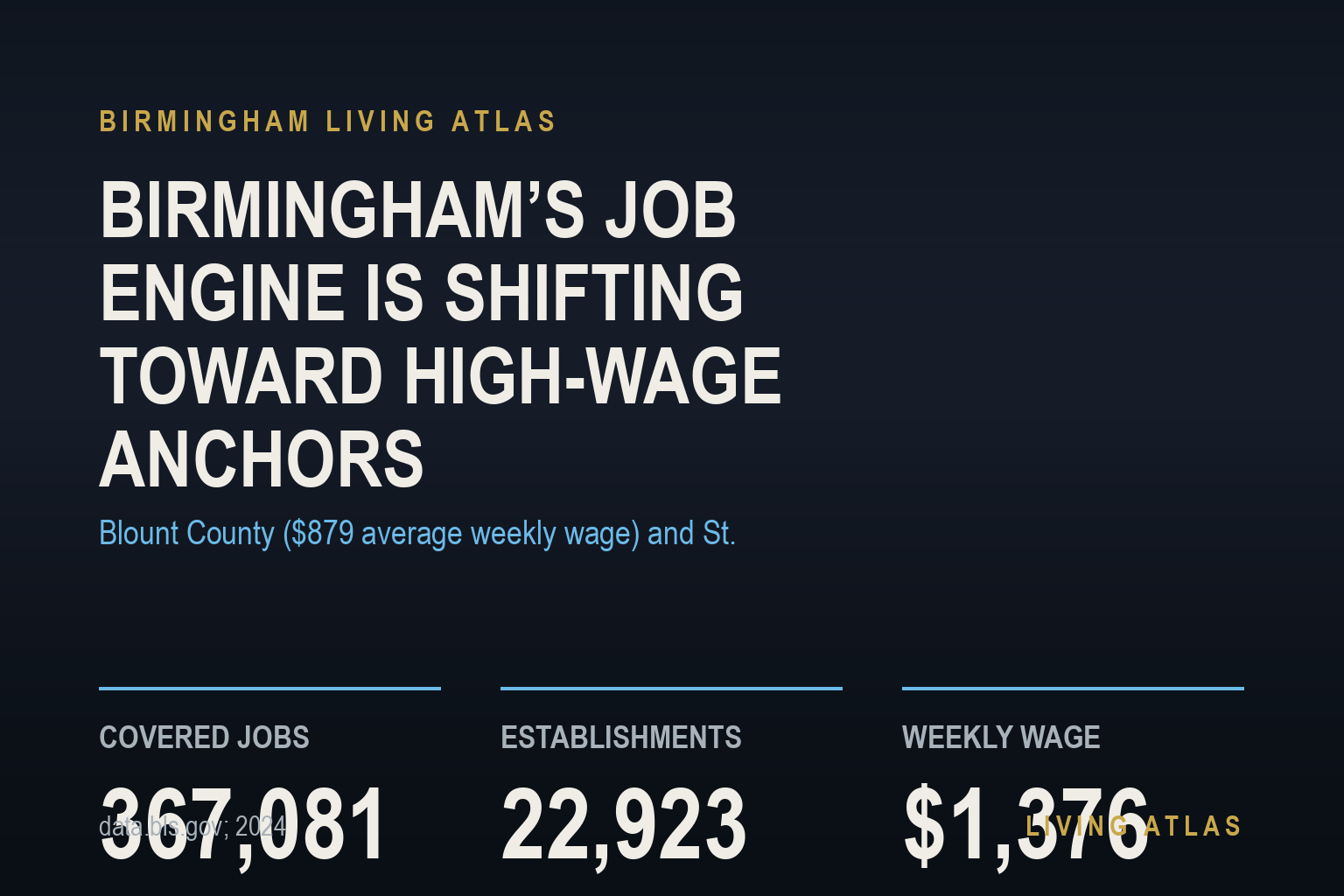
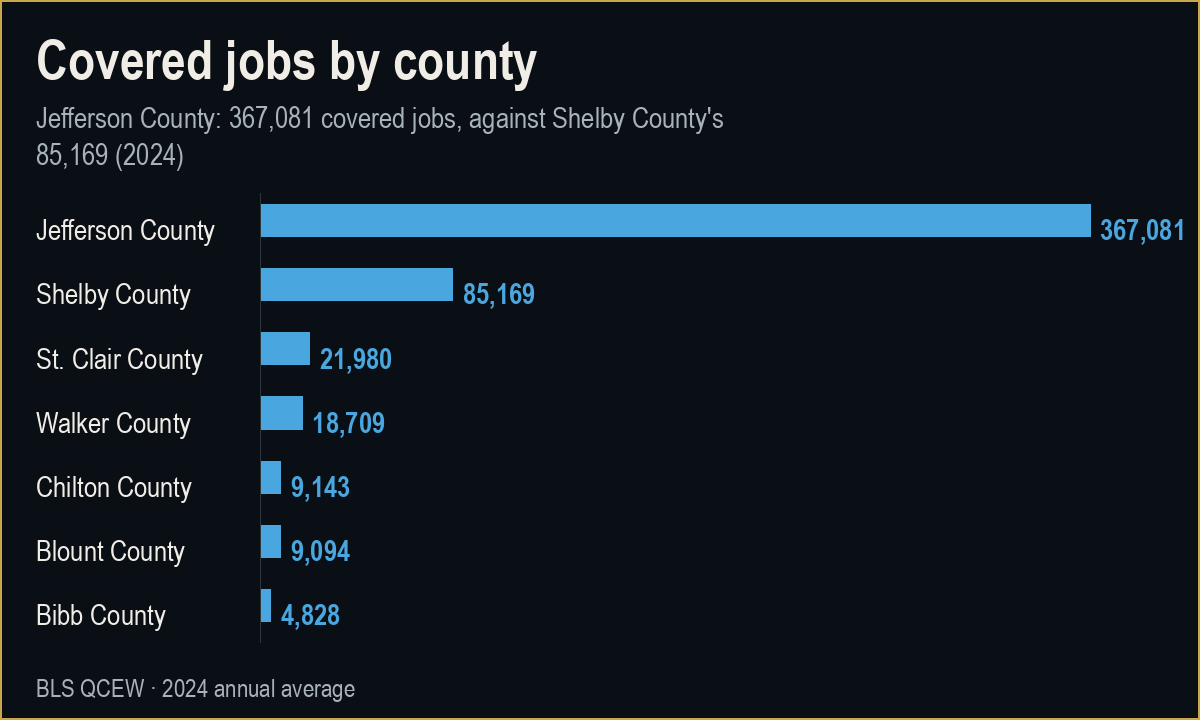
By covered employment, Jefferson County is the region’s center of gravity. It supports 367,081 jobs on average in 2024, with more than 22,900 business establishments providing that work platform.11 Shelby County is the clear secondary hub, with 85,169 covered jobs across 7,251 establishments.22 Together, those two counties account for the majority of the jobs and firms in the multi‑county Birmingham area described by the evidence set.
The wage pattern reinforces that hierarchy. Average weekly pay in Jefferson County reaches $1,376 in 2024, the highest figure in the sample.1 Shelby County follows at $1,284 per week.2 Neighboring St. Clair County sits noticeably lower at $989, even as it has grown its own employment base to 21,980 jobs across 1,943 establishments.333
Further out, Walker, Chilton, Blount and Bibb counties show smaller job bases and lower or mid‑range wages. Walker County supports 18,709 covered jobs at 1,536 establishments, with an average weekly wage of $936.444 Chilton has 9,143 jobs and 922 establishments, paying $915 per week on average.555 Blount County hosts 9,094 covered jobs at 956 establishments, with wages of $879.666 Bibb County has the smallest employment base here — 4,828 jobs and 445 establishments — but a comparatively higher weekly wage of $1,020.777
The pattern is straightforward: jobs and establishments concentrate in Jefferson and Shelby, and that is also where pay is highest. The question for the region is how new capital and institutional expansion in those core counties will reshape opportunity — or deepen the gap with surrounding labor markets.
Smucker’s brings billion‑dollar food manufacturing to Jefferson County
On the private‑sector side, one of the largest recent commitments is The J.M. Smucker Co.’s Uncrustables facility in the Jefferson County community of McCalla. Governor Kay Ivey’s office describes it as a new manufacturing plant and distribution center supporting Smucker’s Uncrustables, framed explicitly as a large‑scale job creator for the Birmingham area.8 The state announcement places the total financial investment at $1.1 billion, to be built in three phases with up to 750 jobs tied to the project if all phases are executed.8
The company has said that its investment and job creation will track production milestones achieved in each phase of the build‑out, rather than arriving all at once.8 At the time of the announcement, construction was expected to begin no later than January 2022 with production targeted to start in calendar 2025.8 Those dates and headcount remain, at this stage, an announced plan rather than a reported outcome; the evidence here does not confirm whether construction or hiring has met that schedule.
If the facility delivers anything close to the announced 750 jobs, it would be a meaningful addition to Jefferson County’s manufacturing and logistics base. Against a county job total in the high hundreds of thousands,1 it would not change the scale of the economy on its own, but it would contribute to an emerging cluster of food production and distribution that benefits from Birmingham’s freight position and labor pool. The main uncertainties are execution timing and the share of roles that are ultimately added locally versus automated away or shifted from other company sites.
Healthcare demand is forcing UAB to expand its footprint
Healthcare is already a central Birmingham employer, and UAB Hospital is expanding in response to rising demand. The institution reports that its emergency department has seen 20 percent patient volume growth over the past five years and anticipates additional growth over the next five years.9 In the short term, UAB began temporary expansion renovations in June 2023, repurposing North Pavilion space to create nine new exam rooms and a temporary waiting area.9 The hospital also planned to install two leased mobile treatment units in August 2023, adding 16 treatment spaces with use expected to begin in early fall.9
These steps sit on top of an already large physical and employment platform. UAB Hospital reports 1,400 hospital beds,10 and says it cared for 929,021 unique patients in 2025.10 A new $156.7 million inpatient rehabilitation pavilion, sized for 134 beds, is presented as a major upgrade in recovery capacity for patients from Alabama and the broader region.10 The evidence set here does not specify job counts associated with these facilities, but the scale of the infrastructure upgrades fits with UAB’s description of continued patient growth and suggests sustained demand for clinical and support workers if volumes keep rising.
If UAB’s patient volume continues to grow at or near the rates it reports, that demand could reinforce healthcare as one of Birmingham’s most durable employment anchors, with spillovers into medical office space, supplier activity and related services close to the hospital district. The risk side is that reimbursement pressures or policy changes could affect hiring intensity even as patient counts increase.
Research construction is turning state funding into long‑lived economic infrastructure
Beyond direct patient care, Birmingham’s universities and research institutions are using state and federal money to build facilities they argue will support economic development over time. UAB states that it is “building new facilities and renovating existing spaces” to strengthen its mission pillars, which explicitly include economic development alongside education, research, community service and patient care.11
Several specific projects illustrate the capital scale and public‑private mix involved. The Altec/Styslinger Genomic Medicine and Data Sciences Building draws on philanthropic contributions plus $50 million from the state of Alabama via the Public School and College Authority, $5 million from Jefferson County and $1 million from the city of Birmingham, alongside other institutional funds.11 A separate Biomedical Research and Psychology Building carries a $190 million price tag, with $152 million supplied by federal funding and the balance from UAB’s Heersink School of Medicine and the College of Arts and Sciences. UAB broke ground on this facility in June 2024 and expects completion in summer 2026.11 Southern Research’s new biotechnology building adds another $98 million of specialized space, supported in part by $45 million from the state education fund.11
State leaders and UAB officials present these outlays as economic bets. UAB notes that funds appropriated by the state to its research enterprise are intended to “improve lives, drive economic growth and [position] Alabama as a leader in biomedical innovation.”12 University leadership also argues that legislative investments in UAB “deliver positive returns that touch every county of the state.”12 Governor Ivey describes one such project as a “signature investment” designed to have a “real impact on our economy” and to serve as a “wise investment with a great return” for Alabamians.12 UAB further states that the investment will attract new external funding and additional world‑class faculty.12
Those are institutional and political claims, not yet measured outcomes, but they clarify the intent: to convert state and federal dollars into research capacity that can, over time, pull in grants, talent and companies. If that happens at scale, the effect on Birmingham’s higher‑wage job mix could be meaningful, particularly inside Jefferson County, where the employment base and average wages are already highest.11
Innovation policy is trying to connect residents and employers
The city’s own economic‑development department is positioned as a connector. Birmingham’s Department of Innovation and Economic Opportunity (IEO) describes its role as “shaping Birmingham’s future by connecting our people, businesses, assets, and opportunities to the markets and investments that drive sustainable growth” and says it works to strengthen homegrown businesses, attract and retain high‑growth industries, cultivate a competitive workforce and position the city for new investment and development.13 IEO also emphasizes that it focuses resources where they have the “highest multiplier effect”, specifically citing businesses ready to scale and industries prepared to invest.13
On the workforce side, the department has launched the Birmingham Workforce Partner Accelerator, a six‑month program aimed at helping nonprofits, startups and community groups develop scalable, fundable workforce‑development programs that are intended to strengthen the city’s economy and create opportunities for residents.13 IEO frames this within broader commitments to residents, business leaders and philanthropic partners: building pathways to economic mobility, providing a predictable environment for employers and offering a transparent framework for collaborative investment.13
These are policy and program descriptions rather than results, but they speak to a specific risk in Birmingham’s current pattern: without deliberate workforce and connectivity efforts, high‑skill research and healthcare growth in Jefferson County and parts of Shelby County could leave workers in lower‑wage counties like Blount, Chilton and Walker on the outside.654
Research complexes are explicitly pitched as economic‑development tools
New academic infrastructure is likewise being marketed as a lever for economic development. In describing UAB’s Science and Engineering Complex, construction firm Hoar Construction quotes UAB voices who say that the research carried out there will benefit the economic‑development landscape of both the city and the state.14 They also argue that placing leading scientists in the same facility will allow more interdisciplinary research that will “bolster economic development here in Alabama and across the globe.”14 The complex itself is described as enhancing facilities to support strategic initiatives across education, research, innovation and economic development, as well as community engagement.14
Those statements are aspirational. The evidence here does not yet document specific company formations, job counts or wage impacts traceable to the complex. But when combined with the funded genomic, biomedical and biotechnology buildings,111111 they outline a clear strategy: use capital projects to deepen Birmingham’s research cluster, then translate that into long‑term demand for high‑skill labor and, in turn, higher regional wages.
What this could mean for the wider Birmingham region
Putting these pieces together, Birmingham’s growth case looks less like a single transformative project and more like a set of overlapping bets in manufacturing, healthcare and research, concentrated largely in Jefferson County and, to a lesser extent, Shelby County. The Smucker’s investment, if it reaches its announced scale,8 would reinforce industrial and logistics employment. UAB’s hospital growth and capital program point toward sustained healthcare demand and research expansion.911 State and federal investments are deliberately structured to pull in additional external funding and talent.12
If those bets compound, the result could be a denser, higher‑wage job core in the counties that already lead the employment and pay tables.1212 The open question is how much of that momentum spills into surrounding counties where employment is smaller and average weekly wages range from the high $800s to the low $900s.654 Programs like the Workforce Partner Accelerator are designed explicitly to broaden participation,13 but their effectiveness has not yet been quantified in the evidence set here.
What to watch next
- Smucker’s execution: Whether the McCalla facility completes its phases on the announced schedule and how many net new jobs are actually created relative to the up‑to‑750 figure.88
- UAB’s hiring and service capacity: How the hospital’s emergency department expansion and new rehabilitation pavilion translate into staffing levels, given the reported 20 percent growth in emergency patient volume.99910
- Research‑driven growth: Evidence of external grants, faculty recruitment or company formation tied to the genomic, biomedical, biotechnology and science‑and‑engineering facilities now funded or under construction.11111114
- Wage and employment shifts by county: Whether average weekly wages and establishment counts in outlying counties like Blount, Chilton, Walker and Bibb begin to converge toward Jefferson and Shelby as new projects mature, or if the gap widens.6547
- Impact of workforce programs: Measurable outcomes from the Birmingham Workforce Partner Accelerator and related IEO initiatives, such as placements into healthcare, manufacturing and research roles that these capital projects are expected to generate.1313
Sources
- U.S. Bureau of Labor Statistics. Quarterly Census of Employment and Wages, annual averages — Jefferson County, Alabama. 2024 View source
- U.S. Bureau of Labor Statistics. Quarterly Census of Employment and Wages, annual averages — Shelby County, Alabama. 2024 View source
- U.S. Bureau of Labor Statistics. Quarterly Census of Employment and Wages, annual averages — St. Clair County, Alabama. 2024 View source
- U.S. Bureau of Labor Statistics. Quarterly Census of Employment and Wages, annual averages — Walker County, Alabama. 2024 View source
- U.S. Bureau of Labor Statistics. Quarterly Census of Employment and Wages, annual averages — Chilton County, Alabama. 2024 View source
- U.S. Bureau of Labor Statistics. Quarterly Census of Employment and Wages, annual averages — Blount County, Alabama. 2024 View source
- U.S. Bureau of Labor Statistics. Quarterly Census of Employment and Wages, annual averages — Bibb County, Alabama. 2024 View source
- Office of the Governor of Alabama. Governor ivey announces the j m smucker co to build alabama manufacturing plant creating up to 750 jobs in birmingham View source
- University of Alabama at Birmingham. Uab hospital emergency department to expand with state support View source
- University of Alabama at Birmingham. Uab hospital now fifth largest in the nation View source
- University of Alabama at Birmingham. Uab continues to transform through 14 new construction and renovation projects View source
- University of Alabama at Birmingham. How strategic investments in people technology and space are advancing uab research excellence View source
- City of Birmingham. Department innovation economic opportunity View source
- hoar.com. Birminghams hoar construction builds 76m uab science engineering complex View source