
Memphis has long marketed itself as a river city, but much of the Mississippi-facing infrastructure is still catching up to that brand. A new expansion at Greenbelt Park’s river landing on Mud Island is a small but telling attempt to close that gap — and a window into how federal and local dollars might be used to turn the waterfront into a more active economic asset.
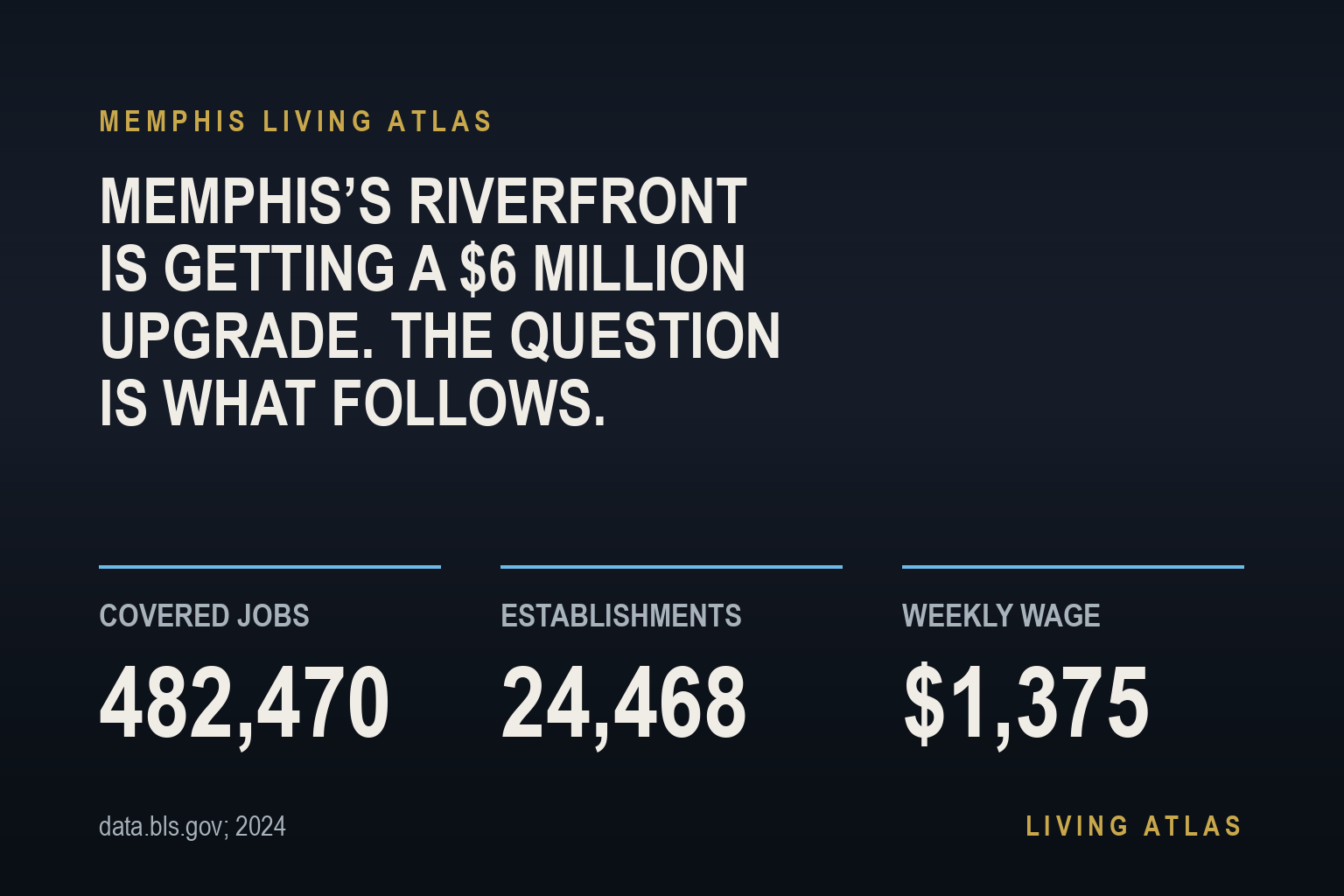
The city and the U.S. Army Corps of Engineers have broken ground on a project that will expand docking capacity for passenger riverboat cruise ships on the Mississippi River. When complete, the work represents a $6 million build-out aimed at handling more cruise traffic directly at Greenbelt Landing.1
In public statements, Memphis leaders have framed the expansion as part of a broader push to make better use of the riverfront. Mayor Paul Young described the goal as “strengthening our connection to the Mississippi River and expanding opportunities for recreation and tourism,” and said the project “improves access to the riverfront, supports economic activity, and makes the experience better for both residents and visitors.”1 Those are aspirations, not current outcomes, but they clarify what the city is trying to accomplish: more visitors on the riverfront, and more reasons for locals to treat it as everyday space rather than a backdrop.
What the Greenbelt Landing project actually builds
Beyond the headline about cruise docking, the project is structured as a set of basic infrastructure upgrades inside Greenbelt Park. City materials describe work on the existing boat ramp, the installation of mooring anchors to secure vessels, upgrades to make parking compliant with the Americans with Disabilities Act (ADA), and additional lighting in the park.1 These are not marquee attractions on their own; they are the kind of enabling improvements that make heavier use of a site possible — more buses and shuttles turning over, more pedestrians on the river walk after dark, and more routine local use of a park that also serves as a landing for out-of-town visitors.
The funding structure underlines the project’s role as public infrastructure rather than a standalone tourism bet. The work stems from a Project Partnership Agreement between the City of Memphis and the U.S. Army Corps of Engineers, supported by $3 million in federal Community Directed Funding secured by U.S. Representative Steve Cohen and matched by $3 million in non-federal city funds.1 In other words, Washington is paying for half of a relatively small but targeted piece of riverfront capacity, and Memphis is putting up the rest.
A river project in the context of a bigger job base
On its own, a $6 million landing expansion will not move the regional job numbers. The Memphis-area economy is anchored by a far larger employment base spread across multiple counties, led by Shelby County, where nearly half a million jobs are covered by unemployment insurance.2
Recent federal data show just how concentrated that base is. Shelby County, which includes Memphis, recorded 482,470 covered jobs in 2024 on an annual average basis, with 24,468 business establishments and an average weekly wage of $1,375.222 Surrounding counties host much smaller but still material employment clusters:
- DeSoto County, Mississippi, just south of Memphis, had 72,666 covered jobs and 3,754 establishments in 2024, with an average weekly wage of $879.333
- Tipton County, Tennessee, to the north, recorded 11,848 covered jobs across 962 establishments and an average weekly wage of $967.444
- Fayette County, Tennessee, to the east, had 8,093 covered jobs and 823 establishments, with weekly wages averaging $1,098.555
- Marshall County, Mississippi reported 11,291 covered jobs, 566 establishments, and an average weekly wage of $935.666
- Tunica County, Mississippi had 5,799 covered jobs, 270 establishments, and an average weekly wage of $802.777
- Crittenden County, Arkansas, across the river to the west, recorded 16,197 covered jobs, 1,096 establishments, and an average weekly wage of $919.888
Combined, these figures underscore that the Memphis area is already a multi-county employment hub, with Shelby County as the dominant core and a ring of smaller labor markets around it. A riverfront project in Memphis proper plugs directly into that core, where the wages and business density are highest, rather than into the more industrial or exurban edges.
Flood protection as the unseen foundation
Any investment on the Mississippi River also sits on top of decades of federally built flood infrastructure. The U.S. Army Corps of Engineers reports that the Memphis District’s flood risk reduction system has prevented more than $4.3 billion in flood damages and protected more than five million acres of cropland in the last decade.9 That performance record does not guarantee future outcomes, but it does indicate that a large share of the region’s economic and agricultural activity already depends on engineered river and levee systems functioning as designed.
From a real-estate and capital perspective, this matters because it lowers one of the barriers to investing on or near the riverfront. If the flood system continues to perform at that level, it reduces (though does not eliminate) the risk that new projects like Greenbelt Landing will be periodically knocked offline by major flood events.
Could small waterfront projects pull larger private capital?
The Greenbelt expansion is not large enough to alter the metro’s labor market statistics on its own. By comparison, the broader Memphis metropolitan area’s civilian labor force has been hovering around the upper 600-thousand range in recent months, with an unemployment rate in the low- to mid‑single digits.10101010 Against that backdrop, even a meaningful increase in cruise traffic would show up more in local hospitality and neighborhood activity than in headline employment counts.
The more interesting question is conditional: if the expanded landing successfully attracts more cruise calls and heavier daily use of Greenbelt Park, could that change how private developers and operators view the riverfront? A plausible scenario is that better docking and basic amenities make it easier to justify incremental investments directly tied to visitor volume — for example, additional food and beverage tenants nearby, small-scale tour operators based at the landing, or upgrades to adjacent lodging properties. Those moves would likely be modest in absolute job terms but could deepen the economic use of river-adjacent land.
For this to evolve into a true catalyst, several things would have to go right. Cruise demand on the Mississippi would need to be sufficient and sustained enough that additional docking space in Memphis translates into more frequent or larger ship calls, not just a reallocation from other local sites. The city would also need to maintain the upgraded infrastructure — ramps, lighting, and parking — at a standard that keeps both residents and operators using the park regularly. And the broader employment base would need to keep growing or at least remain stable, so that tourism-linked jobs are adding to an already functional regional economy rather than substituting for other opportunities.
What to watch next
- Cruise traffic at Greenbelt Landing: Whether the added docking capacity actually results in more or larger passenger riverboat calls to Memphis, or mainly relocates existing activity.
- Follow-on private investment near the park: Any new or expanded hospitality, retail, or tour operations explicitly citing proximity to the landing as a driver.
- Additional riverfront projects using similar funding structures: Future Project Partnership Agreements or federal matches that extend this model to other sites along the Memphis riverfront.
- Stability of the flood protection system: Continued evidence that the Memphis District’s flood risk reduction infrastructure preserves its track record of damage prevention, which underpins confidence in river-adjacent development.9
- Labor-market resilience in the core counties: Changes in covered employment, establishment counts, and wages in Shelby and its surrounding counties that might either magnify or dampen the payoff from better-quality riverfront assets.238
The Greenbelt Landing expansion is ultimately a test of whether a relatively small, well-targeted piece of public infrastructure can help the Memphis riverfront function more like an everyday economic district and less like a scenic boundary. The evidence so far establishes what is being built and how it is funded; the next phase will show whether private activity follows.

Sources
- City of Memphis. Memphis and u s army corps of engineers break ground on greenbelt landing expansion to enhance riverfront access and tou View source
- U.S. Bureau of Labor Statistics. Quarterly Census of Employment and Wages, annual averages — Shelby County, Tennessee. 2024 View source
- U.S. Bureau of Labor Statistics. Quarterly Census of Employment and Wages, annual averages — DeSoto County, Mississippi. 2024 View source
- U.S. Bureau of Labor Statistics. Quarterly Census of Employment and Wages, annual averages — Tipton County, Tennessee. 2024 View source
- U.S. Bureau of Labor Statistics. Quarterly Census of Employment and Wages, annual averages — Fayette County, Tennessee. 2024 View source
- U.S. Bureau of Labor Statistics. Quarterly Census of Employment and Wages, annual averages — Marshall County, Mississippi. 2024 View source
- U.S. Bureau of Labor Statistics. Quarterly Census of Employment and Wages, annual averages — Tunica County, Mississippi. 2024 View source
- U.S. Bureau of Labor Statistics. Quarterly Census of Employment and Wages, annual averages — Crittenden County, Arkansas. 2024 View source
- www.usace.army.mil. Corps of engineers begins phase i floodfight View source
- U.S. Bureau of Labor Statistics. Economy at a Glance View source