
Birmingham’s core county already carries most of the metro’s jobs. The story in the next cycle is whether the city’s medical and biotech build‑out, plus large industrial projects, pull more work — and eventually people and capital — into the surrounding counties that rely on Jefferson County today.
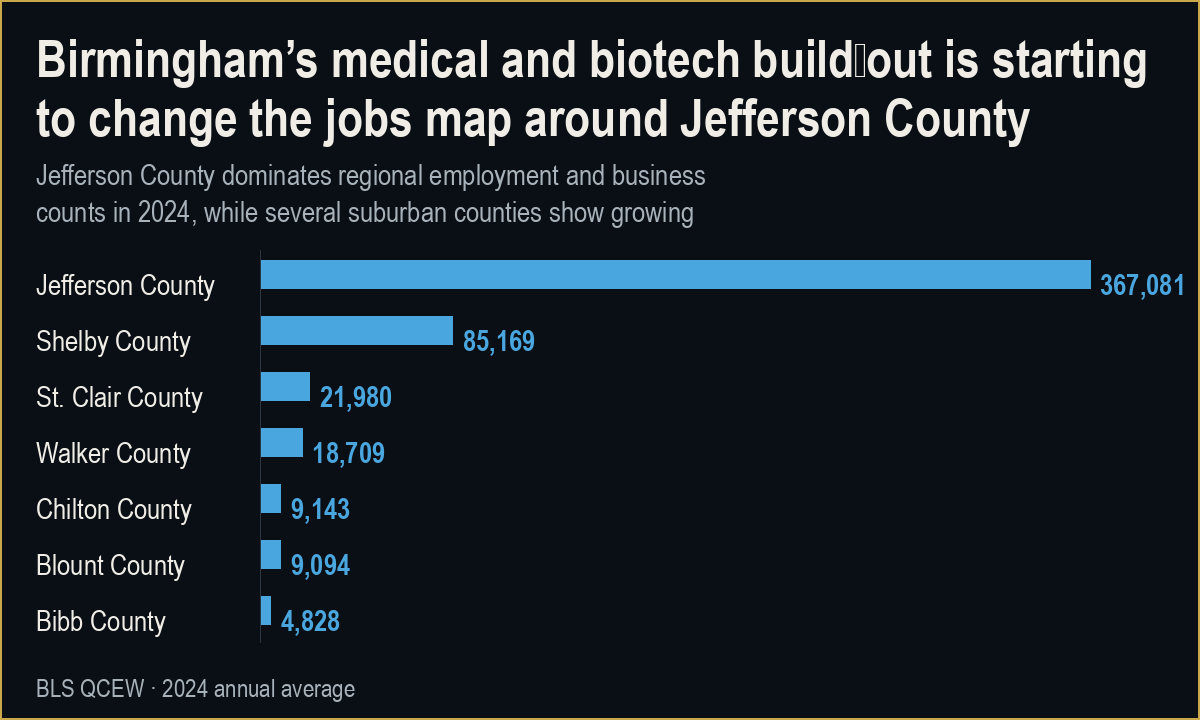
Jefferson County’s covered employment reached 367,081 jobs on a QCEW annual-average basis in 2024, with 22,923 business establishments supporting that base.11 That is the clear center of gravity for the region’s labor market, and it is being reinforced by a set of health care, research and industrial investments that carry their own expansion plans.
Health care and research are adding beds, labs and clinical capacity
The University of Alabama at Birmingham is expanding both its clinical footprint and its research infrastructure inside this jobs hub. UAB Hospital’s emergency department is undergoing a long-term expansion budgeted at $73 million.2 The State of Alabama has allocated $50 million toward that project, which has received Stage 1 approval from the University of Alabama System Board of Trustees, with additional approvals still required.2 Plans call for 66,030 new square feet of construction, 59 new exam rooms and additional imaging capacity for emergency care.22 These are present-tense capital commitments and design specifications, even though the full build‑out still depends on the remaining approvals and execution.
Separately, UAB has opened a new inpatient rehabilitation pavilion described as a $156.7 million investment with 134 patient beds.3 UAB Hospital overall has reached a capacity of 1,400 beds and is reported as the fifth-largest hospital in the United States, up three spots from 2025 in a national ranking cited by the institution.3 Those figures establish UAB as a national-scale anchor, not just a local hospital.
On the research side, UAB highlights that new research buildings and renovations of existing ones bring state-of-the-art technology to campus, support the retention and hiring of investigators, and create additional opportunities for both private and public research funding.4 That statement is institutional framing, but the factual content — that new and renovated research space can support more investigators and funding applications — is consistent with how large academic medical centers operate generally.
Biotech ambitions are being formalized into a regional hub
Those clinical and research expansions sit alongside a designated federal technology initiative. The Birmingham Biotechnology Hub, backed by the U.S. Economic Development Administration, is described as an effort to build a stronger domestic foundation for drug discovery and next‑generation medicines by combining biotechnology with advanced data and AI tools.5 The Hub’s documentation says it draws on regional strengths in clinicogenomic data, human‑relevant testing systems and applied machine learning to improve how treatments are identified, evaluated and prepared for development.5
According to that same description, the Hub’s goals include strengthening the infrastructure for advancing new medicines, supporting biotechnology entrepreneurs, expanding the technical workforce, and making drug discovery more efficient, more predictive and more representative of patient populations.5 These are all announced plans and intended outcomes. If executed, they could increase demand for lab space, specialized office and flex space, and adjacent services in and around Jefferson County’s existing medical district — but those second‑order effects remain conditional on follow‑through and private capital response.
Local government is positioning for more private investment
The City of Birmingham’s Department of Innovation and Economic Opportunity presents itself as a connector between people, businesses, local assets and external markets and investments, with the stated aim of driving “sustainable growth.”6 The department lists a set of concrete activities: working to strengthen homegrown businesses, attract and retain high-growth industries, cultivate a skilled and competitive workforce, and position Birmingham for new investment and development.6
In its own language, the department says it is “aligning local strengths with regional and global opportunities” to build an “opportunity-rich” and resilient economy where businesses can grow and talent can thrive, and where Birmingham can compete as a destination for innovation and economic opportunity.6 It also states a commitment to building pathways toward economic mobility so that citywide growth translates into opportunities across neighborhoods.6 These are policy intents and self‑descriptions rather than measurable outcomes; the test over time will be where capital, jobs and wage growth actually show up on the map.
Industrial capital is landing in Jefferson County’s orbit
Biomedical and institutional growth is not the only story. On the industrial side, the State of Alabama reports that The J.M. Smucker Co. plans to build a manufacturing plant for its Uncrustables sandwiches in the Jefferson County community of McCalla, located in the JeffMet Industrial Complex.7 The total announced financial investment for that facility is $1.1 billion, to be constructed over three phases, with the company saying the project could create up to 750 jobs.7 The state’s announcement notes that construction was expected to begin no later than January 2022, with production planned to start in calendar year 2025.7
The same announcement makes clear that the investments and job creation are contingent on tax and business incentives being approved and on the closing of the property acquisition.7 The scale of the proposed capital spend is concrete, but this remains an announced plan with explicit dependencies, rather than an outcome that can yet be counted in Jefferson County’s realized employment base.
Jefferson County dominates the labor base, but surrounding counties matter
Across the wider region, the employment and establishment data show a steep drop‑off from Jefferson County into its neighbors. Shelby County has 85,169 covered jobs and 7,251 establishments on a 2024 annual-average basis.88 St. Clair County has 21,980 covered jobs and 1,943 establishments,99 while Walker County has 18,709 covered jobs and 1,536 establishments.1010 Chilton and Blount Counties are smaller again, with 9,143 and 9,094 covered jobs respectively, and under 1,000 establishments each in 2024.11111212 Bibb County is smaller still at 4,828 covered jobs and 445 establishments.1313
The pattern is clear: Jefferson County is the core employment engine, with Shelby as the largest secondary node and the other counties functioning as smaller labor and business bases tied into that core. If Jefferson County’s institutional and industrial projects compound, one reasonable inference is that commuting patterns, housing demand and service businesses in these smaller counties could gradually adjust — but the data here only establish today’s hierarchy, not tomorrow’s redistribution.
Wages point to a tiered regional labor market
Average weekly wages also sort into tiers that roughly match the employment hierarchy. In 2024, Jefferson County’s average weekly wage was $1,376, while neighboring Shelby County’s was $1,284.18 Both are materially higher than the averages in St. Clair ($989), Walker ($936), Chilton ($915), Blount ($879) and Bibb ($1,020) Counties.910111213
A reasonable interpretation is that higher‑wage, higher‑skill roles are more concentrated in Jefferson and, to a lesser extent, Shelby County, consistent with the location of UAB Hospital, research facilities, the emerging biotech hub and other white‑collar employers. The lower average wages in surrounding counties align with smaller employment bases and a likely heavier mix of lower‑paying sectors — though the QCEW data provided here do not break wages out by industry, so that sectoral composition remains an uncertainty rather than a documented fact.
Downtown and campus amenities may be changing how people use the core
Inside Birmingham proper, some campus‑adjacent development is framed by local institutions as a quality‑of‑life and community‑building shift. A UAB student-media article quotes a student describing downtown Birmingham as urbanizing and expressing the view that a new football center will add to downtown’s charm and give residents and students more opportunities to attend games, strengthening community bonds.14 That is explicitly an opinion, not a measurable economic outcome. It does, however, illustrate how new sports and campus facilities can change how people experience the core — a softer but still relevant piece of the environment into which jobs and capital are being added.
The growth case — and what has to go right
The evidence supports a few grounded conclusions. First, Jefferson County already holds the region’s overwhelming share of jobs and high‑wage employment, anchored by UAB’s large and expanding clinical and research footprint and supplemented by designated federal biotech initiatives and announced large‑scale manufacturing plans.115237 Second, nearby counties are meaningfully smaller but still material contributors, particularly Shelby County, and their residents are likely intertwined with Jefferson’s job base even if the commuting patterns are not detailed in the current data.
The “bull case” — framed explicitly as a scenario, not a prediction — is that if UAB continues to expand its facilities and research operations, if the Birmingham Biotechnology Hub successfully attracts entrepreneurs and technical talent, and if announced industrial projects like the Smucker plant build out at or near their stated levels, then Jefferson County could add both higher‑skill and production‑oriented jobs on top of an already large base. Under that scenario, surrounding counties could see knock‑on housing demand, service business growth and potentially some wage convergence in certain occupations as competition for labor increases. However, several execution risks are apparent: announced jobs may not materialize on schedule or at the advertised scale; federal and state support may not translate into sustained private investment; and benefits could remain geographically concentrated in a few districts rather than spilling into lower‑wage counties.
Because this analysis is constrained to the verified evidence above, it does not address population growth, housing costs, detailed industry composition, or specific neighborhood-level real estate outcomes. Those are important gaps. Filling them would be necessary to test more aggressive theses about Birmingham’s long‑term trajectory beyond the institutional and industrial projects already documented.
What to watch next
- Concrete construction and hiring milestones for the J.M. Smucker plant in McCalla, including whether the three phases and up to 750 jobs proceed as announced.777
- Subsequent approval stages and build‑out progress for UAB Hospital’s $73 million emergency department expansion, including delivery of the planned 59 exam rooms and 66,000-plus square feet of clinical space.222
- Evidence of new biotech companies, lab build‑outs or workforce programs directly tied to the Birmingham Biotechnology Hub’s stated goals.5
- Changes in covered employment and average weekly wages across Jefferson, Shelby and the smaller surrounding counties in future QCEW releases, as a way to test whether growth is concentrating or diffusing.18910111213
- Any documented private real estate or infrastructure projects (labs, medical office, industrial parks, housing near job centers) that explicitly cite UAB expansions, the biotech hub or large manufacturers as drivers.
Sources
- U.S. Bureau of Labor Statistics. Quarterly Census of Employment and Wages, annual averages — Jefferson County, Alabama. 2024 View source
- University of Alabama at Birmingham. Uab hospital emergency department to expand with state support View source
- University of Alabama at Birmingham. Uab hospital now fifth largest in the nation View source
- University of Alabama at Birmingham. Uab s 12 new construction and renovation projects transforming campus supporting strategic initiatives View source
- U.S. Economic Development Administration. Birmingham Biotechnology Hub View source
- City of Birmingham. Department innovation economic opportunity View source
- Office of the Governor of Alabama. Governor ivey announces the j m smucker co to build alabama manufacturing plant creating up to 750 jobs in birmingham View source
- U.S. Bureau of Labor Statistics. Quarterly Census of Employment and Wages, annual averages — Shelby County, Alabama. 2024 View source
- U.S. Bureau of Labor Statistics. Quarterly Census of Employment and Wages, annual averages — St. Clair County, Alabama. 2024 View source
- U.S. Bureau of Labor Statistics. Quarterly Census of Employment and Wages, annual averages — Walker County, Alabama. 2024 View source
- U.S. Bureau of Labor Statistics. Quarterly Census of Employment and Wages, annual averages — Chilton County, Alabama. 2024 View source
- U.S. Bureau of Labor Statistics. Quarterly Census of Employment and Wages, annual averages — Blount County, Alabama. 2024 View source
- U.S. Bureau of Labor Statistics. Quarterly Census of Employment and Wages, annual averages — Bibb County, Alabama. 2024 View source
- University of Alabama at Birmingham. Studentmedia View source