
Birmingham’s recent run of announcements is less about one headline project than a pattern: public and institutional money is underwriting facilities that only pencil out if the region can staff them. That makes the metro’s existing employment base, and how it’s distributed by county, central to what happens next.
Jefferson and Shelby still anchor the Birmingham jobs map
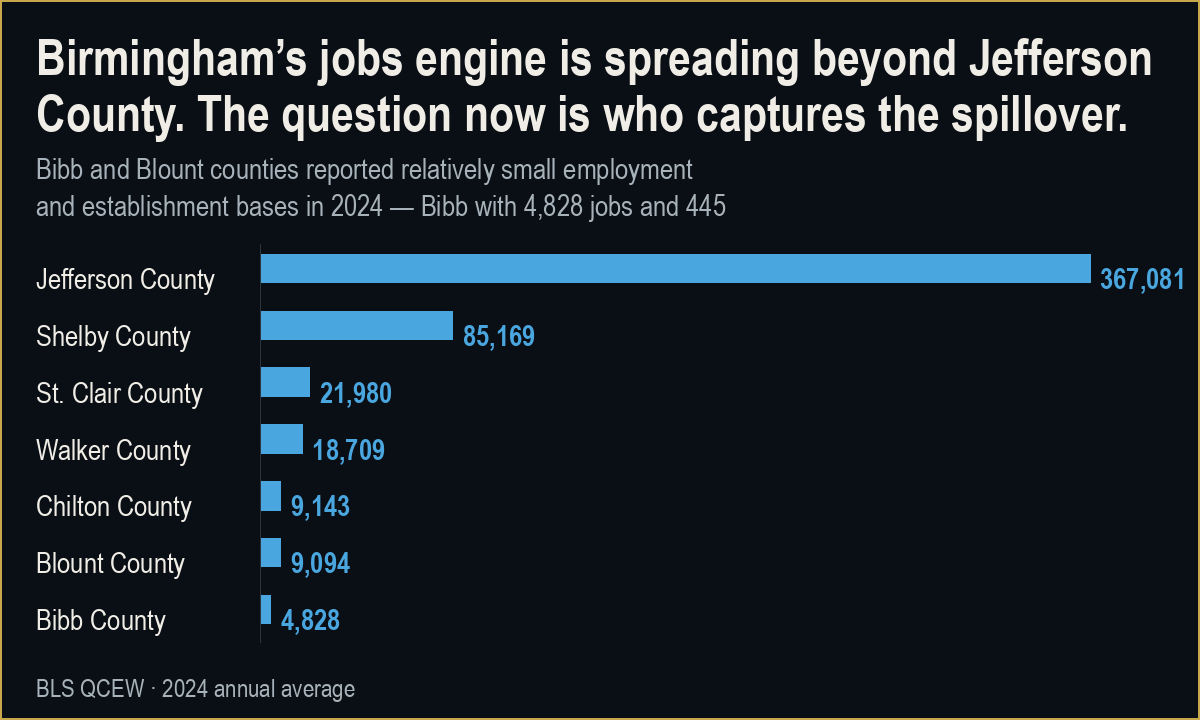
On the labor side, Jefferson County remains the core of the regional economy, with 367,081 covered jobs in 2024 and 22,923 business establishments on the ground 11. Wages in Jefferson are also at the top of the local range, with an average weekly pay of $1,376 in 2024 1.
Next door, Shelby County functions as the primary suburban employment hub. Shelby’s covered employment base stood at 85,169 jobs in 2024 across 7,251 establishments 22. Average weekly wages there were $1,284, slightly below Jefferson but still well above the surrounding rural counties 2.
St. Clair and Walker counties round out the second tier. St. Clair counted 21,980 covered jobs and 1,943 establishments in 2024, with average weekly wages of $989 333. Walker had 18,709 covered jobs, 1,536 establishments and a $936 average weekly wage 444.
Blount, Chilton and Bibb counties remain smaller players in absolute terms, with covered employment of 9,094, 9,143 and 4,828 jobs respectively in 2024 567. Their business bases are correspondingly leaner – 956 establishments in Blount, 922 in Chilton and 445 in Bibb 567 – and average weekly wages range from $879 in Blount to $1,020 in Bibb and $915 in Chilton 576.
The pattern is straightforward: Jefferson and Shelby carry the bulk of the job base and the highest pay, while surrounding counties offer smaller, often lower‑wage employment pools. That starting point matters for how far new projects can reach.
Big-ticket private projects hinge on hiring – and incentives
On the private side, the metro’s most visible manufacturing announcement is J.M. Smucker’s planned facility in the Jefferson County community of McCalla. The company and state describe a $1.1 billion total investment, constructed in three phases and expected to create up to 750 jobs if fully built out 8. Construction was expected to begin no later than January 2022, with production slated to start in calendar year 2025 8.
The company also makes clear those dollars are not automatic. Smucker says both the staged financial investments and the job creation are tied to each phase and are contingent on tax and business incentives being approved and on closing the property purchase where the facility will sit 8. That moves the project firmly into the “announced plan” category: the capital and the jobs depend on execution and on policy decisions that are not fully in the company’s control.
Tech hiring in downtown Birmingham has followed a similar incentives‑backed pattern. In 2018, same‑day delivery firm Shipt outlined a project to add 881 full‑time employees to a then‑Birmingham staff of 330 over three years, at an average salary of $48,231, and described the plan more broadly as “creating more than 800 new jobs in Birmingham over the next several years” 99. The company said this wave of hiring would take its corporate workforce to more than 1,000 people over time 9. As part of the package, the City of Birmingham committed up to $1.7 million to support Shipt’s growth through skill‑development, local hiring and recruitment of software engineers and data scientists 9.
Both cases share a structure: employers laid out multi‑year hiring plans, and local governments put cash and tax support on the table to make Birmingham more competitive. Whether those jobs materialize at the announced scale is an execution question, but the intent is explicit.
UAB and Southern Research are turning research dollars into buildings
Alongside private employers, UAB and its affiliates are building out a research and biotech footprint that relies heavily on public funding. UAB is constructing a $190 million Biomedical Research and Psychology Building, backed by $152 million in federal funding from the Health Resources and Services Administration, which the institution notes accounts for 80% of the project budget; the remaining $38 million, or 20%, are non‑federal funds 1010.
University leadership links this project directly to its existing and targeted research spend. UAB’s president cites $780 million in annual research expenditures today and frames the new facility as a way to “build on” that level and expand the research portfolio 10. In a separate strategic initiative, UAB has articulated a goal of reaching $1 billion in research expenditures, with the Biomedical Research and Psychology Building named as one of the facilities intended to support that push 10.
Other projects blend state, local and philanthropic money. The Altec/Styslinger Genomic Medicine and Data Sciences Building is funded through gifts from donors along with $50 million from the state of Alabama via the Public School and College Authority, $5 million from Jefferson County and $1 million from the City of Birmingham, plus institutional funds 11. A UAB report describes the state’s $50 million share as a historic investment and notes that state leaders have characterized it as the largest such contribution for a university facility 12. The same document also states that this investment is expected to attract additional external funding and more world‑class faculty to UAB 12.
Southern Research, a UAB affiliate, has opened a flagship biotech center that the institution says anchors 150,000 square feet of space, including new wet lab capacity for life sciences across four floors and a basement 11. The center is described as a $98 million facility, of which $45 million came from the state education fund 11.
Beneath the rhetoric, the through‑line is concrete: these are nine‑figure physical projects, much of whose funding is already awarded from federal and state sources, being deployed into specialized buildings that need a steady flow of grants, faculty and private activity to justify themselves.
City hall is trying to connect projects, jobs and neighborhoods
The City of Birmingham’s own economic‑development arm frames its work as stitching these pieces together. The Department of Innovation and Economic Opportunity describes its role as “connecting our people, businesses, assets, and opportunities to the markets and investments that drive sustainable growth” 13. It says it focuses on strengthening homegrown businesses, attracting and retaining high‑growth industries, cultivating a skilled workforce and positioning Birmingham for new investment and development 13.
The department also states a goal of “building pathways toward economic mobility” so that city growth turns into “tangible opportunities for every neighborhood” 13. That language is aspirational, but it does establish an explicit equity lens for the city’s growth strategy.
On the ground, one example of that lens is the Birmingham Civil Rights Crossroads project, a transportation initiative aimed at reconnecting neighborhoods that have not shared in downtown’s rebound. The city notes that while much of downtown Birmingham has started to revitalize, many low‑income and underserved neighborhoods nearby “have not experienced the same level of investment in transportation or public spaces” 14.
To address that gap, Birmingham applied in 2023 for a federal RAISE grant to support plans to reconnect the Graymont and Smithfield neighborhoods to downtown 14. The city’s description of the project says the reimagined route is intended to “foster a healthier community with new connections to public transit, employment opportunities, green spaces, and public health resources” 14. Those are stated objectives rather than outcomes, but they indicate that city leaders are tying infrastructure dollars to job access and amenities, not just traffic flow.
If projects compound, pressure could spread beyond the core counties
If Smucker follows through on all three phases of its McCalla facility and reaches its “up to 750 jobs” target 88, and if UAB succeeds in moving its research expenditures closer to the $1 billion goal it has outlined 10, those two tracks alone would imply more demand for industrial and office space, lab capacity and supporting services in and around Jefferson County. Shipt‑style tech expansions, when backed by local incentives and hiring support 9, add another layer of potential office demand in the urban core 99.
Under that kind of upside scenario, the smaller surrounding counties become relevant as potential relief valves. With fewer than 10,000 covered jobs each in 2024, Blount and Chilton have plenty of room to absorb incremental employers relative to their current size 56. Bibb’s base is even smaller at 4,828 covered jobs 7. If those counties begin to attract suppliers or logistics operations tied to Jefferson‑ and Shelby‑based anchors, their existing wage levels — from $879 per week in Blount to $1,020 in Bibb 57 — set a relatively low starting bar for what counts as an attractive new job locally.
None of that is guaranteed. Incentive‑backed announcements can stall if hiring proves harder than anticipated, if federal research funding flattens, or if planned transportation projects fail to win competitive grants. The evidence so far shows committed capital and explicit hiring plans, but not yet the full follow‑through on the outer‑ring spillover.
What to watch next
- Smucker’s build‑out pace. Does construction in McCalla proceed through all three phases on the timetable the company outlined, and do local incentive approvals keep those phases on track 888?
- Actual job counts vs. announcements. How closely do realized headcounts at projects like Shipt’s Birmingham expansion match the 881 jobs and >800‑job growth described in 2018 99?
- UAB research funding trajectory. Do annual research expenditures move toward the $1 billion target tied to the Biomedical Research and Psychology Building and genomics investments 101011?
- Grant outcomes for connectivity projects. Does Birmingham secure the RAISE or similar federal funding it applied for to reconnect Graymont and Smithfield, and do those projects deliver the promised links to employment and transit 1414?
- Establishment and wage shifts in smaller counties. Over the next few years, do business establishment counts and average wages in Blount, Chilton, Bibb and Walker move meaningfully off their 2024 levels, suggesting that regional growth is starting to diffuse beyond Jefferson and Shelby 5674?
Sources
- U.S. Bureau of Labor Statistics. Quarterly Census of Employment and Wages, annual averages — Jefferson County, Alabama. 2024 View source
- U.S. Bureau of Labor Statistics. Quarterly Census of Employment and Wages, annual averages — Shelby County, Alabama. 2024 View source
- U.S. Bureau of Labor Statistics. Quarterly Census of Employment and Wages, annual averages — St. Clair County, Alabama. 2024 View source
- U.S. Bureau of Labor Statistics. Quarterly Census of Employment and Wages, annual averages — Walker County, Alabama. 2024 View source
- U.S. Bureau of Labor Statistics. Quarterly Census of Employment and Wages, annual averages — Blount County, Alabama. 2024 View source
- U.S. Bureau of Labor Statistics. Quarterly Census of Employment and Wages, annual averages — Chilton County, Alabama. 2024 View source
- U.S. Bureau of Labor Statistics. Quarterly Census of Employment and Wages, annual averages — Bibb County, Alabama. 2024 View source
- Office of the Governor of Alabama. Governor ivey announces the j m smucker co to build alabama manufacturing plant creating up to 750 jobs in birmingham View source
- Office of the Governor of Alabama. Governor ivey announces birminghams shipt to create 881 jobs in major expansion View source
- University of Alabama at Birmingham. Biomedical research and psychology building groundbreaking View source
- University of Alabama at Birmingham. Uab continues to transform through 14 new construction and renovation projects View source
- University of Alabama at Birmingham. How strategic investments in people technology and space are advancing uab research excellence View source
- City of Birmingham. Department innovation economic opportunity View source
- City of Birmingham. Project description phases View source